 Back
BackConservation of Momentum and Collisions: Study Notes
Study Guide - Smart Notes
 Tailored notes based on your materials, expanded with key definitions, examples, and context.
Conservation of Momentum and Collisions
Introduction to Work, Energy, and Momentum
In classical mechanics, the concepts of work, energy, and momentum are fundamental for understanding the motion and interactions of objects. These quantities are conserved under specific conditions and provide powerful tools for analyzing physical systems.
Work (W): The product of the force applied to an object and the displacement in the direction of the force.
Kinetic Energy (K): The energy associated with the motion of an object, given by .
Gravitational Potential Energy (U_g): The energy stored due to an object's position in a gravitational field, .
Elastic Potential Energy (U_{el}): The energy stored in a spring or elastic material, .
Thermal Energy due to Friction (E_{th}): Energy converted to heat by friction, .
Conservation of Energy: In an isolated system, the total energy before an event equals the total energy after the event.
Linear Momentum
Momentum (\vec{p}): Defined as the product of an object's mass and velocity, . Momentum is a vector quantity, meaning it has both magnitude and direction. The SI unit for momentum is .
Each component of momentum (x, y, z) must be conserved independently in the absence of external forces.
Newton referred to momentum as the "quantity of motion."
Conservation of Linear Momentum
Momentum is conserved in a system if the net external force is zero. This principle is crucial for analyzing collisions and explosions.
Mathematical Statement:
Condition:
Component Form: ,
When two objects collide, the total momentum of the system remains unchanged if no external forces act on it.
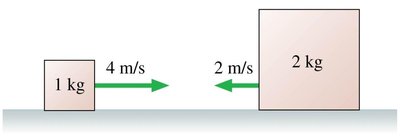
Types of Collisions
Collisions are classified based on whether kinetic energy is conserved:
Elastic Collisions: Both momentum and kinetic energy are conserved.
Inelastic Collisions: Momentum is conserved, but kinetic energy is not. If objects stick together, the collision is perfectly inelastic.
Elastic Collisions
In an elastic collision, the objects bounce off each other with no loss of kinetic energy. A classic example is Newton's Cradle.
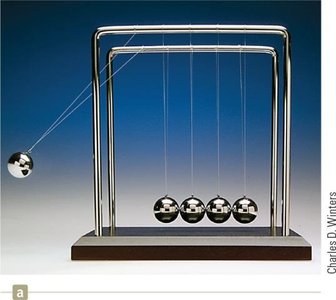
Equations for Elastic Collisions (1D):
Conservation of momentum:
Conservation of kinetic energy:
Example: A ball of mass with initial velocity collides elastically with a ball of mass at rest. The final velocities are:
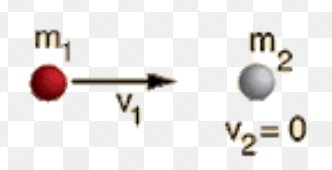
Perfectly Inelastic Collisions
In a perfectly inelastic collision, the colliding objects stick together and move with a common velocity after the collision. Only momentum is conserved.
Equation:
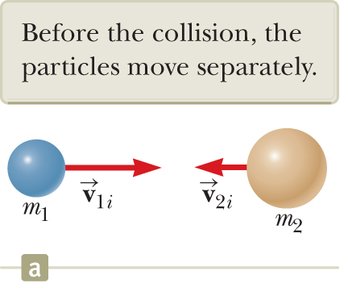
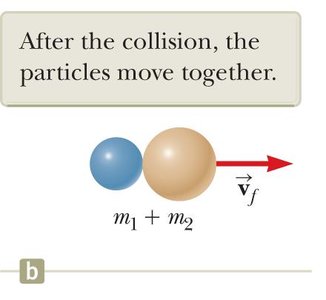

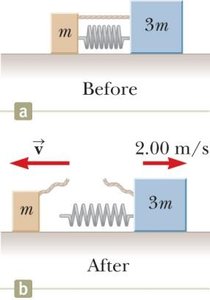
Example: Spring-Loaded Carts (Frictionless Case)
Consider two carts of masses and initially at rest and connected by a compressed spring. When the spring is released, the carts move in opposite directions. Since there is no external force, the total momentum before and after remains zero.
Given: cart moves at to the right, find the velocity of the cart to the left.
Solution:
Total kinetic energy after: (for )
Collisions in Two Dimensions
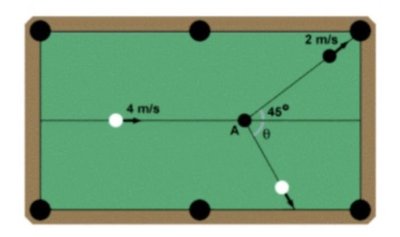
When collisions occur in two dimensions, momentum must be conserved independently in both the x and y directions. This is common in billiard ball collisions and particle interactions.
Equations:
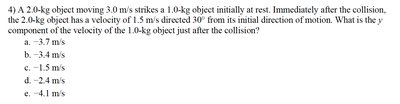
Example: A 2.0-kg object moving at 3.0 m/s strikes a 1.0-kg object at rest. After the collision, the 2.0-kg object moves at 1.5 m/s at 30° from its original direction. Find the y-component of the 1.0-kg object's velocity after the collision.
Type of Collision | Momentum Conserved? | Kinetic Energy Conserved? | Example |
|---|---|---|---|
Elastic | Yes | Yes | Newton's Cradle |
Inelastic | Yes | No | Car crash |
Perfectly Inelastic | Yes | No | Objects stick together |
Summary
Momentum is always conserved in isolated systems, regardless of the type of collision.
Kinetic energy is only conserved in elastic collisions.
For two-dimensional collisions, analyze momentum conservation separately in each direction.
Understanding these principles is essential for solving problems involving collisions, explosions, and other interactions in physics.
