 Back
Conservation of Momentum: Principles, Types of Collisions, and Applications
Study Guide - Smart Notes
 Tailored notes based on your materials, expanded with key definitions, examples, and context.
Conservation of Momentum
Definition and Principle
The conservation of momentum is a fundamental law in physics stating that the total momentum of a closed system remains constant if no external forces act upon it. This principle is crucial for analyzing collisions and explosions in mechanics.
Momentum is defined as the product of an object's mass and velocity: .
If no external force acts on a system, the total momentum before a collision (or explosion) equals the total momentum after the event.
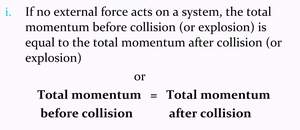
Mathematical Statement:
For two objects:
Illustrative Example: Two-Object Collision
Consider a scenario where a bowling ball (mass ) is thrown at a stationary football (mass ). The bowling ball has an initial velocity , and the football is at rest (). After the collision, the bowling ball moves with velocity and the football with .
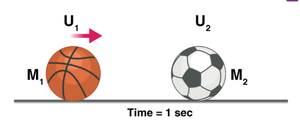
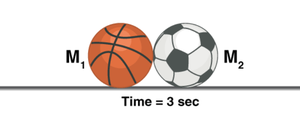
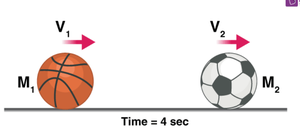
The momentum lost by the bowling ball is gained by the football, ensuring total momentum is conserved.
Even though individual momenta change, the system's total momentum remains constant if no external force acts.
Linear Momentum
Definition
Linear momentum is a vector quantity defined as the product of an object's mass and its velocity:
Unit: kg·m/s
Direction: Same as the velocity vector
Types of Collisions
Classification of Collisions
Collisions are classified based on how kinetic energy and momentum are conserved during the event. The three main types are:
Elastic collisions: Both momentum and kinetic energy are conserved.
Inelastic collisions: Momentum is conserved, but kinetic energy is not; objects may stick together.
Explosions: Objects initially together separate after an internal explosion, conserving momentum.
Case 1: Elastic Collision
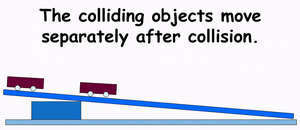
In an elastic collision, the colliding objects move separately after the collision, and both momentum and kinetic energy are conserved.
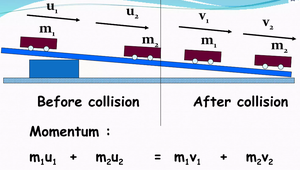
Equation:
Both objects retain their identities and move apart after the collision.
Case 2: Inelastic Collision
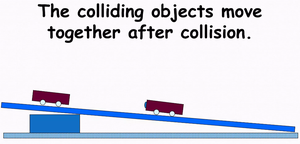
In an inelastic collision, the colliding objects stick together and move with a common velocity after the collision. Momentum is conserved, but kinetic energy is not.
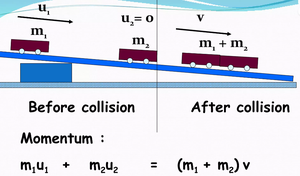
Equation:
Objects move as a single combined mass after the collision.
Case 3: Explosion
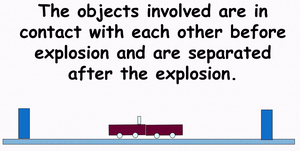
In an explosion, objects initially at rest or in contact separate rapidly due to an internal force. The total momentum before and after the explosion remains constant.
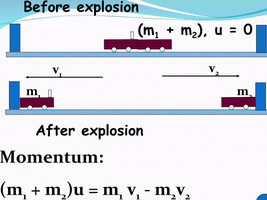
Equation:
Before explosion: objects together, usually at rest ()
After explosion: objects move apart with different velocities
Example Problem: Ice Skaters
Application of Conservation of Momentum
Consider two ice skaters who start from rest and push off against each other on frictionless ice. The woman has a mass of 54 kg and moves with a velocity of 2.5 m/s. The man has a mass of 88 kg. What is the man's velocity?

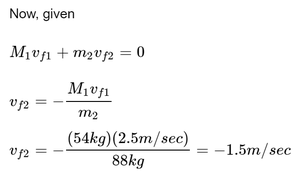
By conservation of momentum:
Solving for the man's velocity:
The negative sign indicates the man moves in the opposite direction to the woman.
Practice Problems
Find the momentum of a round stone weighing 12.05 kg rolling down a hill at 8 m/s.
A cannon ball weighing 35 kg is shot from a cannon towards the east at 220 m/s. Calculate the momentum of the cannon ball.
What is the momentum of a log of wood that weighs 700 kg rolling down a hill at 4.6 m/s?
a. 3320 kg·m/s down hill
b. 3320 kg·m/s
c. 3320 down hill
d. 3320 M
An object that weighs 500 g is rolling along the road at 3.5 m/s. What is the momentum of the object?
a. 124.9 kg·m/s along road
b. 17.50 kg·m/s along road
c. 1750 kg·m/s along road
d. 1.75 kg·m/s along road
Three cars are travelling down an even road at a velocity of 110 m/s. Calculate which car has the highest momentum if the first car weighs 2500 kg, the second car weighs 2650 kg, and the third car weighs 2009 kg.
a. First car
b. Second car
c. Third car
d. All have same momentum
Which of these objects has greater momentum: a 2 kg truck moving east at 3.5 m/s or a 4.3 kg truck moving south at 1.5 m/s?
a. First truck at 7 kg·m/s moving east
b. Second truck at 7.45 kg·m/s due south
c. First truck at 6.45 kg·m/s due east
d. Second truck at 7 kg·m/s due south
Summary Table: Types of Collisions
Type of Collision | Momentum Conserved? | Kinetic Energy Conserved? | Objects After Collision |
|---|---|---|---|
Elastic | Yes | Yes | Move separately |
Inelastic | Yes | No | Move together |
Explosion | Yes | No | Separate after explosion |
