Back
BackConservative Forces and Potential Energy: Springs, Mechanical Energy, and Conservation
Study Guide - Smart Notes
 Tailored notes based on your materials, expanded with key definitions, examples, and context.
Conservative Forces and Potential Energy
Introduction to Potential Energy and Conservative Forces
Potential energy is the energy stored in a system due to its position, shape, or configuration. Conservative forces are those for which the work done depends only on the initial and final positions, not on the path taken. This section explores the relationship between conservative forces, potential energy, and the conservation of mechanical energy.
Potential Energy (PE): Energy stored due to position or configuration, fully recoverable.
Conservative Force: A force where work done depends only on starting and ending points (e.g., gravity, spring force).
Example: The work done by gravity or a spring is independent of the path taken between two points.
Hooke’s Law and the Force of a Spring
Definition and Application of Hooke’s Law
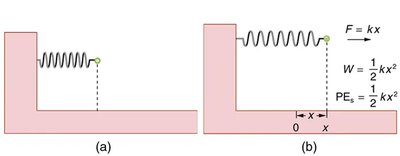
Hooke’s Law describes the force required to deform a spring or other elastic object. The force is proportional to the displacement from equilibrium, and the proportionality constant depends on the material and shape of the object.
Hooke’s Law:
Variables: is the restoring force, is the spring constant, is the displacement from equilibrium.
Interpretation: The force increases linearly with displacement.
Applications: Springs, elastic bands, bungee cords, and other elastic media.
Potential Energy of a Spring
Mathematical Expression and Physical Meaning
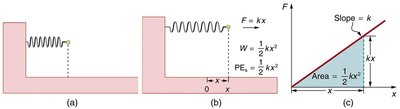
The potential energy stored in a spring is a result of work done to stretch or compress it. This energy is recoverable and depends only on the amount of deformation, not the path taken.
Spring Potential Energy:
Work Done: The work required to stretch or compress the spring is equal to the potential energy stored.
Path Independence: The energy depends only on the final displacement .
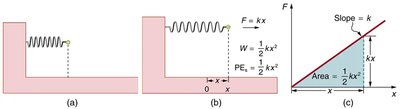
Graphical Representation: The area under the force vs. displacement graph represents the work done (potential energy).
Generalization of Potential Energy
Elastic Potential Energy in Various Systems
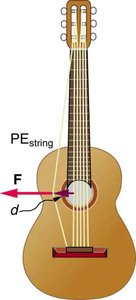
The formula for elastic potential energy can be applied to any system where an elastic medium is deformed, such as guitar strings, rubber bands, or bungee cords. The work done to deform these objects is stored as potential energy.
General Formula:
Example: Stretching a guitar string stores energy, which is released as sound when the string vibrates.
Conservation of Mechanical Energy
Work-Energy Theorem and Conservation Principle
The work-energy theorem states that the net work done by all forces on a system equals the change in kinetic energy. If only conservative forces act, the total mechanical energy (kinetic plus potential) remains constant.
Work-Energy Theorem:
Conservative Forces Only: and
Relationship to Potential Energy:
Conservation of Mechanical Energy: or
Interpretation: In the absence of non-conservative forces (like friction), energy shifts between kinetic and potential forms, but the total remains constant.
Example: Spring-Loaded Car and Energy Conservation
Application of Conservation of Mechanical Energy
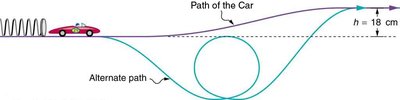
Consider a 0.100-kg car launched by a spring compressed 4.00 cm with a force constant of 250.0 N/m. Neglecting friction, we can use conservation of mechanical energy to determine the car’s speed at various points.
Initial Potential Energy:
Final Kinetic Energy:
Energy Conservation Equation: (if all energy is converted to kinetic)
Application: The car’s speed before ascending a slope and at the top can be found by equating the initial potential energy to the sum of kinetic and gravitational potential energy at each point.
Energy Skatepark Simulation
Exploring Energy Transformations
The Energy Skatepark simulation allows students to visualize and experiment with the conservation of energy in a dynamic system. Users can observe how kinetic, potential, and thermal energy change as a skater moves along a track, including the effects of friction and different reference heights.
Key Concepts: Conservation of energy, energy transformation, reference height, and thermal energy due to friction.
Exploration: Build tracks, observe energy changes, and compare energy at different points along the path.