 Back
Current and Resistance: Fundamentals of Electric Circuits
Study Guide - Smart Notes
 Tailored notes based on your materials, expanded with key definitions, examples, and context.
Current and Resistance
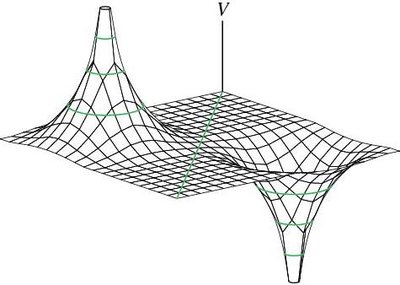
Electric Potential and Potential Difference
Electric potential is a fundamental concept in electromagnetism, representing the potential energy per unit charge at a point in space. A potential difference between two points can drive the flow of electric charge, resulting in an electric current.
Electric Potential (V): The work needed to move a unit charge from a reference point to a specific point against the electric field.
Potential Difference: The difference in electric potential between two points; often provided by batteries or other sources.
Key Equation:
Example: Connecting the ends of a battery with a wire creates a potential difference that drives current.
Batteries as Sources of Potential Difference
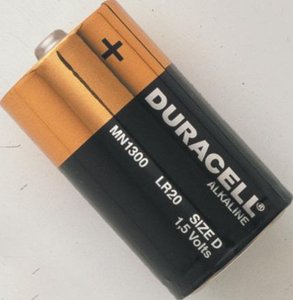
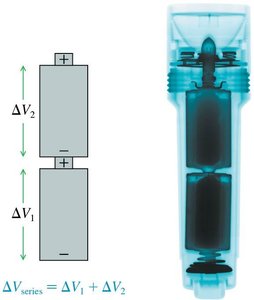
Batteries are devices that maintain a fixed potential difference between their terminals, enabling the flow of current when connected in a circuit. Multiple batteries can be combined to increase the total potential difference.
Single Battery: Provides a fixed voltage (e.g., 1.5 V for a typical alkaline cell).
Batteries in Series: The total voltage is the sum of individual voltages:
Example: Two 1.5 V batteries in series yield 3.0 V.
Charge Carriers in Conductors
In metallic conductors, electrons are the primary charge carriers. These electrons are loosely bound and form a 'sea' of free electrons that can move throughout the material.
Valence Electrons: Electrons in the outer shell of atoms, weakly bound and free to move.
Conduction Electrons: Electrons responsible for electrical conductivity in metals.
Example: The metal as a whole is electrically neutral, but electrons are free to move.
Creating an Electron Current
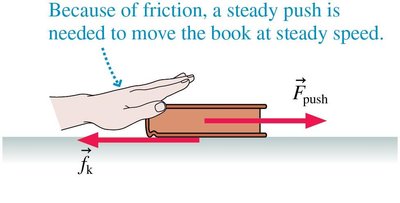
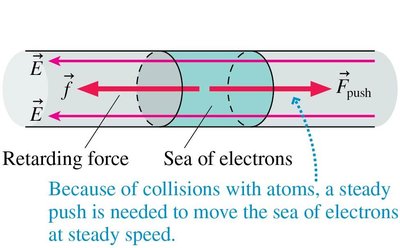
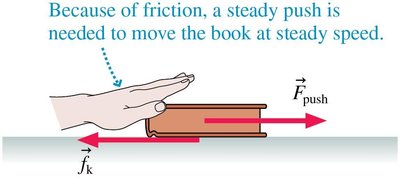
To sustain a current, a continuous push is required, analogous to pushing a book across a table against friction. In a wire, the electric field provides this push, while collisions with atoms act as a retarding force.
Energy Loss: Electrons lose energy through collisions with atoms, similar to friction.
Electric Field: Maintains the motion of electrons, analogous to a steady push.
Example: A book slows down without a push; electrons slow down without an electric field.
Establishing the Electric Field in a Wire
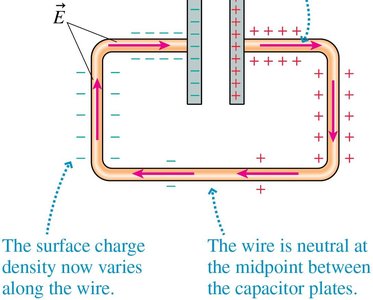
When a wire is connected to a battery, the free electrons rearrange to reach electrostatic equilibrium. If a potential difference exists, a net electric field is established, driving electrons through the wire.
Electrostatic Equilibrium: No net force and no current when the wire is not connected.
Nonuniform Charge Distribution: Connecting the wire creates a potential difference and a nonuniform charge distribution.
Electric Field Direction: Points from the positive to the negative terminal.
Model of Conduction
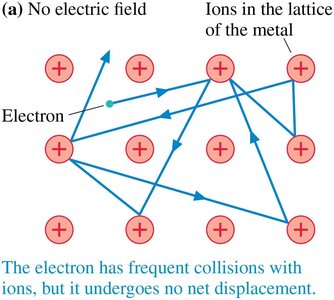
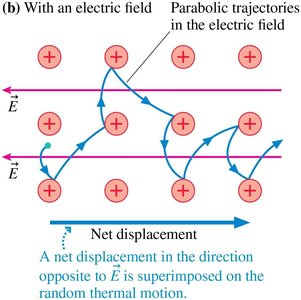
Within a conductor at equilibrium, electrons move randomly due to thermal energy but have no net displacement. When an electric field is applied, electrons acquire a net drift velocity opposite to the field.
Random Motion: Electrons collide with ions, resulting in zero average velocity.
Drift Velocity: Net velocity acquired by electrons under an electric field.
Key Equation:
Example: Electrons move with a net displacement when a field is applied.
Electron Current and Conventional Current
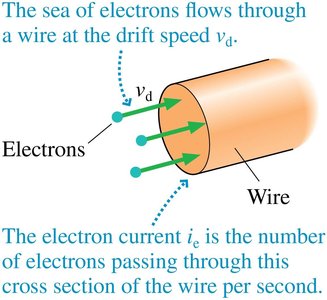
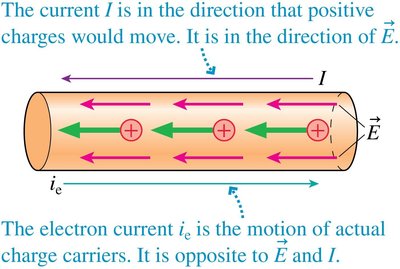
Current is defined as the flow of charge per unit time. The direction of conventional current is opposite to the direction of electron flow in metals.
Conventional Current (I): Direction in which positive charges would move.
Electron Current (i_e): Actual motion of electrons, opposite to I.
Key Equation:
Example: In a wire, electrons move from negative to positive, but current is defined from positive to negative.
Relating Current to Potential: Ohm's Law
Ohm's Law relates the current through a conductor to the potential difference across it and its resistance. Resistance depends on the material's resistivity, length, and cross-sectional area.
Ohm's Law:
Resistivity (\rho): Intrinsic property of a material;
Conductivity (\sigma): Reciprocal of resistivity;
Example: Longer wires or wires with smaller cross-sectional area have higher resistance.
Ohmic Materials
Ohmic materials are those for which the current is directly proportional to the applied voltage, obeying Ohm's Law. Non-ohmic materials do not exhibit this linear relationship.
Ohmic Behavior: Linear relationship between current and voltage.
Non-Ohmic Behavior: Nonlinear relationship, as seen in diodes or filament lamps.
Example: Most metals are ohmic; semiconductors are often non-ohmic.
Summary Table: Key Properties of Current and Resistance
Property | Definition | Equation |
|---|---|---|
Current (I) | Charge flow per unit time | |
Resistivity (\rho) | Material property | |
Conductivity (\sigma) | Reciprocal of resistivity | |
Ohm's Law | Relation between current, voltage, resistance |
Additional info:
These notes cover the fundamental concepts of electric current, resistance, and Ohm's Law, as well as the microscopic model of conduction in metals. The content is directly relevant to Physics with Calculus college courses, specifically matching topics in Chapter 27: Current and Resistance.
