 Back
BackChapter 27 Part II - Current,Carrying Coils, Magnetic Fields, and Resulting Torque
Study Guide - Smart Notes
 Tailored notes based on your materials, expanded with key definitions, examples, and context.
Current-Carrying Coils and Resulting Torque
Introduction to Torque on Current-Carrying Loops
When a current-carrying wire loop is placed in a magnetic field, it experiences a torque that tends to rotate the loop. This principle is fundamental to the operation of electric motors, which are widely used in devices such as washing machines, CD/DVD players, air conditioners, and car alternators.
Torque (\(\tau\)): The rotational effect produced by the interaction of the magnetic field and the current in the loop.
Electric Motors: Devices that convert electrical energy into mechanical rotation using the torque on current-carrying coils.
Origin of Torque in a Wire Loop
The torque arises because the magnetic field exerts forces on the sides of the loop. These forces are equal in magnitude but opposite in direction, resulting in a rotational effect rather than a net linear force.
Force Cancellation: The forces on opposite sides of the loop cancel each other out linearly, but produce a torque.
Alignment: The loop tends to align itself so that its plane is perpendicular to the magnetic field.
Maximum Torque Condition
The maximum torque occurs when the normal to the plane of the loop is perpendicular to the magnetic field (i.e., the angle \(\phi = 90^\circ\)).
Calculating Torque on a Current-Carrying Loop
The torque \(\tau\) on a coil of N turns, carrying current I, with area A in a uniform magnetic field B, at an angle \(\phi\) to the field, is given by:
N: Number of turns in the coil
I: Current through the coil
A: Area of the coil
B: Magnetic field strength
\(\phi\): Angle between the normal to the coil and the magnetic field
This formula applies to any flat coil shape.
Magnetic Moment
The product \(I A\) (current times area) is called the magnetic moment (\(\mu\)), which characterizes the strength and orientation of a coil's magnetic properties. Its units are A·m².
Magnetic Field Produced by Current-Carrying Wires
Right Hand Rule (RHR-2) for Magnetic Field Direction
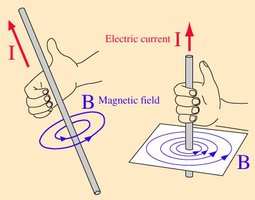
The direction of the magnetic field around a current-carrying wire is determined by the right hand rule: point your thumb in the direction of the current, and your fingers curl in the direction of the magnetic field lines.
Magnetic Field of an Infinitely Long Straight Wire
For a long straight wire, the magnetic field at a distance r from the wire is given by:
\(\mu_0\): Permeability of free space (\(4\pi \times 10^{-7}\) T·m/A)
I: Current in the wire
r: Radial distance from the wire
The field is strongest near the wire and decreases with distance.
Magnetic Field of a Circular Loop
A current-carrying circular loop produces a magnetic field that is strongest at the center of the loop. The field at the center is:
N: Number of turns
I: Current
R: Radius of the loop
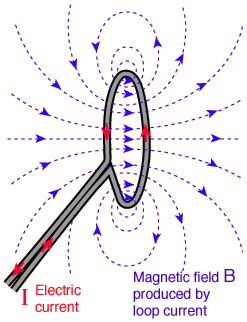
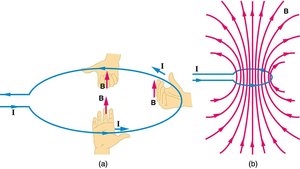
The direction of the field is found using the right hand rule for loops: curl your fingers in the direction of current, and your thumb points in the direction of the magnetic field inside the loop.
Attraction and Repulsion of Parallel Currents
Parallel wires with currents in the same direction attract each other.
Parallel wires with currents in opposite directions repel each other.
Solenoids
A solenoid is a long coil of wire, often wound in the shape of a helix. The magnetic field inside a solenoid is strong and uniform, while outside it is weak and non-uniform. The field inside is given by:
n: Number of turns per unit length (turns/meter)
I: Current
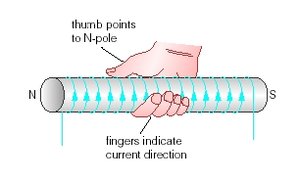
The direction of the field inside the solenoid is found by curling the fingers of your right hand in the direction of current; your thumb points toward the north pole of the solenoid.
Magnetic Flux and Its Orientation
Magnetic Flux Through a Loop
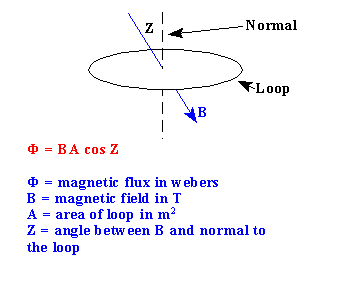
The magnetic flux (\(\Phi\)) through a loop is a measure of the total magnetic field passing through the area of the loop. It is given by:
B: Magnetic field strength
A: Area of the loop
Z: Angle between the magnetic field and the normal to the loop
Electromagnetic Waves
Oscillation of Electric and Magnetic Fields
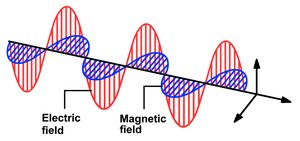
Electromagnetic waves consist of oscillating electric and magnetic fields that are perpendicular to each other and to the direction of wave propagation. These waves are fundamental to the transmission of light and radio signals.
Summary Table: Key Equations and Concepts
Concept | Equation | Description |
|---|---|---|
Torque on a coil | Torque on a coil in a magnetic field | |
Magnetic field (straight wire) | Field at distance r from a long straight wire | |
Magnetic field (loop center) | Field at the center of a circular loop | |
Magnetic field (solenoid) | Field inside a long solenoid | |
Magnetic flux | Flux through a loop at angle Z |
