 Back
BackCurrent, Current Density, and Drift Velocity in a Composite Copper Conductor
Study Guide - Smart Notes
 Tailored notes based on your materials, expanded with key definitions, examples, and context.
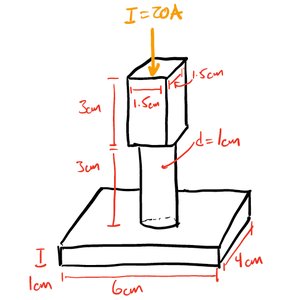
Q1. Consider a copper conductor made of three sections: a 3 cm-long block with a 1.5 cm × 1.5 cm square cross-section, a 3 cm-long cylinder with a 1 cm diameter, and a plate that is 6 cm × 4 cm and 1 cm thick. A current of 20 A is passed through the conductor as shown.
Background
Topic: Electric Current, Current Density, and Drift Velocity in Conductors
This problem tests your understanding of how current, current density, and drift velocity relate in conductors of different shapes and cross-sectional areas. It also involves using material properties (like the number density of conduction electrons) and the concept of conductivity.
Key Terms and Formulas
Current (I): The rate of flow of electric charge, measured in amperes (A).
Current Density (J): The current per unit area, , measured in A/m2.
Number of Conduction Electrons (N_e): , where is the number density of conduction electrons and is the volume.
Drift Velocity (v_d): The average velocity of conduction electrons due to an electric field, or .
Conductivity (\sigma): , where is the electric field.
Fundamental Charge (e): C.
Number Density for Copper (n): electrons/m3.
Step-by-Step Guidance
Part a: Calculate the number of conduction electrons, , for each piece. - Find the volume of each section (block, rod, slab) using their dimensions. - Use for each section, where is the number density for copper.
Part b: Determine the current through each piece. - Consider the fact that current is conserved in a series circuit (the same current flows through each section).
Part c: Calculate the current density for each piece. - Use , where is the cross-sectional area of each section. - For the block and slab, $A$ is width × height; for the rod, .
Part d: Express the drift velocity in terms of , , and . - Start from and rearrange to solve for $v_d$ in terms of $J$, $n$, and $e$.
Part e: Use your result from part c to calculate the drift velocity for each piece. - Plug in the values for , , and for each section.
Try solving on your own before revealing the answer!
