 Back
BackCurrent Density, Resistance, and Ohm’s Law: Study Notes for Physics 212
Study Guide - Smart Notes
 Tailored notes based on your materials, expanded with key definitions, examples, and context.
Current Density, Power, Resistance, and Ohm’s Law
A Model of Conduction
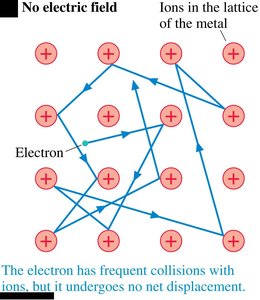
Conduction in metals is explained by the movement of electrons within a lattice of positive ions. In electrostatic equilibrium, there is no electric field inside the conductor, and electrons move randomly, resulting in zero net velocity.
Electrostatic Equilibrium: No electric field exists inside the conductor; electrons undergo frequent collisions but do not experience net displacement.
Electron Motion: Random thermal motion dominates, and the average velocity is zero.
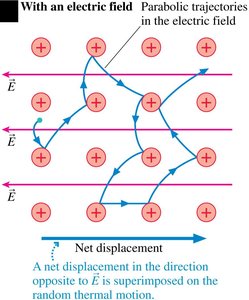
With Electric Field: An applied electric field causes electrons to move along curved (parabolic) paths between collisions, resulting in a net drift velocity opposite to the field direction.
Drift Velocity: The slow net motion of electrons due to the electric field.
Key Formula: (drift velocity, where is mean time between collisions, is electron charge, is electron mass, is electric field)
Current: The rate at which charge passes through a point or cross-sectional area.
Current and Conservation of Charge
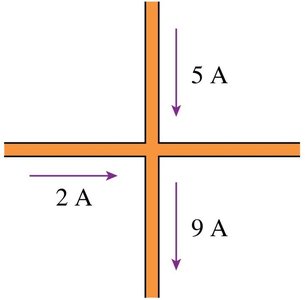
Electric current is defined as the flow of charge per unit time. Charge is conserved, so the current entering a junction equals the sum of currents leaving the junction.
Definition: (current as rate of charge flow)
Units: Ampère (A), where
Conservation: At any junction,
Current Direction: By convention, current direction is the direction positive charges would move.
Example: If enters a junction and splits into and , then .
Current Density
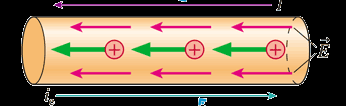
Current density is the amount of current per unit cross-sectional area. It is a vector quantity and relates to the drift velocity of charge carriers.
Definition: (current density)
Relation to Drift Velocity: (where is number density of charge carriers, is charge, is drift velocity)
Magnitude: Depends on material properties and applied electric field.
Conductivity, Resistivity, and Ohm’s Law
Conductivity and resistivity are material properties that determine how easily current flows. Ohm’s Law relates current, voltage, and resistance in a conductor.
Conductivity (): Measure of a material's ability to conduct electric current.
Resistivity (): Measure of a material's resistance to current flow; .
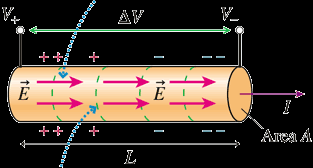
Ohm’s Law: (current is proportional to voltage and inversely proportional to resistance)
Resistance Formula: (depends on material, length , and cross-sectional area )
Units: Ohms (), where
Resistors and Circuit Elements
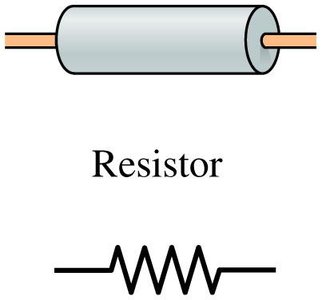
Resistors are components designed to provide specific resistance in circuits. Their schematic symbols and physical forms are standardized for circuit diagrams.
Resistor: Device that resists current flow, converting electrical energy to heat.
Other Elements: Battery, wire, bulb, junction, capacitor, switch.
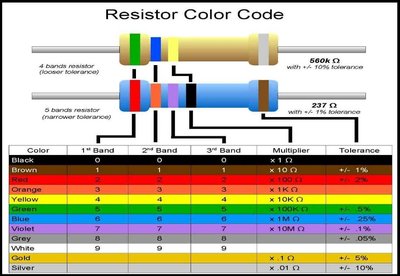
Resistor Color Code: Used to identify resistance values in physical resistors.
Series and Parallel Circuits
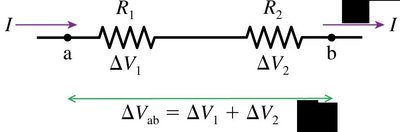
Resistors can be connected in series or parallel, affecting the total resistance and current distribution in the circuit.
Series: Same current flows through each resistor; total resistance is sum of individual resistances.
Formula:
Parallel: Same potential difference across each resistor; total resistance is less than any individual resistance.
Formula:

Power in DC Circuits
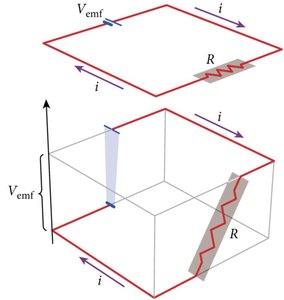
Power is the rate at which electrical energy is converted to other forms (such as heat or light) in a circuit element.
Definition: (power delivered to a device)
Alternate Forms: and
Units: Watts (W), where
Application: The brightness of a light bulb is proportional to its power consumption.
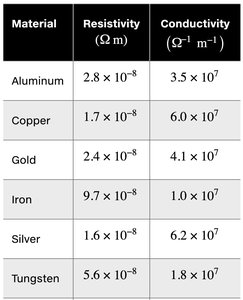
Comparing Resistivity and Conductivity
Different materials have characteristic resistivity and conductivity values, which determine their suitability for electrical applications.
Material | Resistivity (Ω·m) | Conductivity (Ω-1·m-1) |
|---|---|---|
Aluminum | 2.8 × 10⁻⁸ | 3.5 × 10⁷ |
Copper | 1.7 × 10⁻⁸ | 6.0 × 10⁷ |
Gold | 2.4 × 10⁻⁸ | 4.1 × 10⁷ |
Iron | 9.7 × 10⁻⁸ | 1.0 × 10⁷ |
Silver | 1.6 × 10⁻⁸ | 6.2 × 10⁷ |
Tungsten | 5.6 × 10⁻⁸ | 1.8 × 10⁷ |
Summary of Key Equations
Current:
Current Density:
Ohm’s Law:
Resistance:
Power:
Additional info: These notes expand on the lecture content by providing definitions, formulas, and examples for each concept, ensuring completeness and academic clarity for exam preparation.
