 Back
BackCurrent, Resistance, and Electromotive Force
Study Guide - Smart Notes
 Tailored notes based on your materials, expanded with key definitions, examples, and context.
Current, Resistance, and Electromotive Force
Microscopic View of Electric Current
Electric current in conductors arises from the motion of charge carriers, typically electrons, under the influence of an electric field. In the absence of an electric field, electrons move randomly due to thermal energy, resulting in zero net current. When an electric field is applied, electrons acquire a small average drift velocity opposite to the field, producing a net current.
Drift Velocity (vd): The average velocity of charge carriers due to the electric field.
Current (I): The rate of flow of charge through a cross-section, given by where q is the charge, n is the number density, A is the cross-sectional area, and vd is the drift velocity.
Current Density (J): The current per unit area, .
Direction of Current: By convention, current direction is the direction positive charges would move, opposite to electron flow.
Resistivity and Conductivity
Resistivity quantifies how strongly a material opposes the flow of electric current. Conductivity is its reciprocal.
Resistivity (\( \rho \)): , where E is the electric field and J is the current density. Units: .
Conductivity (\( \sigma \)): .
Ohm's Law (Microscopic Form): .
Resistance and Ohm's Law
Resistance is a property of an object that quantifies how much it resists current flow. Ohm's Law relates voltage, current, and resistance.
Resistance (R): , where L is the length and A is the cross-sectional area.
Ohm's Law (Macroscopic Form): .
Factors Affecting Resistance:
Increases with length (L), decreases with area (A).
Depends on material (through \rho).
Temperature Dependence of Resistivity
For most conductors, resistivity increases with temperature:
\( \alpha \): Temperature coefficient of resistivity (units: C).
Substance | \( \rho \, (\Omega m) \) | \( \alpha \, (^\circ C^{-1}) \) |
|---|---|---|
Copper | ||
Gold | ||
Nichrome | ||
Carbon (graphite) | ||
Glass | — | |
Teflon | > | — |
Wood | — |
Ohmic and Non-Ohmic Resistors
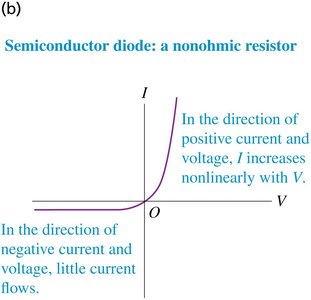
Ohmic resistors obey Ohm's Law (linear - relationship). Non-ohmic devices, such as diodes, have nonlinear $I$-$V$ characteristics.
Ohmic: (straight line on - graph).
Non-Ohmic: does not increase linearly with ; may depend on direction (e.g., diodes).
Resistor Color Codes
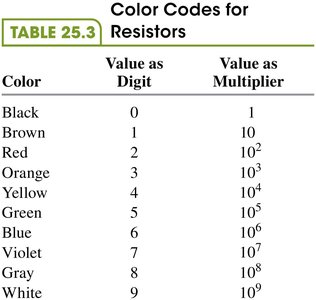
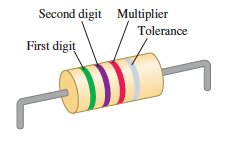
Resistors are marked with colored bands to indicate their resistance value and tolerance. The first two bands represent digits, the third is a multiplier, and the fourth (if present) is tolerance.
Color | Value as Digit | Value as Multiplier |
|---|---|---|
Black | 0 | 1 |
Brown | 1 | 10 |
Red | 2 | 10^2 |
Orange | 3 | 10^3 |
Yellow | 4 | 10^4 |
Green | 5 | 10^5 |
Blue | 6 | 10^6 |
Violet | 7 | 10^7 |
Gray | 8 | 10^8 |
White | 9 | 10^9 |
Example Calculations
Resistance per unit length: For a wire of radius and resistivity , .
Current through a wire: .
Electric field in a wire: .
Potential difference: .
Electric Circuits: Symbols and Measurement Devices
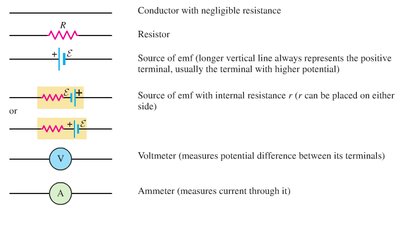
Electric circuits are represented with standard symbols for resistors, emf sources, voltmeters, and ammeters. Voltmeters are connected in parallel and ammeters in series.
Voltmeter: Measures potential difference; ideally infinite resistance.
Ammeter: Measures current; ideally zero resistance.
Electromotive Force (emf) and Internal Resistance
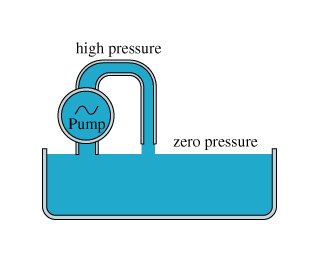
Electromotive force (emf) is the energy supplied per unit charge by a source such as a battery. Real sources have internal resistance, which reduces the terminal voltage when current flows.
emf (\( \mathcal{E} \)): is the total energy per unit charge supplied by the source. Units: Volt (V).
Terminal Voltage: , where is the internal resistance and is the current.
Current in a circuit: , where is the external resistance.
Potential Changes in a Circuit
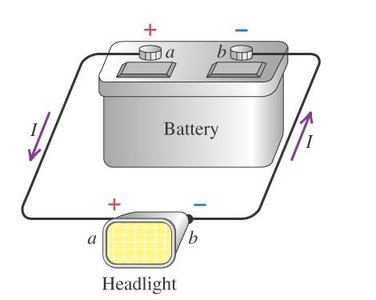
As charge moves through a circuit, its potential increases across the emf source and decreases across resistors. The sum of potential changes around a closed loop is zero (Kirchhoff's loop rule).
Power in Electric Circuits
Power is the rate at which energy is transferred or converted. In resistors, electrical energy is converted to heat.
Power delivered to a resistor: .
Power supplied by emf: .
Household Power Distribution
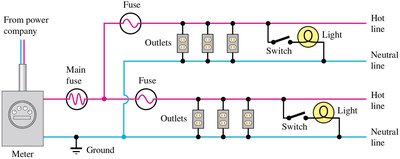
Household circuits use alternating current (AC) with a typical root-mean-square (rms) voltage of 120 V. The hot line carries the voltage, and the neutral line is grounded for safety.
Example: Household Appliances
Current drawn by a device: .
Resistance of a device: .
For an 1800 W toaster, a 1.3 kW frying pan, and a 100 W lamp on a 120 V circuit:
Toaster: A,
Frying pan: A,
Lamp: A,
Summary Table: Types of Materials by Resistivity
Type | Resistivity (\( \Omega m \)) |
|---|---|
Conductor (Copper) | |
Semiconductor (Carbon) | |
Insulator (Glass) |
