 Back
BackDamped and Forced Oscillations: Simple Harmonic Motion, Resonance, and Quality Factor
Study Guide - Smart Notes
 Tailored notes based on your materials, expanded with key definitions, examples, and context.
Simple Harmonic Motion and Damping
Linearly Damped Oscillator
When an oscillator is subjected to a drag force proportional to velocity, it is said to be linearly damped. The equation of motion for a mass-spring system with damping is:
Equation:
Drag force:
General solution: , where and
Types of Damping
The nature of the solution depends on the relationship between the damping constant and the mass and spring constant:
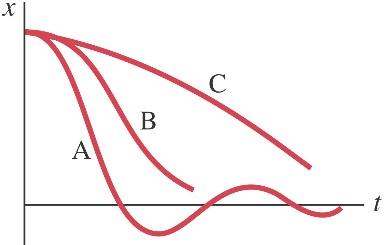
Underdamped: Oscillatory motion with gradually decreasing amplitude ()
Critically damped: Returns to equilibrium as quickly as possible without oscillating ()
Overdamped: Returns to equilibrium without oscillating, but slower than critical ()
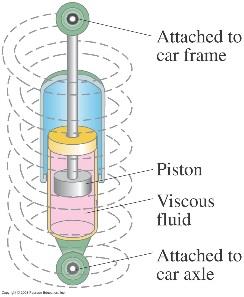
Example: Shock absorbers in vehicles are designed to be critically damped to prevent oscillations after a disturbance.
Quality Factor (Q) and Energy Loss
Definition and Physical Meaning
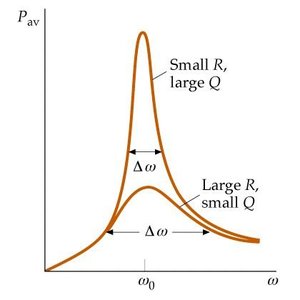
The quality factor Q is a dimensionless measure of how underdamped an oscillator is and describes the sharpness of resonance:
Q is inversely proportional to energy loss per cycle.
Formula:
Energy decay: , where is the decay time.
Fractional energy loss per period:
Example: The low E string of a guitar loses half its energy after 2.25 s, allowing calculation of its decay time and Q factor.

Forced Oscillations and Resonance
Driven Damped Oscillator
When a damped oscillator is subjected to an external periodic force, its equation of motion becomes:
Equation:
Steady-state solution:
Amplitude:
Phase constant:
Resonance
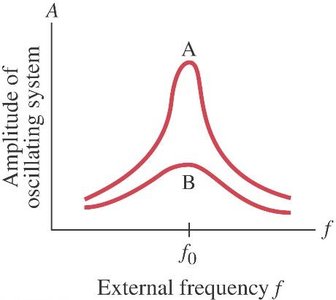
Resonance occurs when the driving frequency matches the natural frequency of the oscillator, resulting in maximum amplitude and energy transfer:
Resonant frequency:
At resonance: Amplitude is maximized, and the system absorbs energy most efficiently from the driving force.
Resonance curve width:
Important Equations Summary
Period of mass-spring oscillator:
Period of simple pendulum:
Damped oscillator solution:
Damping coefficient:
Damped frequency:
Quality factor:
Energy loss per period:
Forced oscillator amplitude:
Resonance curve width:
Applications and Examples
Shock absorbers: Designed for critical damping to prevent oscillations after a disturbance.
Musical instruments: The Q factor determines how long a string vibrates after being plucked.
Engineering: Resonance must be avoided in bridges and buildings to prevent structural failure.
Additional info: The notes cover all major aspects of damped and forced oscillations, including mathematical derivations, physical interpretations, and practical applications. The included images directly illustrate the physical phenomena and concepts discussed.
