Back
BackDC Circuits: Series and Parallel Circuits, Kirchhoff’s Rules, Capacitors, RC Circuits, and Measurement Instruments
Study Guide - Smart Notes
 Tailored notes based on your materials, expanded with key definitions, examples, and context.
DC Circuits
Introduction to DC Circuits
Direct current (DC) circuits are foundational in physics and engineering, involving the flow of electric charge in a single direction. These circuits are present in everyday devices such as cell phones, automobiles, and medical instruments. Understanding the behavior of resistors, capacitors, batteries, and measurement devices in DC circuits is essential for analyzing and designing electronic systems.
Electromotive Force (EMF) and Terminal Voltage
Definition and Internal Resistance
Electromotive force (emf, \( \varepsilon \)): The potential difference provided by a source (battery or generator) when no current is drawn. Unit: volt (V).
Internal resistance (r): Real batteries have internal resistance, causing the terminal voltage to drop when current flows.
Terminal voltage (\( V_{ab} \)): The actual voltage available at the battery terminals when current flows, given by:
When no current is drawn, \( V_{ab} = \varepsilon \).
As current increases, the voltage drop across internal resistance increases, reducing terminal voltage.
Resistors in Series and Parallel
Series Connection
Resistors are connected end-to-end; the same current flows through each.
Total (equivalent) resistance:
The total resistance increases as more resistors are added in series.
Parallel Connection
Resistors are connected across the same two points; the voltage across each is the same.
Total (equivalent) resistance:
The equivalent resistance is always less than the smallest individual resistance.
Example: Two 4-Ω resistors in parallel
Kirchhoff’s Rules
Junction Rule (Conservation of Charge)
At any junction, the sum of currents entering equals the sum leaving:
Loop Rule (Conservation of Energy)
The sum of potential differences around any closed loop is zero:
Apply Ohm’s law (\( V = IR \)) and account for emf sources and resistors.
EMFs in Series and Parallel; Charging a Battery
Batteries in series: Voltages add algebraically.
Batteries in parallel: Provide more current; each supplies a fraction of the total current.
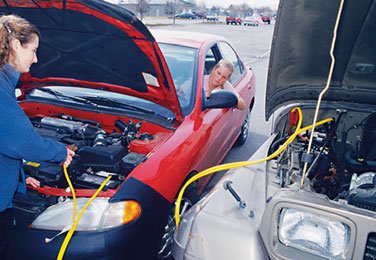
Reverse connection (charging): A higher-voltage source can recharge a lower-voltage battery by forcing current in the reverse direction.
Capacitors in Series and Parallel
Parallel Connection
Capacitances add:
Series Connection
Reciprocals add:
The equivalent capacitance is less than the smallest individual capacitance.
RC Circuits—Resistor and Capacitor in Series
Charging a Capacitor
When a capacitor charges through a resistor, the voltage across the capacitor increases exponentially:
Time constant: (time to reach 63% of maximum voltage).
Discharging a Capacitor
Voltage decreases exponentially:
Current also decays exponentially.
Electric Hazards and Safety
Effects of Electric Current on the Human Body
Currents above 1 mA can be felt; above 10 mA can cause muscle contraction; above 100 mA can be fatal (ventricular fibrillation).
Wet skin greatly reduces resistance, increasing risk.

Grounding and Electrical Safety
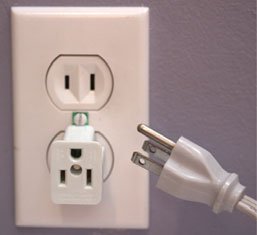
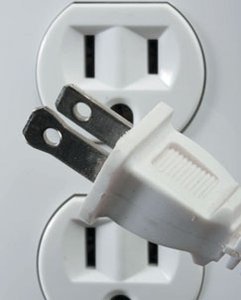
Grounding provides a safe path for current in case of faults.
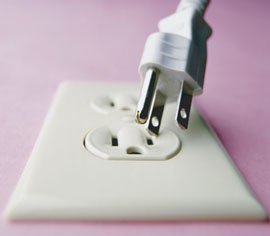
Three-prong plugs connect the device case to ground, reducing shock risk.
Ammeters and Voltmeters—Measurement and Effects
Ammeters
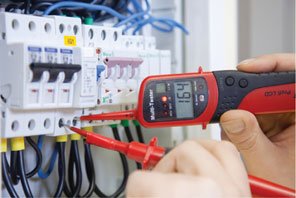
Measure current; must be connected in series.
Low internal resistance to minimize effect on circuit.
Voltmeters
Measure voltage; must be connected in parallel.
High internal resistance to minimize effect on circuit.
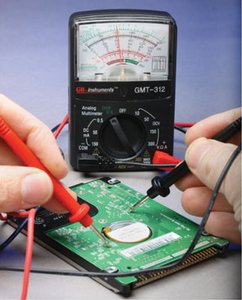
Digital vs. Analog Meters
Digital meters have higher input resistance and less effect on the circuit.
Applications of RC Circuits
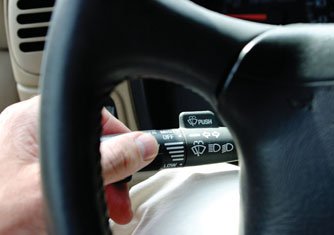
Timing circuits (e.g., windshield wipers, blinkers, pacemakers).
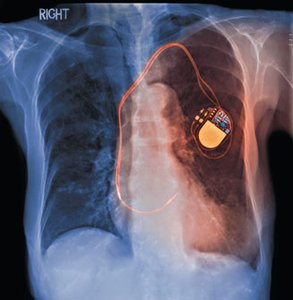
Medical devices such as pacemakers use RC circuits to control pulse timing.
Summary Table: Series and Parallel Connections
Component | Series | Parallel |
|---|---|---|
Resistors | ||
Capacitors |
Key Equations
Ohm’s Law:
Power:
Kirchhoff’s Junction Rule:
Kirchhoff’s Loop Rule:
Capacitor Charging:
Capacitor Discharging:
Applications and Examples
Automotive circuits (e.g., jump starting a car, windshield wipers)
Medical devices (e.g., pacemakers)
Household safety (e.g., proper grounding, use of GFCI outlets)
Measurement techniques (e.g., using ammeters and voltmeters correctly)