 Back
Describing Motion: Visualizing and Mathematically Representing Motion
Study Guide - Smart Notes
 Tailored notes based on your materials, expanded with key definitions, examples, and context.
Describing Motion
Introduction to Motion
Motion refers to the change of an object’s position or direction of travel with respect to time. Understanding motion is fundamental in physics, as it allows us to describe and predict the behavior of objects in the physical world.
Motion: The change in position or direction of an object over time.
Position: The location of an object at a particular point in time, usually described relative to a reference point.
Displacement: The change in position of an object, defined as the straight-line distance from the initial to the final position, including direction.
Goals in Studying Motion
Visualize Motion: Develop the ability to represent and interpret motion using diagrams and sequences.
Mathematical Description: Use mathematical tools and equations to quantitatively describe how objects move.
Visualizing Motion
To analyze motion, physicists often use visual tools that simplify complex movements into understandable representations:
Motion Diagrams: A series of images or points that show an object’s position at equal time intervals. These diagrams help in visualizing the path and speed of an object.
Movies and Sequential Images: Real-life motion can be captured in a sequence of images, which, when analyzed, reveal patterns such as acceleration, constant velocity, or changes in direction.
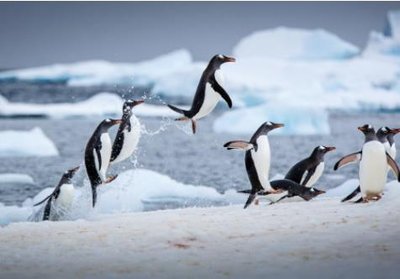
Example: The image above shows a sequence of a penguin jumping out of the water and landing on ice. Each position in the sequence represents the penguin’s location at a different moment in time, similar to a motion diagram. This helps us visualize the trajectory and changes in velocity during the jump.
Mathematical Description of Motion
Once motion is visualized, it can be described mathematically using concepts such as displacement, velocity, and acceleration:
Displacement (\( \Delta x \)): The change in position, calculated as \( \Delta x = x_f - x_i \), where \( x_f \) is the final position and \( x_i \) is the initial position.
Average Velocity (\( v_{avg} \)): The rate of change of displacement, given by \( v_{avg} = \frac{\Delta x}{\Delta t} \), where \( \Delta t \) is the time interval.
Instantaneous Velocity: The velocity of an object at a specific instant, found by taking the derivative of position with respect to time: \( v = \frac{dx}{dt} \).
Acceleration (\( a \)): The rate of change of velocity, given by \( a = \frac{dv}{dt} \).
Application: By analyzing the positions of the penguin at different times, we can calculate its average velocity and acceleration during the jump.
Additional info: In physics, visualizing motion with diagrams and mathematically describing it are foundational skills that lead to deeper topics such as kinematics, dynamics, and energy analysis.
