 Back
Diffusion and Fick’s Law: Physics with Calculus Study Notes
Study Guide - Smart Notes
 Tailored notes based on your materials, expanded with key definitions, examples, and context.
Diffusion: Random Motion and Transport
Definition and Physical Meaning
Diffusion is the process by which particles spread from regions of high concentration to regions of low concentration due to random thermal motion. It is a fundamental mechanism for transport in gases, liquids, and biological systems.
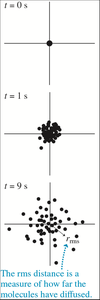
Random Walk: Particles move randomly, resulting in a net movement from high to low concentration.
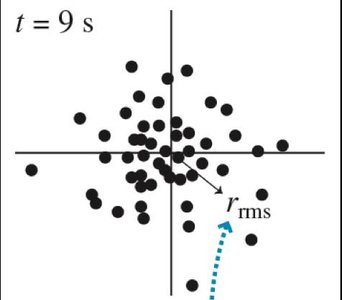
Root Mean Square (rms) Distance: The typical distance a particle diffuses in time t is given by the rms distance.
Equation: where D is the diffusion coefficient.
Time to Diffuse a Distance:
Ballistic Motion Comparison: For ballistic motion, (where v is velocity), which is linear in time, unlike diffusion which grows with the square root of time.
Example: If a particle diffuses 10 μm in 1 second, in 10 seconds it will diffuse (using the rms formula).
Fick’s Law of Diffusion
Mathematical Formulation
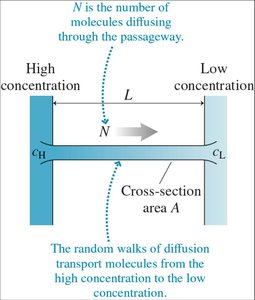
Fick’s Law quantifies the rate at which particles diffuse through a medium. It relates the flux of particles to the concentration gradient.
Fick’s Law:
Variables:
N: Number of molecules diffusing
D: Diffusion coefficient
A: Cross-sectional area
L: Length of the channel
Δc: Concentration difference
Physical Interpretation: The rate of diffusion increases with larger area, higher concentration difference, and higher diffusion coefficient, but decreases with longer diffusion path.
Comparison with Other Transport Laws
Fick’s Law shares structural similarities with other transport laws:
Heat Conduction:
Fluid Flow (Hagen-Poiseuille Law):
Electrical Conduction:
All these laws describe transport driven by a gradient (concentration, temperature, pressure, or potential) and are proportional to area and inversely proportional to length.
Diffusion Coefficients
Values for Common Substances
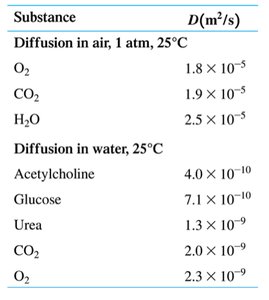
The diffusion coefficient D quantifies how quickly molecules spread in a medium. It depends on the substance and the medium (air or water).
Substance | D (m2/s) |
|---|---|
O2 (air) | 1.8 × 10⁻⁵ |
CO2 (air) | 1.9 × 10⁻⁵ |
H2O (air) | 2.5 × 10⁻⁵ |
Acetylcholine (water) | 4.0 × 10⁻¹⁰ |
Glucose (water) | 7.1 × 10⁻¹⁰ |
Urea (water) | 1.3 × 10⁻⁹ |
CO2 (water) | 2.0 × 10⁻⁹ |
O2 (water) | 2.3 × 10⁻⁹ |
Diffusion in Biological Systems
Limits on Cell Size
Diffusion is essential for cellular function, but its efficiency limits the maximum size of cells. Large cells may not be able to transport molecules quickly enough by diffusion alone.
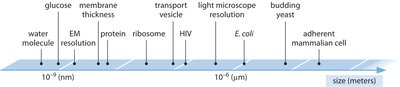
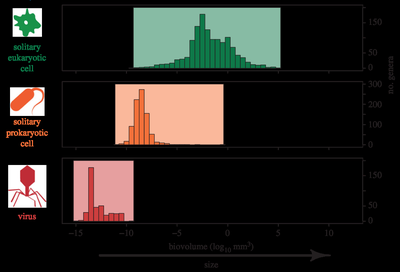
Typical Cell Sizes: Most cells are small (micrometers in diameter) to ensure efficient diffusion.
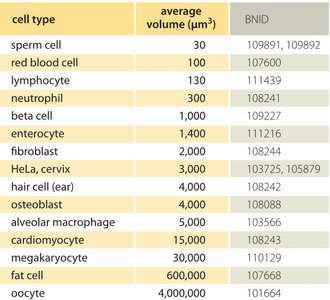
Example: Human cells range from 30 μm3 (sperm cell) to 4,000,000 μm3 (oocyte).
Biological Implication: Cells larger than a certain size require additional transport mechanisms (e.g., circulatory systems).
Diffusion of Oxygen in Water
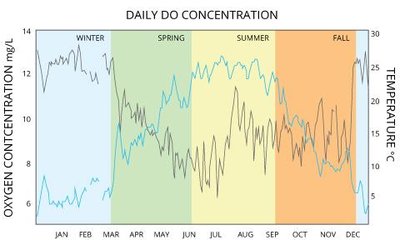
The concentration of dissolved oxygen in water varies with temperature and season, affecting biological processes and diffusion rates.
Oxygen Diffusion: Essential for aquatic life; diffusion coefficient for O2 in water is 2.3 × 10⁻⁹ m2/s.
Environmental Impact: Seasonal changes in temperature and oxygen concentration influence diffusion and biological activity.
Applications and Conceptual Questions
Diffusion vs. Ballistic Motion
Diffusion is random and slow compared to ballistic motion, which is direct and fast. Biological systems use diffusion for short-range transport, but rely on other mechanisms for long-range transport.
Brownian Motion: Random movement of particles, related to entropy and thermal energy.
Odor Diffusion Example: Odor molecules from an orange diffuse through air, allowing you to smell it even in still air.
Additional info: Diffusion is a key concept in physics, chemistry, and biology, underlying many transport phenomena and limiting the size and function of cells.
