 Back
BackDirect Current Electricity: Fundamentals, Circuits, and Safety
Study Guide - Smart Notes
 Tailored notes based on your materials, expanded with key definitions, examples, and context.
Direct Current Electricity
Electric Current
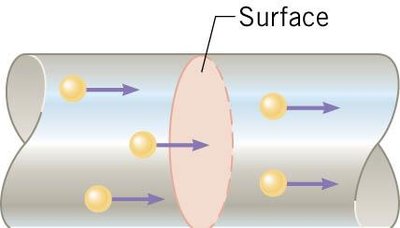
Electric current is a fundamental concept in physics, describing the flow of electric charge through a conductor. The current (I) is defined as the amount of charge (q) passing through a surface per unit time (t):
Definition: Electric current is the rate at which charge flows through a surface perpendicular to the motion of the charges.
Unit: The SI unit of current is the ampere (A), where 1 ampere equals 1 coulomb per second.
Formula:
Types: Direct current (DC) flows in one direction, while alternating current (AC) reverses direction periodically.
Example: A pocket calculator with a 3.0 V battery and 0.17 mA current delivers 0.61 C of charge and 0.18 J of energy in one hour.
Conventional Current
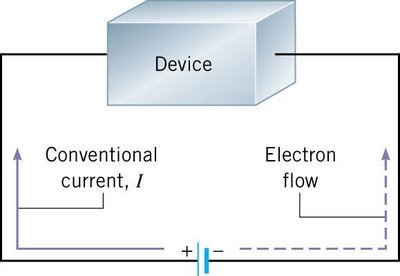
Conventional current is defined as the hypothetical flow of positive charges, which is opposite to the actual electron flow in most circuits.
Direction: Conventional current flows from the positive terminal to the negative terminal of a battery.
Electron Flow: Electrons actually move from the negative terminal to the positive terminal.
Electromotive Force (EMF)
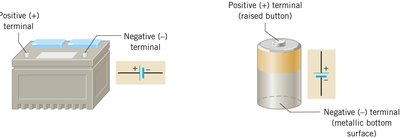
Electromotive force is the maximum potential difference across the terminals of a battery or cell, resulting from internal chemical reactions.
Definition: EMF is the energy provided per unit charge by a source such as a battery.
Unit: The SI unit is the volt (V).
Example: Batteries and cells transfer electrons from one terminal to another, creating EMF.
Resistance & Ohm’s Law
Resistance is a property of materials that opposes the flow of electric current. Ohm’s Law relates voltage, current, and resistance in a conductor.
Ohm’s Law:
Definition: Resistance (R) is the ratio of voltage (V) to current (I).
Unit: The SI unit is the ohm (Ω), where .
Resistor: Any device that offers resistance to electrical flow is called a resistor.
Example: A torch filament with 3.0 V and 0.40 A has a resistance of 7.5 Ω.
Resistivity
Resistivity is a material property that quantifies how strongly a material opposes the flow of electric current.
Formula: , where is resistivity, is length, and is cross-sectional area.
Unit: Resistivity is measured in ohm·meter (Ω·m).
Temperature Dependence: Resistance and resistivity change with temperature, described by the temperature coefficient .
Series & Parallel Wiring
Electrical devices can be connected in series or parallel, affecting the current and voltage distribution in the circuit.
Series Wiring: Devices share the same current; total resistance is the sum of individual resistances: .
Parallel Wiring: Devices share the same voltage; total resistance is given by: .
Example: Two resistors in series (6 Ω and 3 Ω) with a 12 V battery have a total resistance of 9 Ω and a current of 1.33 A.
Example: Two speakers in parallel (8 Ω and 4 Ω) with 6 V have an equivalent resistance of 2.67 Ω and a total current of 2.25 A.
Electric Power
Electric power is the rate at which electrical energy is transferred or converted in a circuit.
Formula:
Alternative Forms: and
Unit: The SI unit is the watt (W).
Example: A torch with 0.40 A and 3.0 V delivers 1.2 W of power and dissipates 396 J in 5.5 minutes.
Terminal Voltage & Internal Resistance
Batteries and generators have internal resistance, which affects the actual voltage available at the terminals.
Formula:
Example: A car battery with 12.0 V emf and 0.0100 Ω internal resistance delivers 11.9 V at 10.0 A and 11.0 V at 100.0 A.
Measurement of Current & Voltage
Current and voltage are measured using ammeters and voltmeters, respectively.
Ammeter: Inserted in series to measure current.
Voltmeter: Connected in parallel to measure voltage between two points.
Alternating Current (AC)
Alternating current is widely used for power transmission due to its advantages in efficiency and transformation.
Transmission: AC allows for easy transmission of large amounts of power over long distances.
Transformation: AC voltage can be easily increased or decreased using transformers.
Generation: AC is easily generated by various power sources (wind, nuclear, hydro, etc.).
Electrical Safety
Electrical safety is crucial to prevent accidents and injuries. Proper grounding, fuses, and warning signs are essential components.
Grounding: Reduces danger by providing a safe path for current.
Fuses: Provide over-current protection by breaking the circuit when current exceeds safe levels.
Warning Signs: Indicate electrical hazards and promote safe practices.
Appliance Power Ratings: Appliances have minimum and maximum power ratings, which must be considered for safe operation.
Appliance | Minimum Power (W) | Maximum Power (W) |
|---|---|---|
Dishwasher | 1200 | 1500 |
Electric Blanket | 200 | 200 |
Electric Heater Fan | 2000 | 3000 |
Electric Kettle | 1200 | 3000 |
25" colour TV | 150 | 150 |
Fridge / Freezer | 150 | 400 |
Iron | 1000 | 1000 |
Microwave | 600 | 1700 |
Electric Shaver | 15 | 20 |
Laptop Computer | 50 | 100 |
Hair Blow dryer | 1800 | 2500 |
Example: Birds can perch on power lines without being electrocuted because there is no potential difference across their bodies.
Additional info: Electrical safety also involves understanding physiological effects of current, proper circuit design, and use of protective devices.
