 Back
BackDouble-Slit Interference and Diffraction: Step-by-Step Physics Guidance
Study Guide - Smart Notes
 Tailored notes based on your materials, expanded with key definitions, examples, and context.
Q1. Light from a helium-neon laser (λ = 633 nm) illuminates two slits spaced 0.40 mm apart. A viewing screen is 2.0 m behind the slits. A bright fringe is observed at a point 9.5 mm from the center of the screen. What is the fringe number m, and how much farther does the wave from one slit travel to this point than from the other slit?
Background
Topic: Double-Slit Interference
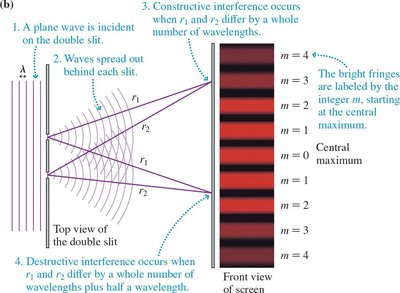
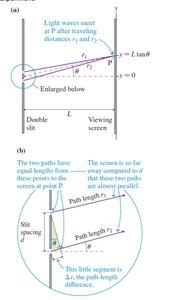
This question tests your understanding of the double-slit experiment, specifically how to determine the fringe number (order) and the path-length difference for a bright fringe on the interference pattern.
Key Terms and Formulas
Wavelength (): The distance between successive peaks of a wave.
Slit spacing (): The distance between the centers of the two slits.
Fringe number (): The order of the bright fringe, with at the central maximum.
Path-length difference (): The extra distance one wave travels compared to the other.
Screen distance (): The distance from the slits to the viewing screen.
Position on screen (): The distance from the central maximum to the fringe.
Key formulas:
Position of bright fringe:
Path-length difference:
For small angles:
Step-by-Step Guidance
Identify the known values: , , , .
Convert all units to meters for consistency: , , .
Use the formula for the position of the bright fringe to solve for the fringe number :
Rearrange to solve for :
To find the path-length difference , use . For small angles, , so:
Try solving on your own before revealing the answer!
Final Answer:
(or 0.19 mm)$
We calculated the fringe number using the formula for and found the path-length difference using the small-angle approximation.
Q2. A double-slit interference pattern is observed on a screen 1.0 m behind two slits spaced 0.30 mm apart. From the center of one particular fringe to the center of the ninth bright fringe from this one is 1.6 cm. What is the wavelength of the light?
Background
Topic: Double-Slit Interference
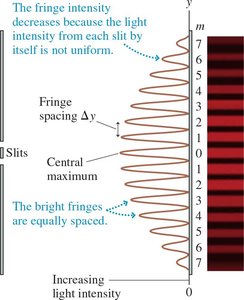
This question tests your ability to use the double-slit interference formula to determine the wavelength of light based on the spacing between bright fringes.
Key Terms and Formulas
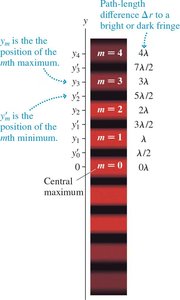
Fringe spacing (): The distance between adjacent bright fringes.
Number of fringes (): The number of bright fringes between two points.
Wavelength (): The quantity to solve for.
Slit spacing (): The distance between the slits.
Screen distance (): The distance from the slits to the screen.
Key formula:
Fringe spacing:
Total distance for fringes:
Step-by-Step Guidance
Identify the known values: , , , .
Convert all units to meters: , .
Use the formula and to set up the equation:
Rearrange to solve for :
Plug in the values for , , , and to calculate .
Try solving on your own before revealing the answer!
Final Answer:
We used the fringe spacing formula and the total distance for nine fringes to solve for the wavelength.
Q3. If you gently spread the barbs on a feather and look through it at a light source, you'll see a clear pattern of rainbows due to diffraction by the feather's barbules, which are small, evenly spaced structures. If the barbules are spaced at 50 per mm, what is the first-order diffraction angle for blue light of 450 nm and red light of 650 nm?
Background
Topic: Diffraction Grating
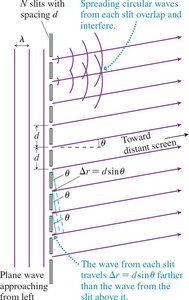
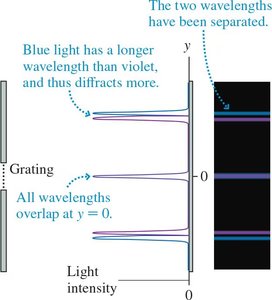
This question tests your understanding of how a diffraction grating separates light into its component wavelengths, and how to calculate the angle for a given order and wavelength.
Key Terms and Formulas
Grating spacing (): The distance between adjacent lines/barbules.
Order (): The integer representing the diffraction order.
Wavelength (): The color of light being considered.
Diffraction angle (): The angle at which a particular wavelength is diffracted.
Key formula:
Diffraction grating equation:
Step-by-Step Guidance
Find the grating spacing from the given number of lines per mm: .
Set for first-order diffraction.
Use the diffraction grating equation for each wavelength:
Rearrange to solve for :
Plug in the values for blue light () and red light () to find for each.
Try solving on your own before revealing the answer!
Final Answer:
Blue light: Red light:
We calculated the angles using the grating equation for each wavelength.
Q4. Light from a sodium lamp passes through a diffraction grating that has 1000 slits per millimeter. The interference pattern is viewed on a screen 1.000 m behind the grating. Two bright yellow fringes are visible 72.88 cm and 73.00 cm from the central maximum. What are the wavelengths of these two fringes?
Background
Topic: Diffraction Grating and Wavelength Calculation
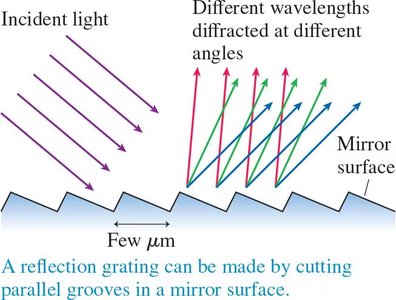
This question tests your ability to use the diffraction grating equation and geometry to determine the wavelengths of light based on fringe positions.

Key Terms and Formulas
Grating spacing (): The distance between adjacent slits.
Order (): The integer representing the diffraction order.
Wavelength (): The quantity to solve for.
Fringe position (): The distance from the central maximum to the fringe.
Screen distance (): The distance from the grating to the screen.
Key formula:
Diffraction grating equation:
For small angles:
Step-by-Step Guidance
Find the grating spacing : .
Convert fringe positions to meters: , .
Use for each fringe.
Plug and into the grating equation to solve for for each fringe.
Try solving on your own before revealing the answer!
Final Answer:
We used the grating equation and geometry to find the wavelengths for each fringe.
Q5. A researcher illuminated a specimen of ground beetle with a beam of yellow light with λ = 570 nm. The resulting diffraction produced clear maxima at 13° and 25°. What is the spacing of the ridges that produces this diffraction effect?
Background
Topic: Diffraction Grating and Maxima
This question tests your ability to use the diffraction grating equation to determine the spacing of periodic structures based on observed diffraction angles.
Key Terms and Formulas
Wavelength (): The distance between successive peaks of the light wave.
Diffraction angle (): The angle at which maxima are observed.
Grating spacing (): The distance between adjacent ridges.
Order (): The integer representing the diffraction order.
Key formula:
Diffraction grating equation:
Step-by-Step Guidance
Identify the known values: , , .
Assume for the first maximum and for the second maximum.
Use the grating equation for each angle:
Set up the equations and solve for using the values for and .
Try solving on your own before revealing the answer!
Final Answer:
(or 2.54 μm)
We used the grating equation for both maxima and solved for the ridge spacing.
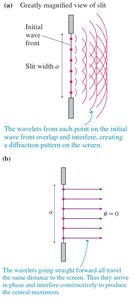
Q6. Light from a helium-neon laser (λ = 633 nm) passes through a narrow slit and is seen on a screen 2.0 m behind the slit. The first minimum in the diffraction pattern is 1.2 cm from the middle of the central maximum. How wide is the slit?
Background
Topic: Single-Slit Diffraction
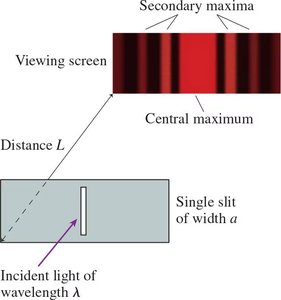
This question tests your understanding of single-slit diffraction and how to use the position of the first minimum to determine the slit width.
Key Terms and Formulas
Wavelength (): The distance between successive peaks of the light wave.
Slit width (): The width of the slit.
Screen distance (): The distance from the slit to the screen.
Position of first minimum (): The distance from the central maximum to the first minimum.
Key formula:
Position of first minimum:
For small angles:
Step-by-Step Guidance
Identify the known values: , , .
Convert all units to meters: , .
Use and substitute into the minimum formula:
Rearrange to solve for :
Plug in the values for , , and to calculate .
Try solving on your own before revealing the answer!
Final Answer:
(or 0.106 mm)
We used the single-slit diffraction formula and the geometry to solve for the slit width.
Q7. Light from a helium-neon laser (λ = 633 nm) passes through a 0.50-mm-diameter hole. How far away should a viewing screen be placed to observe a diffraction pattern whose central maximum is 3.0 mm in diameter?
Background
Topic: Circular Aperture Diffraction
This question tests your understanding of diffraction through a circular aperture and how to relate the diameter of the central maximum to the viewing distance.
Key Terms and Formulas
Wavelength (): The distance between successive peaks of the light wave.
Diameter of aperture (): The diameter of the hole.
Diameter of central maximum (): The width of the central bright spot.
Screen distance (): The distance from the aperture to the screen.
Key formula:
Angular width of central maximum:
For small angles:
Step-by-Step Guidance
Identify the known values: , , .
Convert all units to meters: , , .
Use the formula for angular width: .
Relate the angular width to the screen distance: .
Rearrange to solve for : .
Try solving on your own before revealing the answer!
Final Answer:
We used the angular width formula and geometry to solve for the screen distance.
