 Back
BackDynamics and Forces: Newton’s Laws and Types of Forces
Study Guide - Smart Notes
 Tailored notes based on your materials, expanded with key definitions, examples, and context.
Chapter 4: Dynamics (Newton’s Laws) Part I
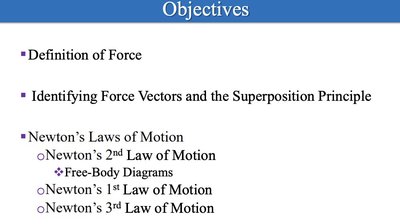
Objectives
This chapter introduces the concept of force, the identification of force vectors, and the superposition principle. It also covers Newton’s Laws of Motion and their applications, including free-body diagrams.
Definition of Force
Identifying Force Vectors and the Superposition Principle
Newton’s Laws of Motion
Newton’s 2nd Law of Motion (with Free-Body Diagrams)
Newton’s 1st Law of Motion
Newton’s 3rd Law of Motion
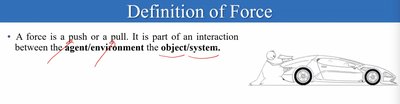
Definition of Force
What is a Force?
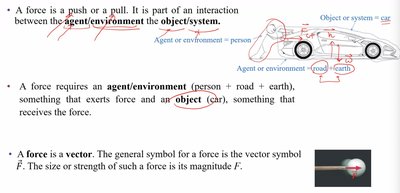
A force is a push or a pull. It is part of an interaction between an agent/environment and an object/system. Forces require an agent (something that exerts the force) and an object (something that receives the force).
Force as a Vector: The general symbol for a force is the vector symbol . The magnitude of a force is its strength.
Example: A person (agent) pushing a car (object).
Classes of Forces
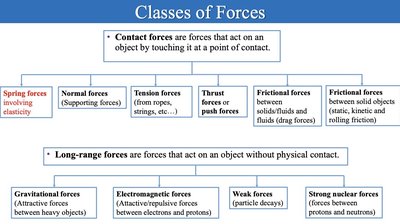
Contact Forces vs. Long-Range Forces
Forces are classified based on whether they require physical contact or act at a distance.
Contact Forces: Act by touching the object at a point of contact.
Normal forces (supporting forces)
Tension forces (from ropes, strings, etc.)
Thrust or push forces
Frictional forces (between solids, fluids, and drag forces)
Spring forces (involving elasticity)
Long-Range Forces: Act without physical contact.
Gravitational forces
Electromagnetic forces
Weak forces (particle decays)
Strong nuclear forces (between protons and neutrons)
Drawing Force Vectors
Visualizing Forces
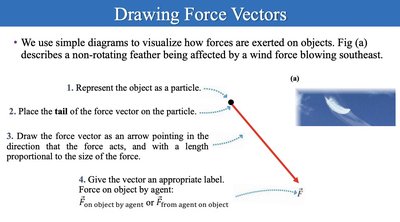
Force vectors are drawn as arrows pointing in the direction the force acts, with length proportional to the force's magnitude. The tail of the vector is placed on the object, and the vector is labeled appropriately.
Notation: or
Example: Wind force acting on a feather.
Contact Forces
Spring Force
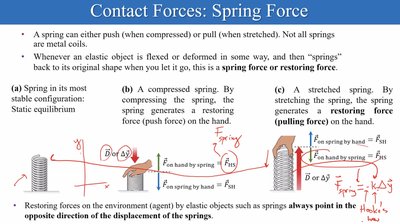
A spring can push (when compressed) or pull (when stretched). The restoring force always points in the opposite direction of the displacement. The force is described by Hooke’s Law:
Formula:
Example: Compressed and stretched springs generate restoring forces.
Tension Force
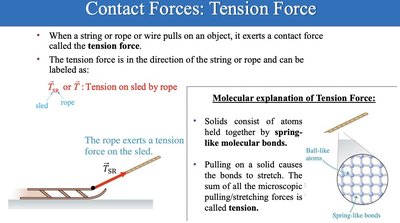
When a string, rope, or wire pulls on an object, it exerts a tension force. The tension force is in the direction of the string or rope.
Notation: (Tension on sled by rope)
Molecular Explanation: Tension arises from spring-like molecular bonds being stretched.
Normal Force
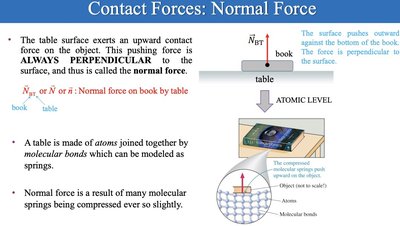
The normal force is the upward contact force exerted by a surface, always perpendicular to the surface. It results from molecular bonds acting as springs.
Notation: (Normal force on book by table)
Atomic Level: Compression of molecular bonds generates the normal force.
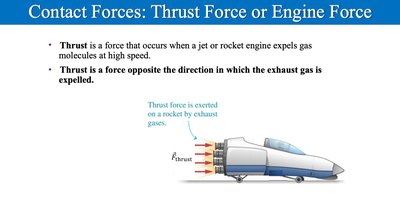
Thrust Force or Engine Force
Thrust is a force generated when a jet or rocket expels gas molecules at high speed. The force is opposite the direction of the exhaust gas.
Example: Thrust force on a rocket by exhaust gases.

Frictional Forces
Kinetic and Static Friction
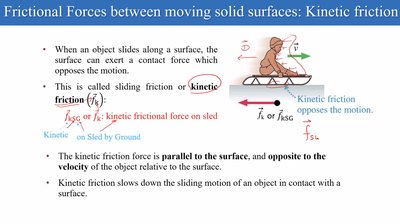
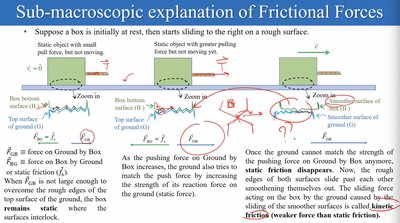
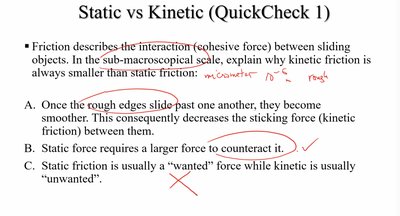
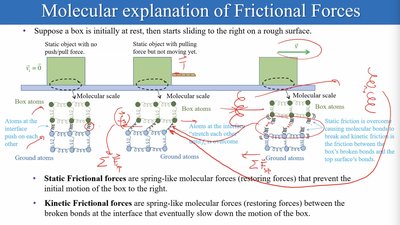
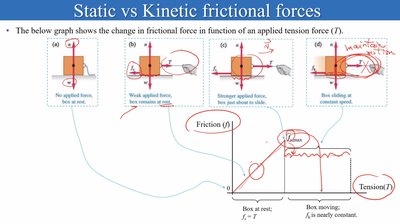
Frictional forces oppose motion between surfaces. Kinetic friction acts when objects slide past each other, while static friction prevents motion when objects are at rest.
Kinetic Friction: or (kinetic frictional force on sled by ground)
Static Friction: or (static frictional force on sled by ground)
Direction: Frictional forces are parallel to the surface and opposite to the velocity.
Drag Forces
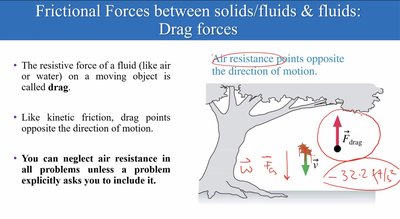
Drag is the resistive force of a fluid (air or water) on a moving object. Like kinetic friction, drag points opposite the direction of motion.
Air Resistance: Often neglected unless specified in problems.
Long-Range Forces
Force of Gravity or Weight
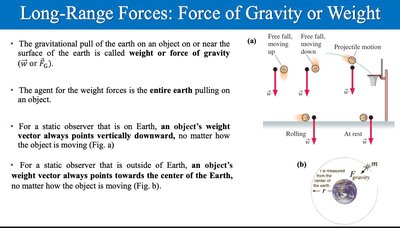
The gravitational pull of the earth on an object is called weight or force of gravity. The agent is the entire earth, and the weight vector always points toward the center of the earth.
Notation: or
Direction: Vertically downward for a static observer on earth; toward the center for an external observer.
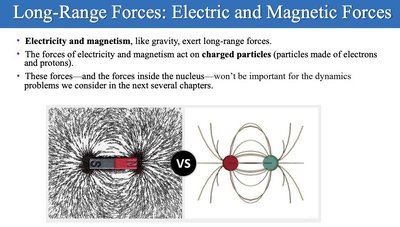
Electric and Magnetic Forces
Electricity and magnetism exert long-range forces on charged particles. These forces act between electrons, protons, and inside the nucleus.
Example: Magnetic and electric field lines.
Identifying Forces in Practice
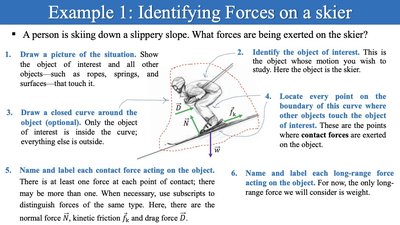
Example: Forces on a Skier
To identify forces acting on a skier:
Draw the situation, including all objects and surfaces.
Draw a closed curve around the object of interest.
Name and label each contact force acting on the object.
Identify the object of interest (the skier).
Locate every point where contact forces act.
Name and label each long-range force acting on the object.
Example: Normal force , kinetic friction , and drag force act on the skier.
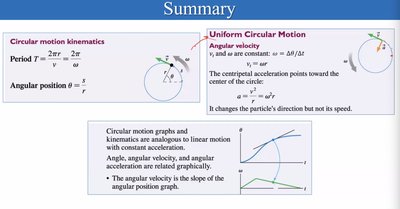
Summary of Circular Motion Kinematics
Uniform Circular Motion
Circular motion graphs and kinematics are analogous to linear motion with constant acceleration. Angle, angular velocity, and angular acceleration are related graphically.
Period:
Angular Position:
Angular Velocity: and are constant;
Centripetal Acceleration: Points toward the center of the circle, changing the particle’s direction but not its speed.
QuickCheck: Force of Friction
Where Can Friction Occur?
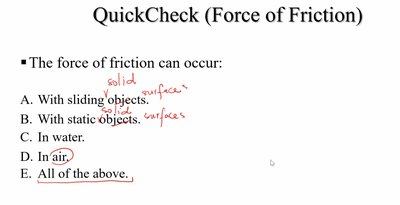
Friction can occur with sliding objects (kinetic and drag forces), static objects (static friction), and in fluids (drag force).
Key Point: Friction is present in solids and fluids, both at rest and in motion.
Additional info:
Some explanations and examples were expanded for clarity and completeness, especially regarding molecular explanations and practical identification of forces.
