 Back
BackDynamics: Forces, Friction, Free Body Diagrams, and Tension
Study Guide - Smart Notes
 Tailored notes based on your materials, expanded with key definitions, examples, and context.
3.1 Laws of Motion
Newton's Laws of Motion
Newton's laws of motion are fundamental principles describing the relationship between the motion of an object and the forces acting upon it.
Law of Inertia (Newton's First Law): A body at rest or moving at a constant speed will remain at rest or keep moving at a constant speed in a straight line unless a force is applied to it.
Newton's Second Law: The acceleration of an object is directly proportional to the magnitude of net force applied.
3.2 Dynamics: Forces
Newton's Third Law of Motion
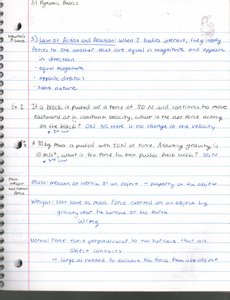
Newton's third law states that when two bodies interact, they exert forces on each other that are equal in magnitude and opposite in direction.
Action and Reaction: For every action, there is an equal and opposite reaction.
Examples:
Normal force
Weight
Applied force
Examples of Forces
Example 1: If a block is pushed with a force of 50 N and continues to move constantly, the net force acting on the block is zero. There is no change in velocity.
Example 2: If a block is pushed with 100 N of force, assuming gravity is 10 m/s2, the mass of the block is 10 kg. The force needed to move the block is 100 N.
Mass and Weight
Mass: Measure of inertia; property of an object.
Weight: Force exerted on an object by gravity; acts downward at the surface.
Normal Force
Normal force: Perpendicular to the surface; the larger the weight, the larger the normal force.
3.2 Dynamics: Normal Force
Normal Force in Inclined Planes
The normal force is the component of contact force perpendicular to the surface.
Example: A block on the floor with a mass of 20 kg is pushed by a force of 150 N in the horizontal direction. The normal force is equal to the weight of the block.
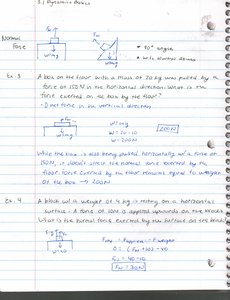
Example: While the block is being pushed horizontally with a force of 150 N, the normal force remains equal to the weight of the block.
Example: A block of 0.5 kg is resting on a horizontal surface. The normal force is equal to the weight.
3.2 Dynamics: Elevator Forces
Normal Force in Elevators
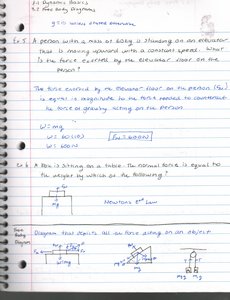
When a person stands in an elevator moving upward at constant speed, the normal force equals the force of gravity.
Example: A person with a mass of 60 kg stands on an elevator. The normal force is equal to the weight:
Normal Force on a Table
Example: If a block is sitting on a table, the normal force is equal to the weight.
3.3 Free Body Diagrams
Free Body Diagrams
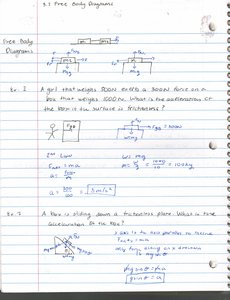
Free body diagrams are visual representations of all forces acting on an object. They are essential for analyzing the dynamics of a system.
Key Forces:
Normal force ()
Weight ()
Applied force ()
Friction ()
Examples
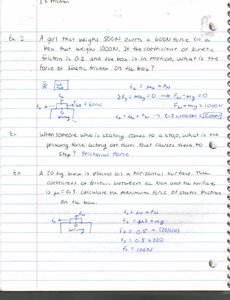
Example 1: A girl that weighs 500 N exerts a 300 N force on a box that weighs 1000 N. The normal force is equal to the weight of the box.
Example 2: A boy is sliding down an inclined plane. The acceleration is determined by the net force along the incline.
3.4 Friction
Types of Friction
Friction is the force that opposes the motion of objects in contact. There are two main types:
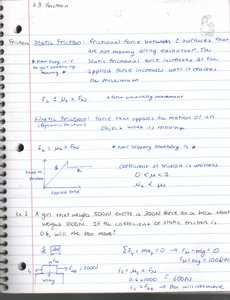
Static Friction: Frictional force between two surfaces that are not moving relative to each other. It increases until a maximum value is reached.
Formula:
Kinetic Friction: Force that opposes the motion of an object when it is already moving.
Formula:
Coefficient of Friction:
Examples
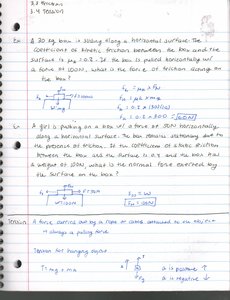
Example 1: A girl that weighs 500 N exerts a 300 N force on a box that weighs 1000 N. If the coefficient of static friction is 0.2, the box is in motion. The force of kinetic friction is
Example 2: When someone is skating, kinetic friction acts on them.
Example 3: A 20 kg box is sliding along a horizontal surface. The coefficient of kinetic friction is 0.2. The force of friction is
3.4 Tension
Tension in Strings and Cables
Tension is the force carried by a rope or cable attached to an object. It acts along the length of the rope and pulls equally on the objects at either end.
Formula:
Direction: Tension is positive if it acts upward, negative if downward.
Examples
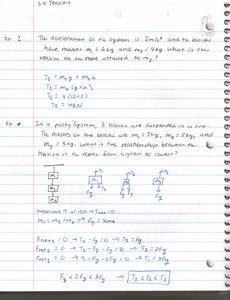
Example 1: The acceleration of the system is and the heavier mass moves up. If and , the tension in the string attached to is
Example 2: In a pulley system, 3 blocks are suspended in a line. The tension in the ropes from highest to lowest is .
Additional info: Academic context and formulas have been expanded for clarity and completeness. All images included are directly relevant to the adjacent explanations.
