 Back
BackDynamics I: Motion Along a Line – Force, Equilibrium, and Friction
Study Guide - Smart Notes
 Tailored notes based on your materials, expanded with key definitions, examples, and context.
Mechanical Equilibrium and Newton’s Laws
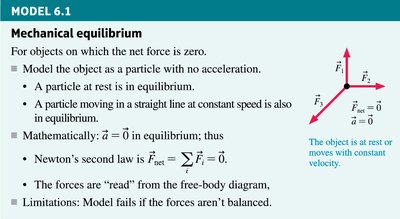
Equilibrium Model
Mechanical equilibrium describes the state of an object when the net force acting on it is zero. This concept is foundational for analyzing stationary objects and those moving at constant velocity.
Newton’s First Law: An object at rest or moving with constant velocity remains in that state unless acted upon by a net external force.
Newton’s Second Law (Equilibrium): For equilibrium, the sum of all forces is zero:
Component Form:
All force components must independently sum to zero for equilibrium.
Applications: Essential for engineering structures (e.g., bridges) and analyzing stationary systems.
Constant Force and Non-Equilibrium Motion
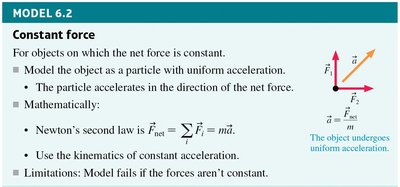
When the net force on an object is not zero, the object accelerates in the direction of the net force. This is described by Newton’s Second Law in its general form.
Newton’s Second Law (General):
If the net force is constant, the acceleration is also constant, and kinematic equations can be used to analyze motion.
Forces are determined from free-body diagrams, and the direction of acceleration follows the direction of the net force.
Problem-Solving Strategy: Newtonian Mechanics
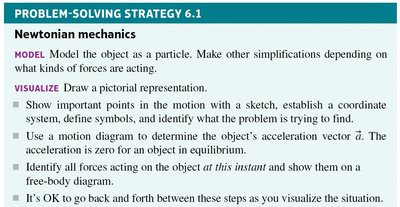
Solving force and motion problems systematically involves modeling, visualizing, solving, and reviewing.
Model: Simplify the object as a particle and identify relevant forces.
Visualize: Draw diagrams, establish coordinate systems, and identify what is being asked.
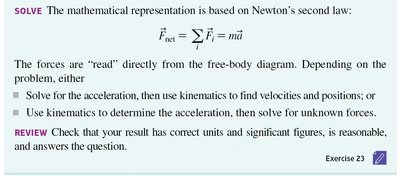
Solve: Apply Newton’s Second Law:
Use kinematics to relate acceleration, velocity, and displacement as needed.
Review: Check units, significant figures, and the reasonableness of your answer.
Mass, Gravity, and Weight
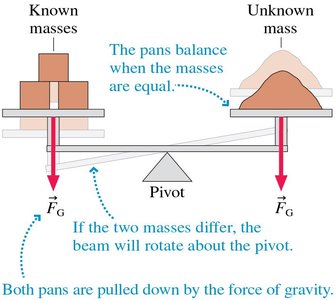
Mass
Mass is a fundamental property of matter, representing the amount of substance and its resistance to acceleration (inertia).
Measured using a balance, which compares an unknown mass to known masses.
Mass is independent of location and external forces.
Scalar quantity (no direction).
Gravity
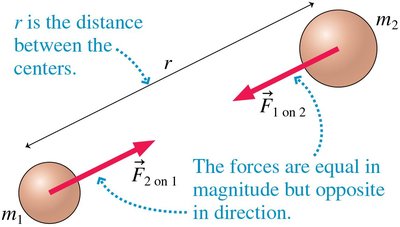
Gravity is a universal attractive force between objects with mass, described by Newton’s Law of Universal Gravitation.
Newton’s Law of Gravitation:
G is the gravitational constant.
Gravity is significant for large masses (e.g., planets) but negligible for small objects.
The acceleration due to gravity at Earth’s surface is .
Weight
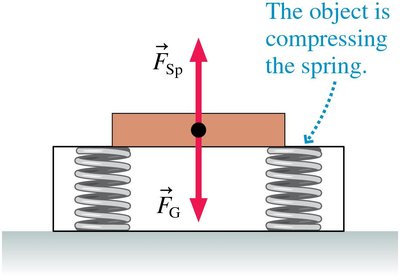
Weight is the force exerted on an object due to gravity. It depends on both the object’s mass and the local gravitational field.
Weight formula:
Measured by the force a scale exerts to support the object (spring force).
Weight varies with location (e.g., Earth vs. Moon), while mass does not.
Apparent Weight and Accelerating Systems
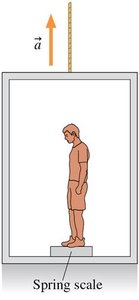
The reading on a scale (apparent weight) can change if the object is accelerating, such as in an elevator.
When accelerating upward:
When accelerating downward:
In free fall (): (weightlessness)
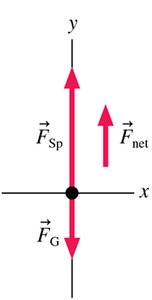
Weightlessness
Weightlessness occurs when the only force acting on an object is gravity, such as in free fall or orbit. The object and its surroundings accelerate at the same rate, so no normal force is felt.
Astronauts in orbit experience weightlessness because they are in continuous free fall around Earth.

Friction Forces
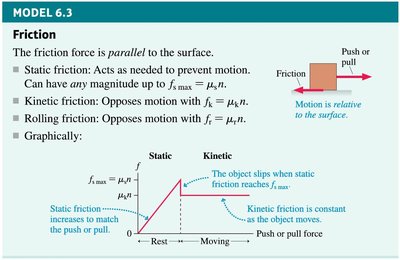
Static Friction
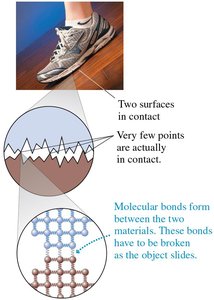
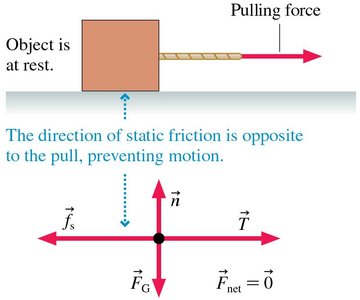
Static friction prevents relative motion between two surfaces in contact. It arises from microscopic interactions and molecular bonds at the contact points.
Acts parallel to the surface and opposes the initiation of motion.
Magnitude can vary up to a maximum value:
is the coefficient of static friction, is the normal force.
Once the applied force exceeds , the object begins to move.
Kinetic Friction
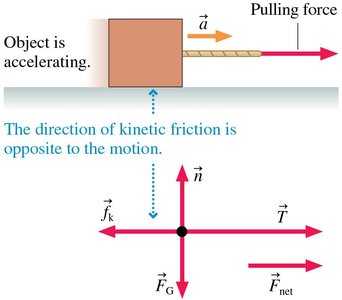
Kinetic friction acts when two surfaces are sliding past each other. It opposes the direction of motion and has a constant magnitude for given materials.
Magnitude:
is the coefficient of kinetic friction (typically ).
Kinetic friction is usually less than the maximum static friction.
Rolling Friction
Rolling friction occurs when an object such as a wheel or ball rolls over a surface. It is generally much smaller than static or kinetic friction.
Magnitude:
is the coefficient of rolling friction.
Rolling friction slows down rolling objects but is essential for controlled motion (e.g., vehicles).
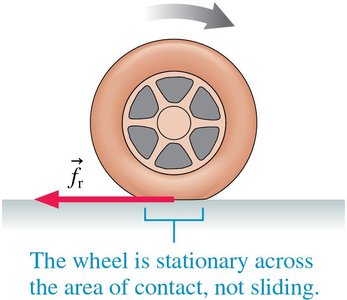
Comparison of Friction Types
The three main types of friction—static, kinetic, and rolling—differ in their physical origins and magnitudes. The coefficients of friction depend on the materials in contact.
Materials | Static | Kinetic | Rolling |
|---|---|---|---|
Rubber on dry concrete | 1.00 | 0.80 | 0.02 |
Rubber on wet concrete | 0.30 | 0.25 | 0.02 |
Steel on steel (dry) | 0.80 | 0.60 | 0.002 |
Steel on steel (lubricated) | 0.10 | 0.05 | --- |
Wood on wood | 0.50 | 0.20 | --- |
Wood on snow | 0.12 | 0.06 | --- |
Ice on ice | 0.10 | 0.03 | --- |
Drag Force
Drag in Fluids
When an object moves through a fluid (liquid or gas), it experiences a resistive force called drag. Drag depends on the object’s speed, shape, and the properties of the fluid.
Drag arises from two main sources: inertia (displacing fluid) and viscosity (internal friction within the fluid).
The Reynolds number () determines whether drag is dominated by viscous or inertial effects.
For low : (linear with speed)
For high : (quadratic with speed)
As speed increases, drag increases until it balances the force of gravity (for falling objects), resulting in terminal velocity:
Terminal speed (): The constant speed reached when the drag force equals the applied force (e.g., gravity for a falling object).
Summary Table: Types of Forces in Linear Motion
Force Type | Formula | Key Properties |
|---|---|---|
Weight | Acts downward, depends on gravity | |
Static Friction | Prevents motion, variable up to max | |
Kinetic Friction | Opposes sliding motion, constant | |
Rolling Friction | Opposes rolling, usually very small | |
Drag Force (low ) | Linear with speed | |
Drag Force (high ) | Quadratic with speed |
