 Back
BackDynamics I: Motion Along a Line – Forces, Equilibrium, Friction, and Drag
Study Guide - Smart Notes
 Tailored notes based on your materials, expanded with key definitions, examples, and context.
Mechanical Equilibrium
Definition and Conditions
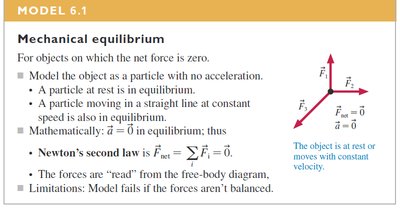
Mechanical equilibrium occurs when the net force acting on an object is zero, resulting in no acceleration. This concept is fundamental in understanding how objects remain at rest or move with constant velocity.
Equilibrium Model: Model the object as a particle with no acceleration.
Rest and Constant Velocity: A particle at rest or moving in a straight line at constant speed is in equilibrium.
Mathematical Expression: in equilibrium, so .
Free-Body Diagram: Forces are "read" from the diagram; model fails if forces aren't balanced.
Component Form of Equilibrium
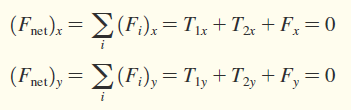
Newton's second law in equilibrium is written in component form to analyze forces along each axis.
Force Components in Equilibrium Problems
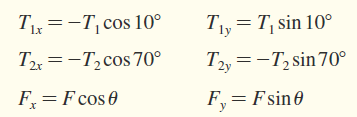
Force vectors are resolved into components using trigonometric functions, with signs determined by direction.
Solving for Unknowns in Equilibrium
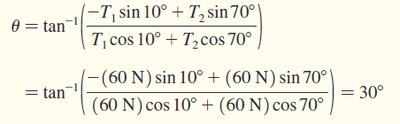
Simultaneous equations are used to solve for unknown force magnitudes and directions.
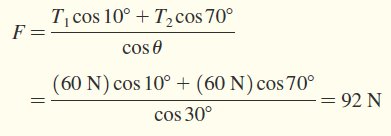
To find the angle :
Example:
To find the force :
Example:
Force and Motion: Towing a Car Up a Hill
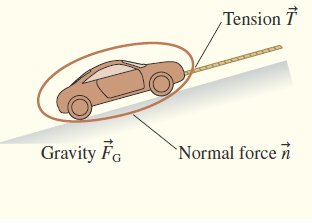
Free-Body Diagram and Forces
When analyzing a car being towed up a slope, the forces include tension, gravity, and the normal force.
Weight: The gravitational force acts downward.
Tension: The tow rope exerts a force .
Normal Force: The surface exerts a force perpendicular to the slope.
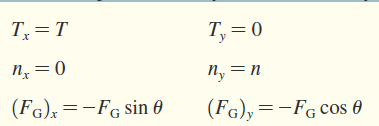
Component Analysis
Each force is resolved into x and y components for calculation.
Newton's Second Law in Dynamics
Application to Accelerating Objects /
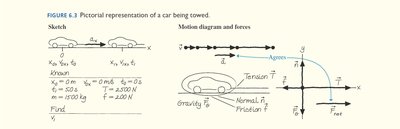
Newton's second law relates the net force to the acceleration of an object. For a car being towed, the law is applied to determine speed after a given time.
Equation:
Trajectory: Use acceleration in kinematic equations to find velocity and position.
Mass, Weight, and Gravity
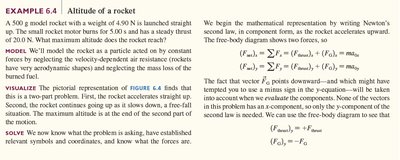
Mass: An Intrinsic Property
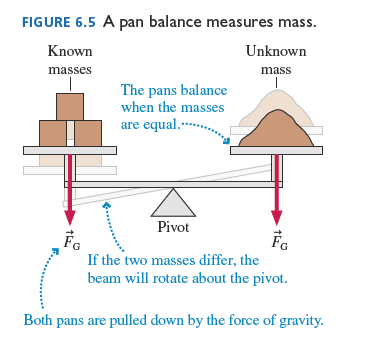
Mass is a scalar quantity describing an object's inertia and amount of matter. It is intrinsic and does not depend on location or external forces.
Gravity: A Force
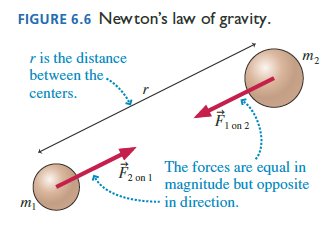
Gravity is an attractive, long-range force between any two masses, described by Newton's law of gravity.
Where is the gravitational constant.
Gravity Near the Surface of a Planet
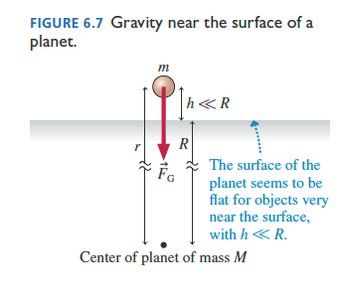
For objects near a planet's surface, gravity can be approximated as a constant force directed downward.
is the acceleration due to gravity, a property of the planet.
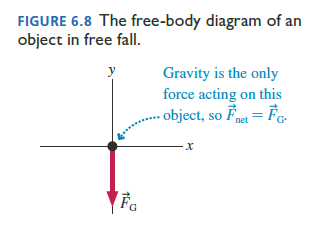
Weight: A Measurement
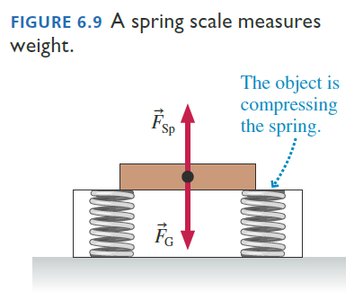
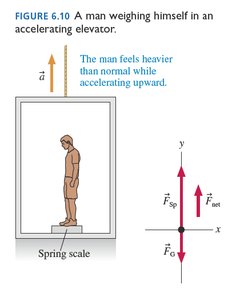
Weight is defined as the reading of a spring scale when an object is at rest relative to the scale. It is not an intrinsic property, but a measurement.
(at rest or constant velocity)
Weightlessness
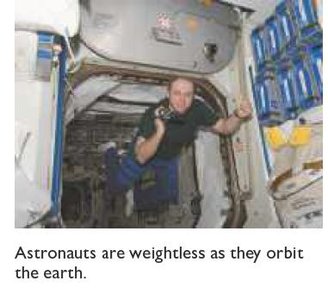
Weightlessness occurs when there is no contact force pressing against an object, such as astronauts in orbit.
Friction
Static Friction
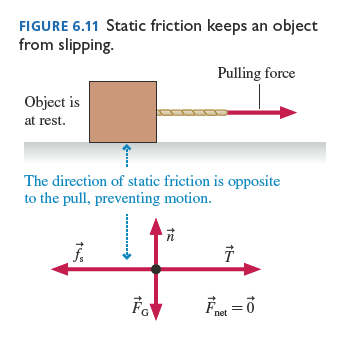
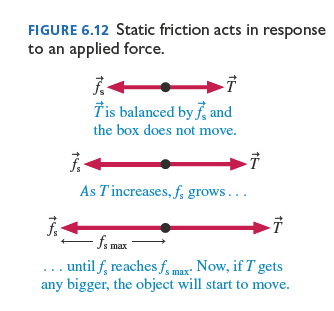
Static friction prevents an object from slipping and acts in response to applied forces, up to a maximum value.
is the coefficient of static friction.
Coefficients of Friction
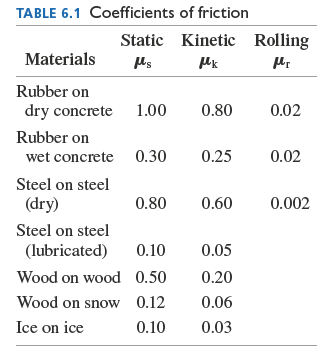
Different materials have characteristic coefficients of static, kinetic, and rolling friction.
Materials | Static \( \mu_s \) | Kinetic \( \mu_k \) | Rolling \( \mu_r \) |
|---|---|---|---|
Rubber on dry concrete | 1.00 | 0.80 | 0.02 |
Rubber on wet concrete | 0.30 | 0.25 | 0.02 |
Steel on steel (dry) | 0.80 | 0.60 | 0.002 |
Steel on steel (lubricated) | 0.10 | 0.05 | — |
Wood on wood | 0.50 | 0.20 | — |
Wood on snow | 0.12 | 0.06 | — |
Ice on ice | 0.10 | 0.03 | — |
Kinetic Friction
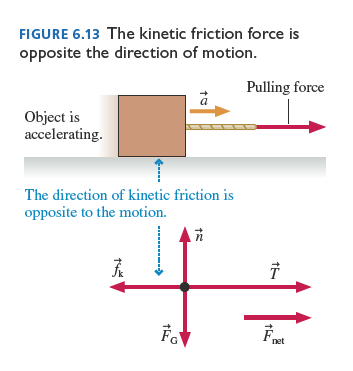
Kinetic friction acts when an object is sliding, with a constant magnitude less than the maximum static friction.
is the coefficient of kinetic friction.
Rolling Friction
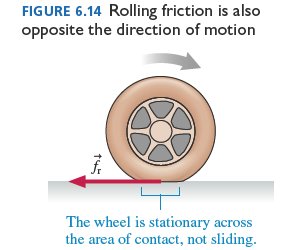
Rolling friction occurs when a wheel rolls on a surface, with the contact area stationary relative to the surface.
is the coefficient of rolling friction.
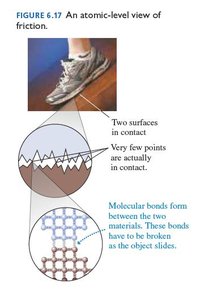
Atomic-Level View of Friction
Friction arises from microscopic interactions between surfaces, including molecular bonds and surface roughness.
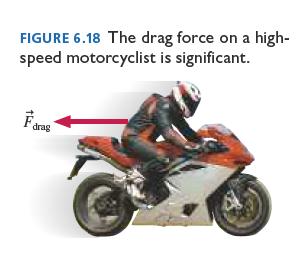
Drag Force
Definition and Model
The drag force opposes the motion of objects moving through air, increasing with speed and depending on shape and area.
is the drag coefficient, is air density, is cross-sectional area, is speed.

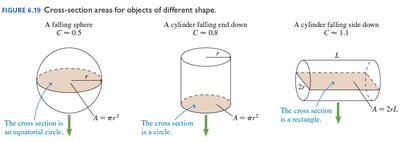
Cross-Sectional Area and Drag Coefficient
The cross-sectional area and drag coefficient depend on the object's shape and orientation.
Sphere: ,
Cylinder (end down): ,
Cylinder (side down): ,
Terminal Speed
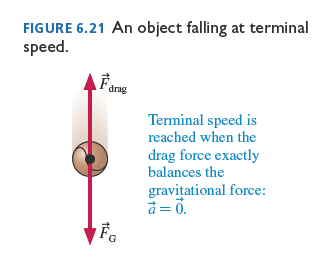
Terminal speed is reached when the drag force exactly balances the gravitational force, resulting in zero acceleration.
Terminal speed:
Summary Table: Types of Friction
Type | Formula | Coefficient | Condition |
|---|---|---|---|
Static | Object at rest | ||
Kinetic | Object sliding | ||
Rolling | Wheel rolling |
Additional info: These notes expand on the original material by providing definitions, formulas, and context for each topic, ensuring completeness and academic quality for exam preparation.
