 Back
BackDynamics II: Motion in a Plane – Centripetal Forces and Satellite Motion
Study Guide - Smart Notes
 Tailored notes based on your materials, expanded with key definitions, examples, and context.
Dynamics II: Motion in a Plane
Centripetal Forces and Circular Motion
Circular motion occurs when an object moves along a curved path, requiring a net force directed toward the center of the circle, known as the centripetal force. The analysis of centripetal forces is essential for understanding the dynamics of objects in circular motion, such as cars on curves, satellites in orbit, and amusement park rides.
Centripetal Acceleration: The acceleration directed toward the center of the circle, given by $a_c = \frac{v^2}{R}$, where v is the tangential speed and R is the radius.
Centripetal Force: The net force required to keep an object moving in a circle, $\Sigma F_c = m a_c = m \frac{v^2}{R}$.
Free-Body Diagram (FBD): Always start by drawing the FBD to identify forces acting on the object.
Key Steps: Draw FBD, write $\Sigma F_c = m a_c$, substitute $a_c$ as $\frac{v^2}{R}$, and solve for the unknown.
Example: Tension in Circular Motion
A 3 kg block tied to a 2 m string slides in a circle on a frictionless table, completing a rotation every 4 seconds. To find the tension:
Calculate tangential speed: $v_T = \frac{2\pi R}{T}$
Apply $\Sigma F_c = m \frac{v^2}{R}$ to solve for tension.
Flat and Banked Curves
Objects moving around curves experience centripetal forces. The nature of the curve (flat or banked) determines the source of this force.
Flat Curve: The force of static friction provides the centripetal force. Maximum speed before slipping is $v_{max} = \sqrt{g R \mu_s}$, where $\mu_s$ is the coefficient of static friction.
Banked Curve: On a frictionless incline, the horizontal component of the normal force provides the centripetal force. The ideal speed is $v = \sqrt{g R \tan \theta}$, where $\theta$ is the banking angle.
Example: Car on a Flat Curve
An 800 kg car drives around a flat curve of radius 50 m with $\mu_s = 0.5$. Find the maximum speed:
Use $v_{max} = \sqrt{g R \mu_s}$
Example: Racecar on a Banked Curve
An 800 kg racecar drives around a banked curve inclined at 37° with radius 200 m. Find the speed for no sliding:
Use $v = \sqrt{g R \tan \theta}$
Vertical Circular Motion
When objects move in vertical circles, gravity affects their speed and the forces acting on them. The speed is not constant, and the normal force changes depending on the position in the loop.
At the bottom: $N = m \frac{v^2}{R} + mg$
At the top: $N = m \frac{v^2}{R} - mg$
Forces toward the center are positive; away from the center are negative.
Example: Rollercoaster Loop
A 70 kg person in a rollercoaster loop of radius 10 m has speeds of 30 m/s at the bottom and 20 m/s at the top. Calculate centripetal acceleration and normal force at both positions.
Apply $a_c = \frac{v^2}{R}$ and use the formulas above for normal force.
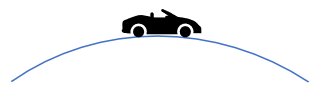
Satellite Motion and Orbits
Satellites are objects that orbit planets or stars. The shape and nature of the orbit depend on the satellite's speed and distance from the central body.
Types of Orbits: Suborbital, orbital, circular, escape.
For circular orbits, the gravitational force provides the centripetal force.
Key equations:
$F_G = \frac{G m_1 m_2}{r^2}$
$v_{sat} = \sqrt{\frac{GM}{r}}$
$r = R + h$ (orbital radius = planet radius + altitude)

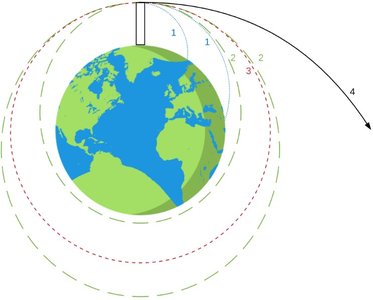
Example: Minimum, Orbital, and Escape Speeds
Given minimum speed (2000 m/s), circular orbit speed (5000 m/s), and escape speed (10,000 m/s), predict orbit shapes for various launch velocities.
Below minimum: falls back
Between minimum and orbital: elliptical orbit
At orbital: circular orbit
Above escape: leaves planet
Velocity and Period of Satellites
The velocity and period of a satellite in circular orbit are determined by the mass of the central body and the orbital radius.
Orbital Speed: $v_{sat} = \sqrt{\frac{GM}{r}}$
Orbital Period: $T = \frac{2\pi r}{v}$
Kepler's Third Law: $T^2 = \frac{4\pi^2 r^3}{GM}$
As orbital radius increases, speed decreases, period increases.
Example: International Space Station
Calculate the orbital period and speed for the ISS orbiting 400 km above Earth's surface.
Use $r = R_{Earth} + h$
Apply $v_{sat}$ and $T$ formulas.
Practice Problems and Applications
Calculate maximum speed for a truck on a curve.
Determine the force exerted by the road on a car passing over a bump.
Estimate the mass of the Sun using Earth's orbital speed and distance.
Find orbital speed and period for satellites around planets and moons.
Summary Table: Centripetal Force Equations
Situation | Equation |
|---|---|
General Circular Motion | $a_c = \frac{v^2}{R}$ |
Flat Curve | $v_{max} = \sqrt{g R \mu_s}$ |
Banked Curve | $v = \sqrt{g R \tan \theta}$ |
Satellite Orbit | $v_{sat} = \sqrt{\frac{GM}{r}}$ |
Orbital Period | $T^2 = \frac{4\pi^2 r^3}{GM}$ |

Constants: $G = 6.67 \times 10^{-11} \frac{m^3}{kg \cdot s^2}$, $M_{Earth} = 5.97 \times 10^{24} kg$, $R_{Earth} = 6.37 \times 10^6 m$
Additional info: The notes cover all major aspects of centripetal force, circular motion, and satellite dynamics, including practical applications and key equations for exam preparation.
