 Back
BackDynamics in Two Dimensions: Circular Motion and Applications
Study Guide - Smart Notes
 Tailored notes based on your materials, expanded with key definitions, examples, and context.
Dynamics in Two Dimensions
Introduction to Motion in a Plane
Motion in two dimensions extends the concepts of kinematics and dynamics from straight-line (one-dimensional) motion to more complex paths, such as circles and curves. This chapter focuses on the forces and accelerations involved in circular and curved motion, including applications like cars turning, satellites orbiting, and rollercoasters looping.
Review of Newtonian Mechanics
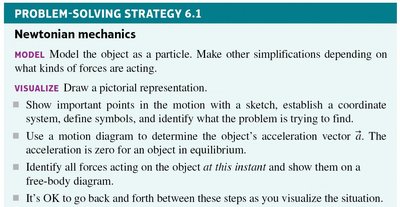
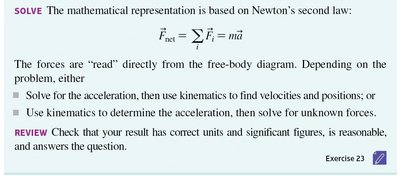
Problem-Solving Strategy: Newtonian Mechanics
To analyze motion, we use Newton's laws and a systematic approach:
Model: Treat the object as a particle and make simplifying assumptions about the forces involved.
Visualize: Draw a pictorial representation, establish a coordinate system, and identify what the problem is asking.
Solve: Apply Newton's second law, , to relate forces to acceleration. Use kinematics as needed to find velocities and positions.
Review: Check units, significant figures, and the reasonableness of your answer.
Uniform Circular Motion
Kinematics and Dynamics of Uniform Circular Motion
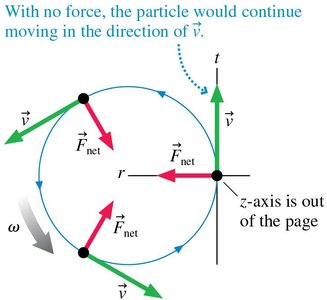
Uniform circular motion occurs when an object moves in a circle at constant speed. The velocity is always tangent to the path, while the acceleration (centripetal acceleration) points toward the center of the circle. The magnitude of the centripetal acceleration is given by:
Where is the tangential speed, is the radius, and is the angular speed.
Defining a Coordinate System for Circular Motion
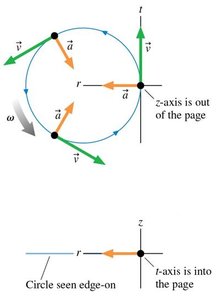
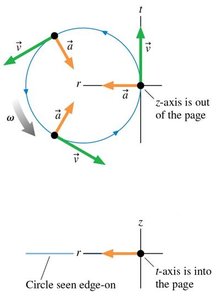
For circular motion, it is convenient to use an coordinate system:
r-axis: Radial, points from the object to the center of the circle.
t-axis: Tangential, points tangent to the path in the counterclockwise direction.
z-axis: Perpendicular to the plane of motion.
Velocity and acceleration components in this system:
, ,
, ,
Forces in Uniform Circular Motion
According to Newton's second law, a net force must act toward the center of the circle to maintain circular motion. This force is called the centripetal force:
The centripetal force is not a new type of force; it is the name for any force (or combination of forces) that points toward the center and causes circular motion (e.g., tension, gravity, friction).
Applications of Circular Motion
Banked Curves
Banked curves are designed so that the normal force from the road provides the necessary centripetal force for a car to turn, reducing reliance on friction. The optimal speed for a frictionless banked curve is:
Where is the banking angle, is the radius, and is the acceleration due to gravity.
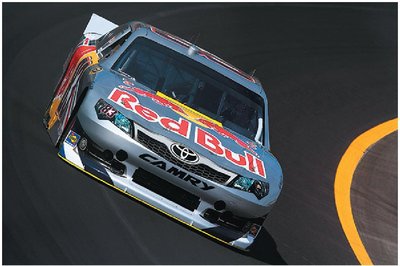
If the car's speed differs from , friction must act to prevent slipping:
If , friction acts up the incline.
If , friction acts down the incline.
Circular Orbits
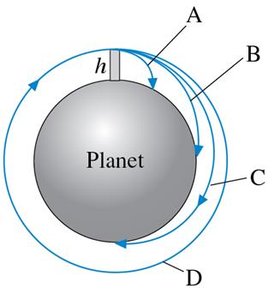
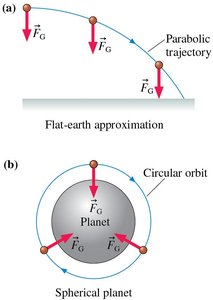
When a projectile is launched horizontally from a height, its trajectory depends on its speed. At a certain speed, the curvature of its path matches the curvature of the planet, resulting in a circular orbit:
For a circular orbit near a planet's surface:
The period of orbit:
Apparent Weight and Weightlessness
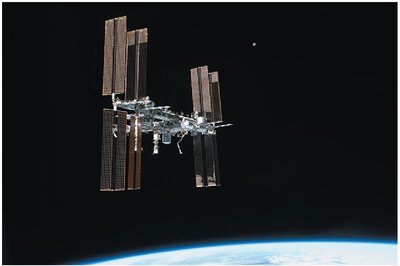
In orbit, astronauts experience weightlessness because both they and their spacecraft are in free fall, accelerating toward Earth at the same rate. Apparent weight is zero in this situation, even though gravity is still acting on them.
Centrifugal Force and Reference Frames
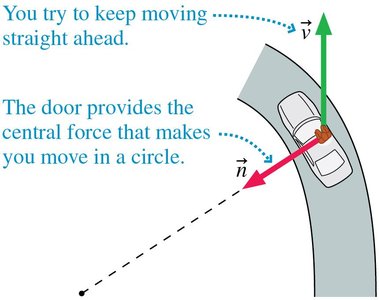
The sensation of being pushed outward in a turning car is due to inertia, not a real force. In a non-inertial (accelerating) reference frame, a fictitious centrifugal force appears to act outward, but in an inertial frame, only real forces (like the normal force from the car door) act toward the center.
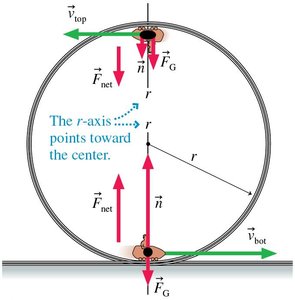
Loop-the-Loop Motion
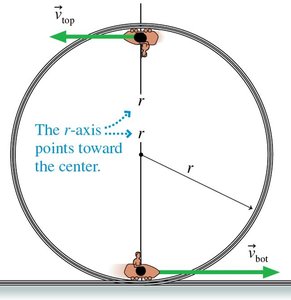
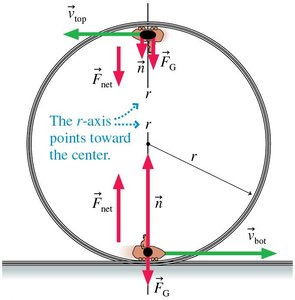
When a rollercoaster or object moves in a vertical loop, the forces at the top and bottom differ:
At the bottom: (normal force is greater than weight)
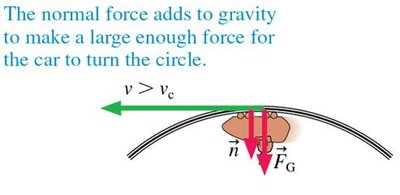
At the top: (normal force adds to gravity)
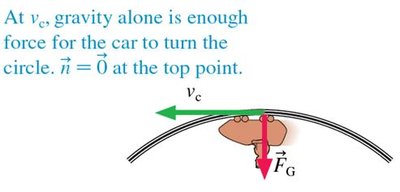
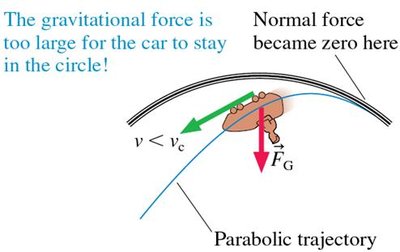
The minimum speed at the top (critical speed) for staying on the track:
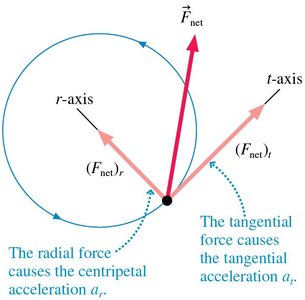
Non-uniform Circular Motion
Radial and Tangential Components
When the speed of an object in circular motion changes, there is both a radial (centripetal) and a tangential acceleration:
Radial acceleration:
Tangential acceleration:
Newton's second law applies separately to each direction:
Problem-Solving Strategy: Circular Motion
Steps for Solving Circular Motion Problems
Model: Treat the object as a particle and make simplifying assumptions.
Visualize: Draw a diagram, establish an coordinate system, and identify forces with a free-body diagram.
Solve: Apply Newton's second law in the radial and tangential directions, use kinematics as needed.
Review: Check units, significant figures, and the physical reasonableness of your answer.
Summary Table: Key Equations for Circular Motion
Quantity | Equation | Description |
|---|---|---|
Centripetal acceleration | Acceleration toward center | |
Centripetal force | Net force toward center | |
Critical speed (loop) | Minimum speed to stay on track at top | |
Orbital speed | Speed for circular orbit near surface | |
Orbital period | Time for one revolution | |
Banked curve speed | Optimal speed for frictionless banked curve |
Additional info: These notes expand on the provided slides and images by including definitions, formulas, and academic context for clarity and completeness.
