 Back
BackDynamics: Newton’s Laws of Motion – Structured Study Notes
Study Guide - Smart Notes
 Tailored notes based on your materials, expanded with key definitions, examples, and context.
Chapter 4: Dynamics – Newton’s Laws of Motion
4-1 Force
In physics, a force is defined as a push or pull that produces a change in the state of motion of an object. Forces are vector quantities, meaning they have both magnitude and direction. The SI unit of force is the newton (N), and in the British Engineering system, it is the pound (lb). Forces are essential for initiating motion, changing velocity, or altering the direction of an object.
Force: Anything that produces a change in the state of motion of an object.
Vector quantity: Has both magnitude and direction.
Units: 1 N = 0.225 lb; 1 lb = 4.45 N
4-2 Newton’s First Law of Motion (Law of Inertia)
Newton’s First Law states that an object will remain at rest or in uniform motion in a straight line unless acted upon by a net external force. This property is called inertia. The greater the mass of an object, the greater its inertia. Mass is a scalar quantity and does not change with location, while weight is a force and varies with gravitational acceleration.
Inertia: Tendency of an object to maintain its state of rest or uniform velocity.
Mass (m): Measure of inertia; SI unit is kilogram (kg).
Weight (W): Force of gravity acting on an object; W = mg.

4-3 Net Force and Equilibrium
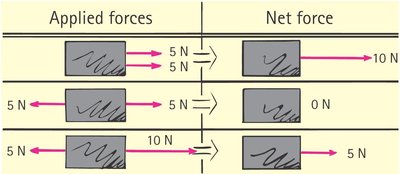
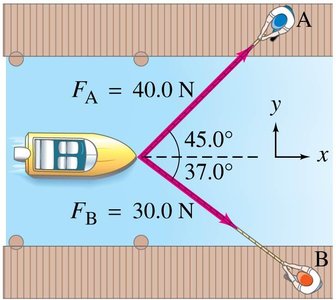
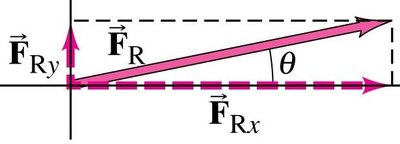
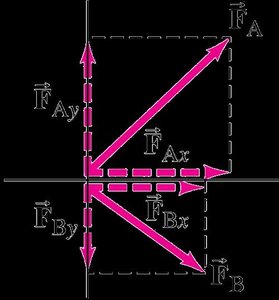
When multiple forces act on an object, the net force is the vector sum of all forces. If the net force is zero, the object is in equilibrium. There are two types of equilibrium:
Static equilibrium: Object at rest.
Dynamic equilibrium: Object moving with constant velocity.
Mathematically, equilibrium conditions are:
4-4 Newton’s Second Law of Motion
Newton’s Second Law relates the net force acting on an object to its acceleration. The law states that the acceleration of an object is directly proportional to the net force and inversely proportional to its mass:
In component form: ,
The unit of force, the newton, is defined as:
Example: If a 40.0 N force acts on an 8.0 kg box with a friction force of 24.0 N, the acceleration is:
4-5 Newton’s Third Law of Motion
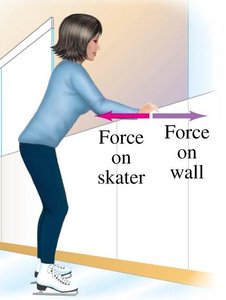
Newton’s Third Law states that for every action, there is an equal and opposite reaction. When one object exerts a force on a second object, the second object exerts an equal force in the opposite direction on the first object. These forces act on different objects and are called action-reaction pairs.
Action and reaction forces are equal in magnitude and opposite in direction.
They act on different objects, not on the same object.


Applications and Examples of Newton’s Laws
Rocket propulsion: The rocket expels gases backward (action), and the gases push the rocket forward (reaction).
Car movement: Tires push backward on the road, and the road pushes the car forward.
Collisions: In a collision, both objects experience forces of equal magnitude but may have different effects due to differing masses.
4-6 Weight and the Force of Gravity
The weight of an object is the gravitational force exerted on it by a massive body (e.g., Earth). Weight varies with location due to changes in gravitational acceleration (), but mass remains constant.
Weight on different planets depends on the value of at that location.
4-6 Normal Force
The normal force () is the support force exerted by a surface perpendicular to the object resting on it. It balances the component of weight perpendicular to the surface.

4-7 Free-Body Diagrams
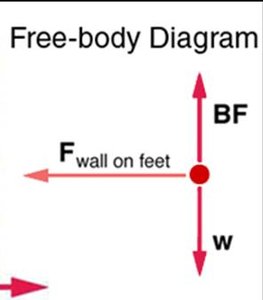
A free-body diagram is a graphical illustration used to visualize the forces acting on a single object. It helps in analyzing the net force and applying Newton’s laws to solve problems.
Draw the object as a point or simple shape.
Represent all external forces with arrows pointing away from the object.
Do not include forces the object exerts on other objects.
4-7 Tension in a Flexible Cord
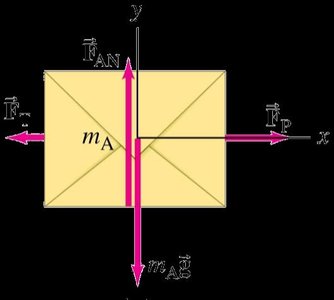
Tension is the force transmitted through a string, rope, or cable when it is pulled tight by forces acting from opposite ends. If the cord is massless, the tension is the same throughout its length.
Tension can only pull, not push.
For a massless cord:
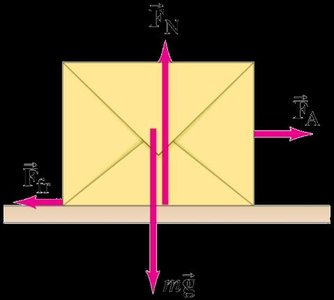
4-8 Friction
Friction is a force that opposes the relative motion or attempted motion between two surfaces in contact. There are two main types:
Static friction (): Prevents motion up to a maximum value
Kinetic friction (): Opposes motion once sliding begins,
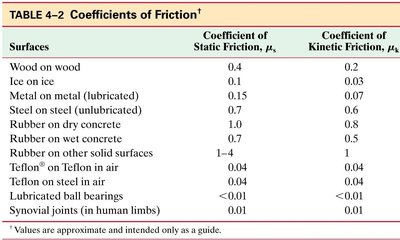
The coefficients and depend on the materials in contact.
4-8 Inclined Planes
When analyzing forces on an inclined plane, it is useful to resolve the weight into components parallel and perpendicular to the incline:
Parallel to incline:
Perpendicular to incline:
The normal force balances the perpendicular component, and friction opposes motion along the incline.
Summary Table: Coefficients of Friction
Surfaces | Coefficient of Static Friction, | Coefficient of Kinetic Friction, |
|---|---|---|
Wood on wood | 0.4 | 0.2 |
Ice on ice | 0.1 | 0.03 |
Metal on metal (lubricated) | 0.15 | 0.07 |
Steel on steel (unlubricated) | 0.7 | 0.6 |
Rubber on dry concrete | 1.0 | 0.8 |
Rubber on wet concrete | 0.7 | 0.5 |
Lubricated ball bearings | <0.01 | <0.01 |
Additional info: The above notes expand on the original slides by providing definitions, equations, and context for each law and concept, as well as including relevant images and a summary table for friction coefficients.
