 Back
BackDynamics of Motion in a Plane: Uniform and Nonuniform Circular Motion
Study Guide - Smart Notes
 Tailored notes based on your materials, expanded with key definitions, examples, and context.
Motion in a Plane
Dynamics in Two Dimensions
Motion in a plane involves analyzing objects that move under the influence of forces acting in more than one direction. This section focuses on the application of Newton's laws to such motion, including projectile motion and circular motion.
Example: Rocketing in the Wind
Scenario: A 30 kg rocket is launched vertically with a thrust of 1500 N, while a 20 N horizontal wind acts on it. The goal is to determine the rocket's trajectory and its sideways deflection after reaching a height of 1.0 km.
Model: The rocket is treated as a particle, and vertical air resistance is neglected due to its aerodynamic shape.
Key Forces: Thrust (upward), gravity (downward), and wind (horizontal).
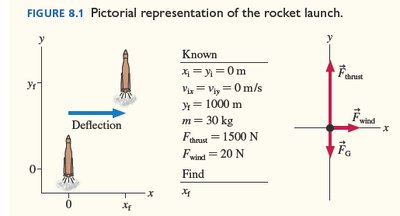
The accelerations along the x- and y-axes are given by:
Horizontal acceleration:
Vertical acceleration:
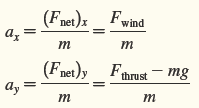
Both accelerations are constant, so kinematic equations can be used to describe the motion. The resulting trajectory is a straight line, and the sideways deflection at 1.0 km is found to be 17 m.
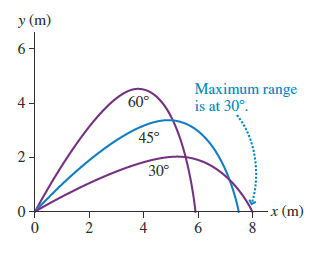
Projectile Motion
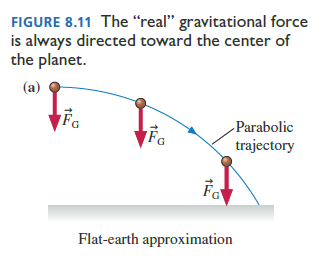
Projectile motion describes the path of an object launched into the air, subject only to gravity and possibly air resistance. The gravitational force acts downward, causing a constant vertical acceleration.
Without air resistance: The path is a parabola.
With air resistance (drag): The trajectory is altered, typically reducing range and height.
Uniform Circular Motion
Concepts and Coordinate Systems
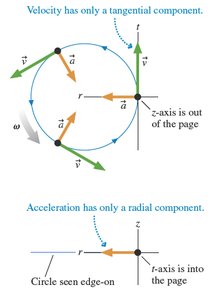
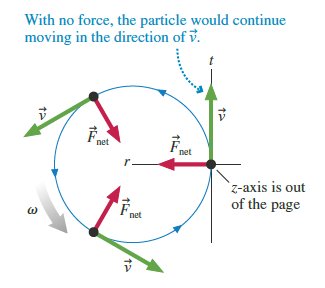
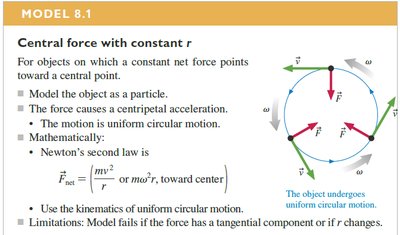
Uniform circular motion occurs when an object moves in a circle at constant speed. The velocity vector is always tangent to the circle, while the acceleration (centripetal acceleration) points toward the center.
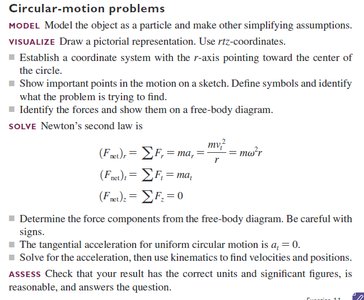
rtz-coordinate system: The r-axis points radially inward, the t-axis is tangent to the circle, and the z-axis is perpendicular to the plane of motion.
Speed: , where is the angular velocity in rad/s.
Centripetal acceleration:
Dynamics of Uniform Circular Motion
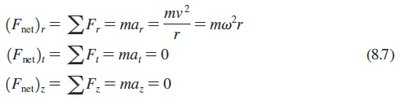
Newton's second law applies to circular motion, requiring a net force directed toward the center of the circle (centripetal force):
Radial force:
Tangential and perpendicular forces: Zero for uniform circular motion.
Example: Spinning in a Circle
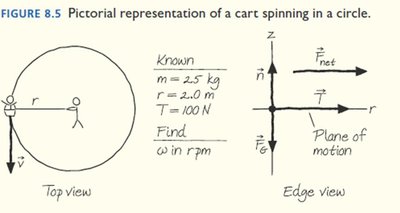
Scenario: A child and cart (total mass 25 kg) are spun in a circle of radius 2.0 m with a rope tension of 100 N. Find the angular velocity in rpm.
Key forces: Tension (radial), normal force (vertical), gravity (vertical).
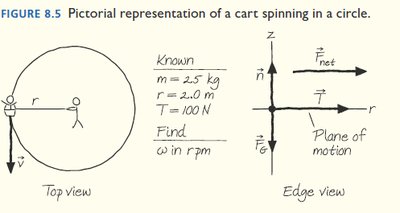
Radial equation:
Vertical equation:
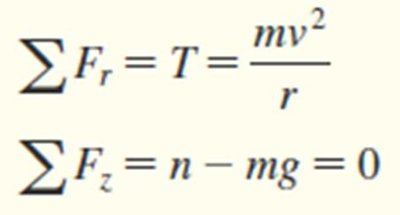
Solving for and converting to angular velocity yields the answer in rpm.
Central-Force Model
A central force is always directed toward a fixed point. Uniform circular motion is an example, where the net force is centripetal and constant in magnitude and direction (toward the center).
Turning the Corner: Friction and Banking
Unbanked Curve (Friction Only)
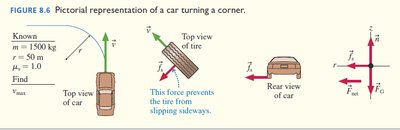
Scenario: A car turns a flat curve of radius ; static friction provides the centripetal force.
Maximum speed: , where is the coefficient of static friction.
Banked Curve (No Friction)
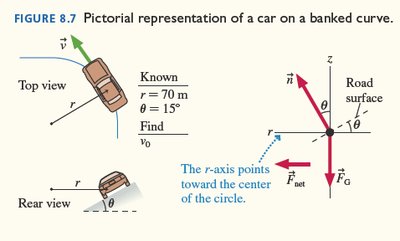
Scenario: A car turns a banked curve of radius and angle ; the normal force provides the required centripetal force.
Speed for no friction:
Nonuniform Circular Motion
When the speed of an object in circular motion changes, it experiences both radial (centripetal) and tangential accelerations. The net force has both radial and tangential components.
Radial force: Causes change in direction (centripetal acceleration).
Tangential force: Causes change in speed (tangential acceleration).
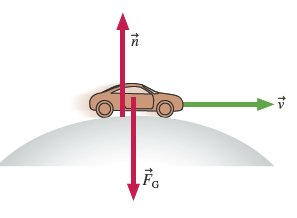
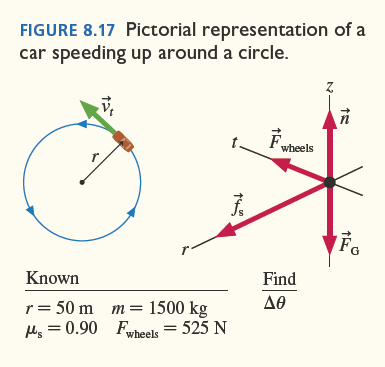
Example: Car Speeding Up Around a Circle
Scenario: A car accelerates around a circular track, with static friction providing the radial force and the drive wheels providing the tangential force.
Key equations: for maximum speed before sliding, and for tangential acceleration.
Circular Orbits
Projectile Motion and Orbits
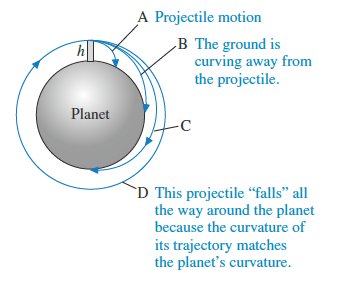
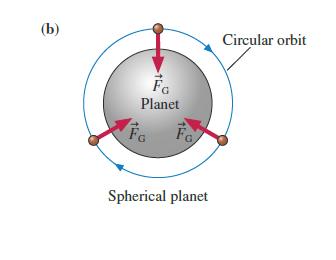
When a projectile is launched at high enough speed, it can enter a closed trajectory around a planet, known as an orbit. In this case, the gravitational force provides the exact centripetal force needed for circular motion.
Additional Topics
Gravity on a Rotating Earth
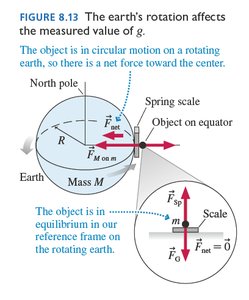
The rotation of the Earth affects the measured value of gravitational acceleration due to the centripetal acceleration required for circular motion at the equator.
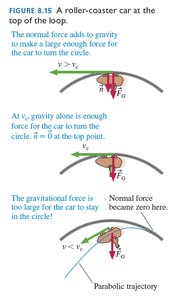
Vertical Circular Motion: Loop-the-Loop
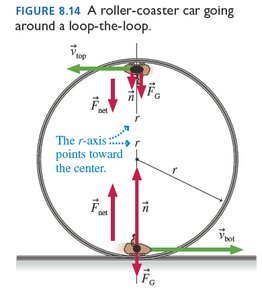
In vertical circular motion, such as a roller-coaster loop, the normal force and gravity combine to provide the required centripetal force. The minimum speed at the top of the loop (critical speed) ensures the car stays on the track.
Summary Table: Key Equations for Circular Motion
Quantity | Uniform Circular Motion | Nonuniform Circular Motion |
|---|---|---|
Radial Acceleration | ||
Tangential Acceleration | ||
Net Radial Force | ||
Net Tangential Force |
Additional info: This summary includes expanded academic context and examples to ensure the notes are self-contained and suitable for exam preparation.
