 Back
BackDynamics of Rotational Motion: Chapter 10 Study Notes
Study Guide - Smart Notes
 Tailored notes based on your materials, expanded with key definitions, examples, and context.
Dynamics of Rotational Motion
Angular Position, Velocity, and Acceleration
Rotational motion is described using angular position, angular velocity, and angular acceleration, analogous to linear motion. These quantities are fundamental for understanding the dynamics of objects rotating about a fixed axis.
Angular Position (\theta): The orientation of a line with respect to a reference axis, measured in radians or degrees.
Angular Displacement (\Delta\theta): The change in angular position.
Angular Velocity (\omega): The rate of change of angular position, measured in rad/s. \( \omega = \frac{\Delta\theta}{\Delta t} \)
Angular Acceleration (\alpha): The rate of change of angular velocity, measured in rad/s2. \( \alpha = \frac{\Delta\omega}{\Delta t} \)
Equations of motion for constant angular acceleration:
\( \omega = \omega_0 + \alpha t \)
\( \theta = \theta_0 + \omega_0 t + \frac{1}{2} \alpha t^2 \)
\( \omega^2 = \omega_0^2 + 2\alpha (\theta - \theta_0) \)
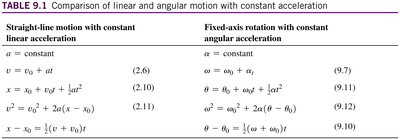
Additional info: These equations mirror those for linear motion, facilitating the transition between translational and rotational dynamics.
Linear vs. Angular Quantities
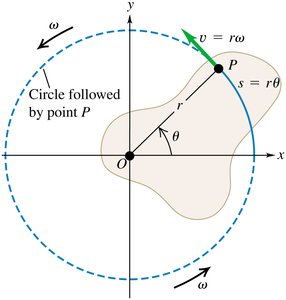
Rotational motion has direct analogs to linear motion, allowing for comparison and conversion between the two types of motion.
Linear velocity (v): \( v = r\omega \)
Linear acceleration (a): \( a = r\alpha \)
Moment of Inertia
The moment of inertia quantifies an object's resistance to changes in rotational motion, analogous to mass in linear motion. It depends on the mass distribution relative to the axis of rotation.
Definition: \( I = \sum m_i r_i^2 \) for discrete masses, or \( I = \int r^2 dm \) for continuous objects.
Common shapes: Each shape has a characteristic moment of inertia formula.
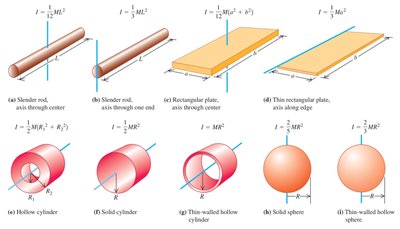
Example: A solid cylinder of mass M and radius R has \( I = \frac{1}{2}MR^2 \).
Kinetic Energy in Rotational Motion
The kinetic energy of a rotating rigid body is given by:
\( K = \frac{1}{2} I \omega^2 \)
For combined rotation and translation: \( K = \frac{1}{2} I \omega^2 + \frac{1}{2} m v_{CM}^2 \)
Torque
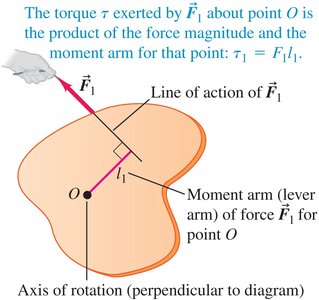
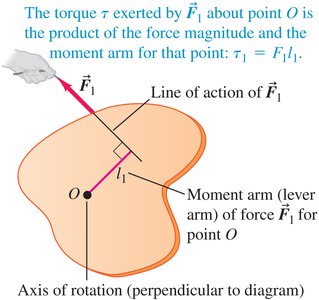
Torque is the rotational analog of force, measuring the tendency of a force to cause rotation about an axis.
Definition: \( \tau = F \ell \), where \( \ell \) is the moment arm (perpendicular distance from axis to line of action).
Units: Newton-meter (N·m).
Sign convention: Counterclockwise torques are positive; clockwise are negative.
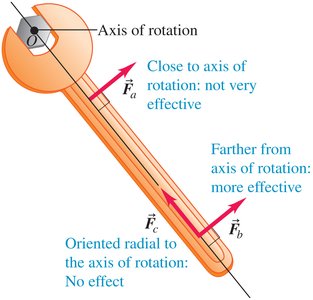
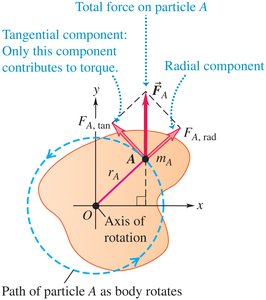
Torque in terms of tangential force: \( \tau = r F_{tan} \)
Torque and Angular Acceleration
Newton's second law for rotation relates net torque to angular acceleration:
\( \sum \tau = I \alpha \)
Both torque and moment of inertia depend on the axis of rotation.
Correct signs must be used when summing torques.
Examples and Applications
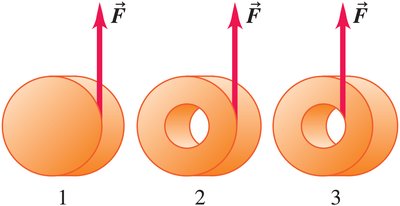
Rotational dynamics are applied in various scenarios, such as calculating the torque applied by a force at a distance, or determining angular acceleration for different mass distributions.
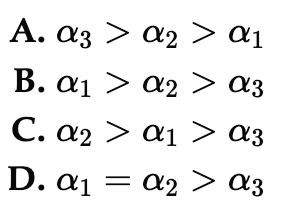
Example: Ranking angular accelerations for cylinders with different mass distributions.
Work and Power in Rotational Motion
Work done by a torque and the power associated with rotational motion are analogous to their linear counterparts.
Work: \( W = \tau \Delta\theta \)
Power: \( P = \tau \omega \)
Angular Momentum
Angular momentum is the rotational analog of linear momentum, defined as:
\( L = I \omega \)
Units: kg·m2/s
Angular momentum is a vector quantity.
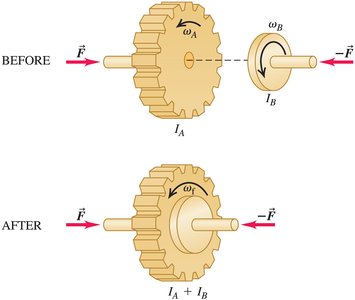
Conservation of Angular Momentum
When the net external torque on a system is zero, angular momentum is conserved. This principle applies from atomic scales to galaxies.
\( L_i = L_f \)
\( I_i \omega_i = I_f \omega_f \)
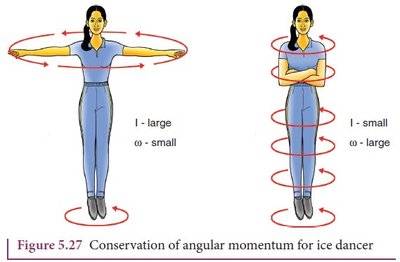
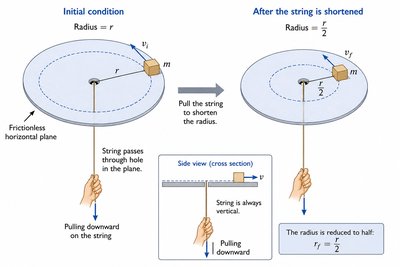
Example: When a skater pulls in their arms, their moment of inertia decreases and angular velocity increases to conserve angular momentum.
Equilibrium of a Rigid Body
For a rigid body to be in equilibrium, both the net force and net torque must be zero.
First Condition: \( \sum F = 0 \)
Second Condition: \( \sum \tau = 0 \)
Vector Nature of Angular Quantities
Angular velocity, angular acceleration, torque, and angular momentum are all vector quantities. Their direction is determined by the right-hand rule.
Right-Hand Rule: Curl fingers in direction of rotation; thumb points in direction of angular vector.
Practice Problems and Applications
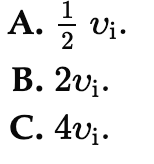
Rotational dynamics are applied in real-world scenarios such as winches, yo-yos, bowling balls, and kinetic sculptures. These examples illustrate the use of torque, angular acceleration, and conservation laws in practical situations.
Summary Table: Linear vs. Rotational Motion
Linear Motion | Rotational Motion |
|---|---|
Displacement: x | Angular Displacement: \theta |
Velocity: v | Angular Velocity: \omega |
Acceleration: a | Angular Acceleration: \alpha |
Force: F | Torque: \tau |
Mass: m | Moment of Inertia: I |
Linear Momentum: p = mv | Angular Momentum: L = I\omega |
