 Back
BackDynamics of Rotational Motion: Conservation, Equilibrium, and Applications
Study Guide - Smart Notes
 Tailored notes based on your materials, expanded with key definitions, examples, and context.
Dynamics of Rotational Motion
Introduction to Rotational Dynamics
Rotational dynamics extends Newtonian mechanics to objects that rotate about an axis. It involves the study of torque, angular momentum, and the conditions for rotational equilibrium. These principles are essential for understanding the motion of rigid bodies and their response to applied forces and torques.
Torque and Rotational Motion
Definition of Torque
Torque (\( \tau \)) is the rotational equivalent of force. It measures the tendency of a force to rotate an object about an axis.
Mathematically, torque is defined as:
where r is the distance from the axis of rotation to the point of force application, F is the magnitude of the force, and \theta is the angle between r and F.
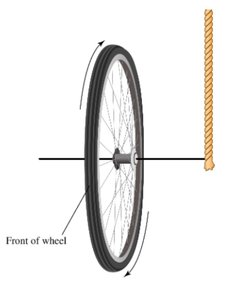
The direction of torque is given by the right-hand rule.
Dynamic Equation of Rotational Motion
The rotational analog of Newton's second law is:
where I is the moment of inertia and \alpha is the angular acceleration.
Work and Power in Rotational Motion
Work done by a torque:
Power delivered by a torque:
Angular Momentum
Definition and Properties
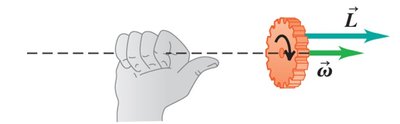
Angular momentum (\( L \)) for a rotating rigid body is:
where \omega is the angular velocity.
Angular momentum is a vector quantity, with direction given by the right-hand rule.
Conservation of Angular Momentum
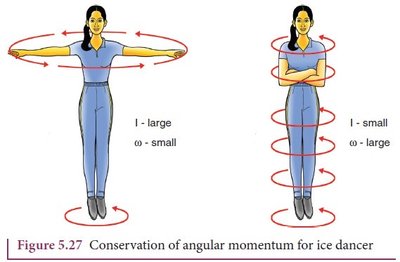
When the net external torque on a system is zero, the total angular momentum is conserved:
This principle applies from atomic to astronomical scales.
Example: Mass on a String
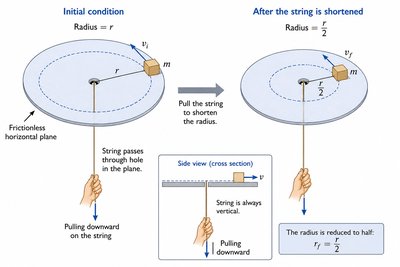
A block slides in a circular path on a frictionless plane, attached to a string passing through a hole. When the string is pulled and the radius is halved, the speed of the block changes according to conservation of angular momentum:
Thus, when .
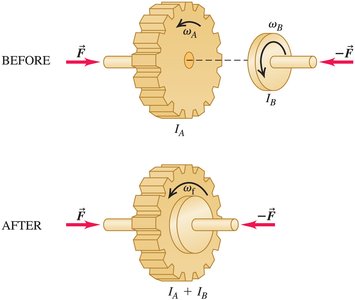
Example: Two Rotating Disks Interacting
When two disks with moments of inertia and and angular velocities and are brought together without external torque, their final angular velocity is:
Equilibrium of a Rigid Body
Conditions for Equilibrium
For a rigid body to be in equilibrium, two conditions must be satisfied:
First Condition: The vector sum of all external forces is zero:
Second Condition: The sum of all external torques is zero (about any axis):
Both conditions must be met for true equilibrium.
Torque Due to Gravitational Force
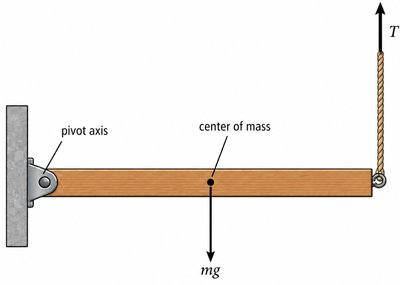
The weight of a rigid body can be considered as acting at its center of mass for torque calculations.
Example: Playing on a Seesaw
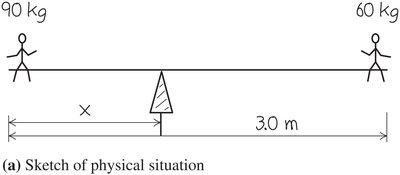
To balance a seesaw, the torques produced by the weights of the two people about the pivot must be equal and opposite:
Example: Climbing a Medieval Ladder
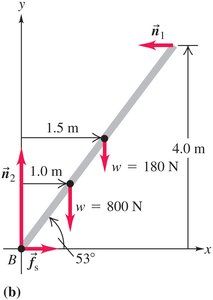
A ladder in equilibrium against a frictionless wall requires analysis of both forces and torques. The normal and friction forces at the base, and the minimum coefficient of static friction, can be found using equilibrium equations.
Vector Nature of Angular Quantities
Angular Velocity, Acceleration, Torque, and Momentum
All angular quantities are vectors, with directions determined by the right-hand rule.
For example, angular velocity and angular momentum point along the axis of rotation.
Gyroscopic Motion and Precession
Gyroscope and Precession
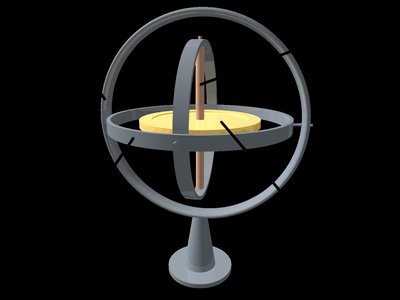
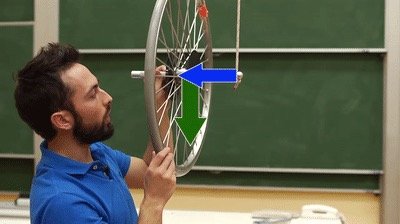
A gyroscope demonstrates conservation of angular momentum and the phenomenon of precession when an external torque is applied.
Precession is the slow, conical motion of the rotation axis of a spinning object under an external torque.
Precession Angular Velocity
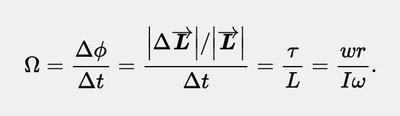
The angular velocity of precession is given by:
Applications and Example Problems
Dynamics of a Bucket in a Well
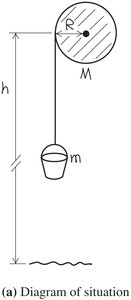
When a bucket is lowered by a rotating cylinder, both the linear acceleration of the bucket and the angular acceleration of the cylinder must be considered. The equations of motion are coupled by the string tension.
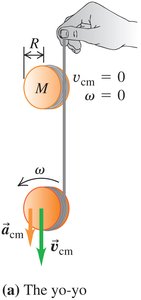
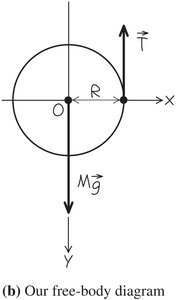
Dynamics of a Primitive Yo-Yo
The acceleration of a yo-yo and the tension in the string are found by applying Newton's second law for both translation and rotation:
Translational:
Rotational:
With for rolling without slipping.
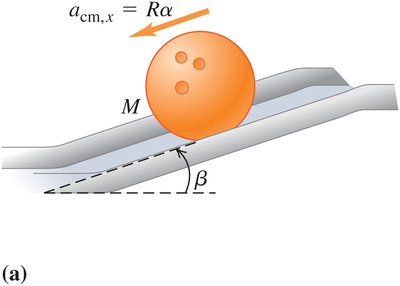
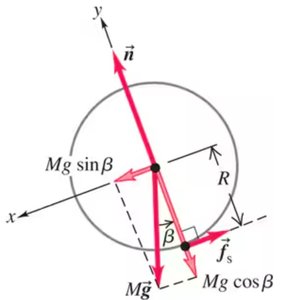
Rolling Motion: Bowling Ball Example
A bowling ball rolling down an incline without slipping involves both rotational and translational motion. The acceleration and friction force can be found using energy or force analysis, considering the moment of inertia of a solid sphere.
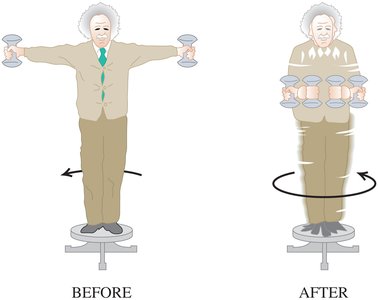
Angular Momentum Conservation: Rotating Professor
When a rotating person pulls their arms in, their moment of inertia decreases and angular velocity increases to conserve angular momentum. The change in kinetic energy can be compared before and after the arms are pulled in.
Summary Table: Key Equations in Rotational Dynamics
Quantity | Equation | Description |
|---|---|---|
Torque | Rotational effect of a force | |
Rotational Newton's 2nd Law | Sum of torques equals moment of inertia times angular acceleration | |
Angular Momentum | Product of moment of inertia and angular velocity | |
Conservation of Angular Momentum | No external torque | |
Work by Torque | Work done by a constant torque | |
Power by Torque | Power delivered by a torque | |
Precession Angular Velocity | Precession rate under torque |
