 Back
BackDynamics of Rotational Motion: Torque, Angular Acceleration, and Conservation Laws
Study Guide - Smart Notes
 Tailored notes based on your materials, expanded with key definitions, examples, and context.
Dynamics of Rotational Motion
Torque and Its Effects
Torque is the rotational analog of force and is responsible for causing changes in rotational motion. It depends on both the magnitude of the force applied and the distance from the axis of rotation (moment arm).
Definition: Torque (\( \tau \)) is defined as the product of the force (\( F \)) and the perpendicular distance (\( r \)) from the axis of rotation to the line of action of the force.
Formula:
Direction: Torque is positive for counterclockwise rotation and negative for clockwise rotation.
Net Torque: The net torque is the sum of all individual torques acting on a body.
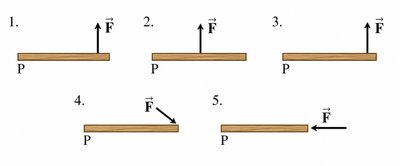
Example: The torque is greatest when the force is applied farthest from the pivot and perpendicular to the rod (case 3 in the image above).
Torque and Angular Acceleration
Newton's second law for rotation relates the net torque acting on a rigid body to its angular acceleration (\( \alpha \)) and moment of inertia (\( I \)).
Formula:
Moment of Inertia (\( I \)): A measure of an object's resistance to changes in its rotational motion, depending on mass distribution relative to the axis.
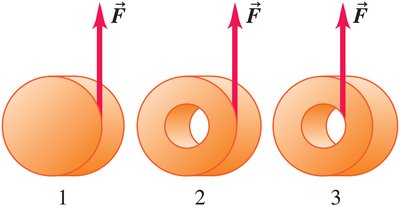
Example: Comparing angular accelerations for solid and hollow cylinders, the one with the smallest moment of inertia (solid cylinder) will have the largest angular acceleration for the same applied torque.
Applications: Rotational Dynamics Problems
Many practical systems involve the application of torque and the resulting angular acceleration. Examples include winches, yo-yos, and rolling objects.
Winch Example: A force pulls a cable wrapped around a cylinder, causing it to rotate and accelerate.
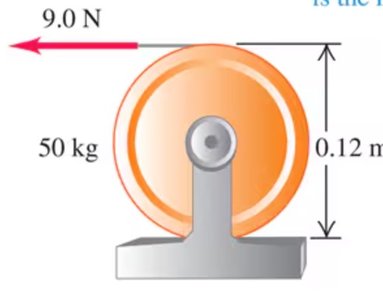
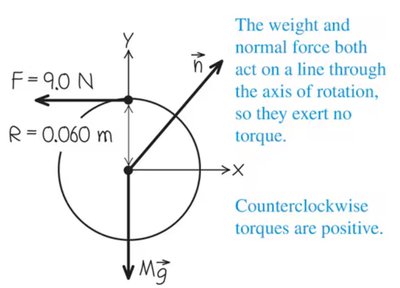
Free-Body Diagram: Analyzing forces and torques helps determine the acceleration of the system.
Bucket and Well Example: A bucket attached to a rotating cylinder demonstrates the interplay between linear and rotational motion.
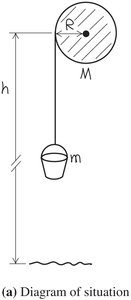
Yo-Yo Example: The acceleration and tension in the string are found using rotational dynamics, not just energy conservation.
Rolling Motion and Friction
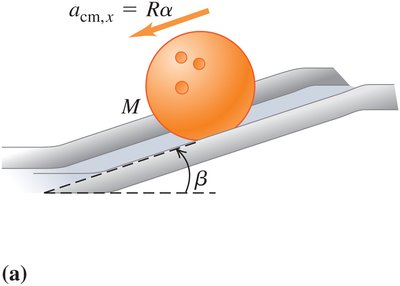
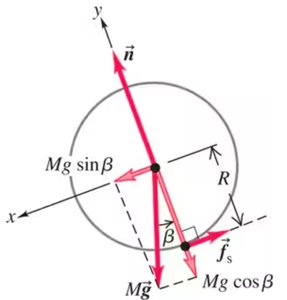
When a rigid body rolls without slipping, both translational and rotational motions are present. The acceleration and friction force can be determined using Newton's laws for rotation and translation.
Example: A bowling ball rolling down an incline experiences both gravitational and frictional forces.
Work and Power in Rotational Motion
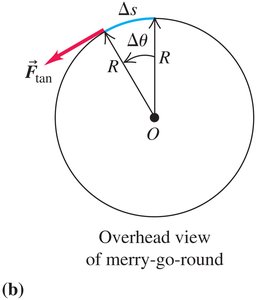
Work Done by a Constant Torque
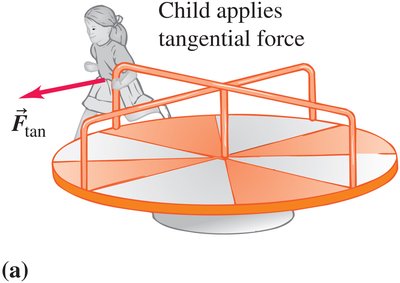
When a constant torque acts on a rotating body, it does work analogous to the work done by a force in linear motion.
Formula:
\( \tau \) is in newton-meters (N·m), \( \Delta \theta \) is in radians, and work is in joules (J).
This is the rotational analog of \( W = F_{\parallel} d \) for linear motion.
Power Delivered by a Torque
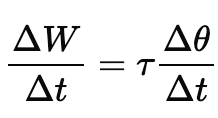
The power associated with a torque is the rate at which work is done by the torque as the body rotates.
Formula:
Where \( \omega \) is the angular velocity in radians per second.
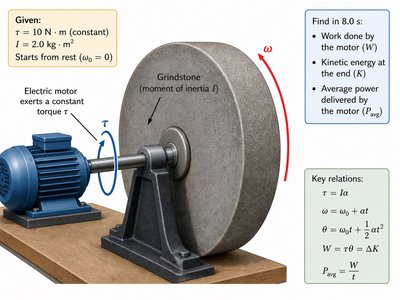
Example: Electric Motor and Grindstone
An electric motor applies a constant torque to a grindstone, causing it to accelerate from rest. The work done, kinetic energy, and average power can be calculated using the above formulas.
Angular Momentum
Definition and Properties
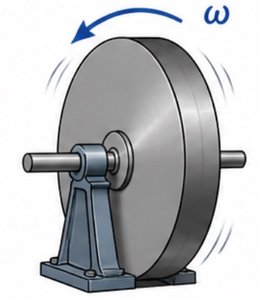
Angular momentum is the rotational analog of linear momentum and is a measure of the quantity of rotation of a body.
Formula:
Units: kg·m2/s
Angular momentum is a vector quantity; its direction is determined by the right-hand rule.
Positive for counterclockwise, negative for clockwise rotation.
Dynamics of Rotation Using Angular Momentum
The time rate of change of angular momentum of a body is equal to the net external torque acting on it.
Formula:
If \( \sum \tau = 0 \), angular momentum is conserved.
Example: Rotating Sculpture
A mobile sculpture with two spheres and a rod rotates about its midpoint. The angular momentum and kinetic energy can be calculated using the moment of inertia and angular velocity.
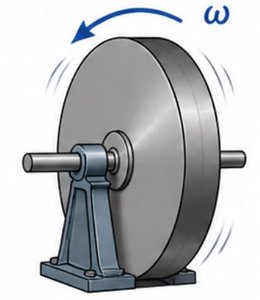
Conservation of Angular Momentum
Principle and Applications
When the net external torque on a system is zero, the total angular momentum remains constant. This principle applies from atomic to astronomical scales.
Formula:
Changing the moment of inertia (e.g., by changing body position) results in a change in angular velocity to conserve angular momentum.
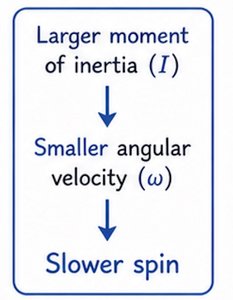
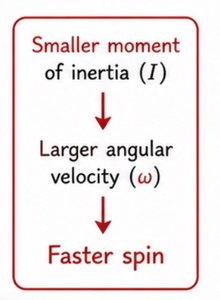
Example: A figure skater spins faster when pulling in her arms, reducing her moment of inertia and increasing angular velocity to conserve angular momentum.
Additional info: These notes cover the core concepts of rotational dynamics, including torque, angular acceleration, work, power, angular momentum, and their conservation, with practical examples and diagrams to reinforce understanding.
