 Back
BackElectric and Magnetic Fields: Charged Particle Motion and Calculations
Study Guide - Smart Notes
 Tailored notes based on your materials, expanded with key definitions, examples, and context.
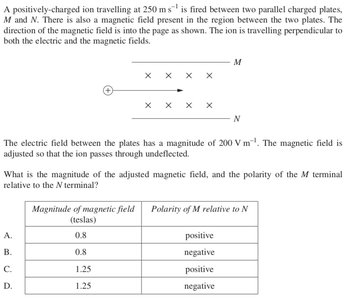
Q1. A positively-charged ion travelling at 250 m s-1 is fired between two parallel charged plates, M and N. There is also a magnetic field present in the region between the two plates. The direction of the magnetic field is into the page as shown. The ion is travelling perpendicular to both the electric and the magnetic fields. The electric field between the plates has a magnitude of 200 V m-1. The magnetic field is adjusted so that the ion passes through undeflected. What is the magnitude of the adjusted magnetic field, and the polarity of the M terminal relative to the N terminal?
Background
Topic: Motion of charged particles in electric and magnetic fields
This question tests your understanding of how electric and magnetic fields can be balanced so that a charged particle moves in a straight line, and how to determine the polarity of the plates.
Key Terms and Formulas
Electric force: $F_E = qE$
Magnetic force: $F_B = qvB$
For no deflection: $F_E = F_B$
Polarity: Which plate is at higher potential depends on the direction of the electric field and the charge of the ion.
Step-by-Step Guidance
Identify the forces acting on the ion: The electric force ($F_E$) and the magnetic force ($F_B$) are acting in opposite directions.
Set the forces equal for no deflection: $qE = qvB$
Cancel $q$ and rearrange to solve for $B$: $B = \frac{E}{v}$
Substitute the given values: $E = 200\ \text{V m}^{-1}$, $v = 250\ \text{m s}^{-1}$
Try solving on your own before revealing the answer!
Final Answer: 0.8 T, M is positive relative to N
$B = \frac{200}{250} = 0.8\ \text{T}$
The electric field points from M to N, so M is positive relative to N for a positively charged ion to be balanced by the magnetic force.
