 Back
BackElectric Charge and Coulomb’s Law: Foundations of Electrostatics
Study Guide - Smart Notes
 Tailored notes based on your materials, expanded with key definitions, examples, and context.
Electric Charge and Its Properties
Fundamental Nature of Electric Charge
All ordinary matter is composed of atoms, which in turn are made of protons, neutrons, and electrons. Of these, protons and electrons possess a property called electric charge. This property is responsible for electromagnetic interactions, which underlie most non-gravitational phenomena in daily life.
Proton: Carries a positive charge, +e.
Electron: Carries a negative charge, −e.
Neutron: Electrically neutral (no charge).
Magnitude of elementary charge: (coulombs).
Charge is quantized: All observable charges are integer multiples of the elementary charge, . Fractional charges do not occur for isolated particles.
Example: An object may have charge , , etc., but never .
Exception (advanced): In the fractional quantum Hall effect, collective excitations called quasiparticles can behave as if they carry fractional charge (e.g., ), but these are not fundamental particles.
Conservation of Charge
Electric charge is conserved in all physical processes, including chemical and nuclear reactions. Charge can be transferred but not created or destroyed.
This conservation law is linked to a fundamental symmetry of nature called gauge invariance (Noether’s theorem).
Coulomb’s Law: The Force Between Charges
Statement of Coulomb’s Law
The force between two point charges and separated by a distance is given by:
is Coulomb’s constant.
is a unit vector pointing from charge 1 to charge 2.
The force is repulsive if (like charges), and attractive if (opposite charges).
Newton’s Third Law: The force exerted by charge 1 on charge 2 is equal in magnitude and opposite in direction to the force exerted by charge 2 on charge 1:
Superposition Principle
When more than two charges are present, the total force on any given charge is the vector sum of the forces from all other charges:
Each pairwise interaction is independent of the others.
Example: Forces from Multiple Charges
Consider a blue charge acted upon by a red charge (repulsive) and a yellow charge (attractive). The net force is the vector sum of the individual forces:
Force from red charge (): Repulsive, points away from red charge.
Force from yellow charge (): Attractive, points toward yellow charge.
Net force (): Vector sum of the above.
Force Between a Charge and a Dipole
When a charge interacts with a pair of equal and opposite charges (a dipole), the net force depends on the distances involved. If the red and yellow charges are closer together than to the blue charge, the force from the nearer charge dominates.
Let be the distance from the red charge to the blue charge, and from the yellow charge to the blue charge.
By Coulomb’s law, and .
If , then , so the net force points toward the red and yellow charges.
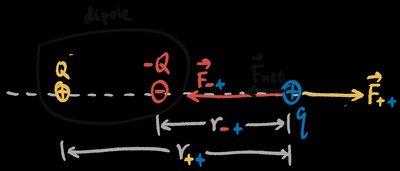
Additional info: A dipole, though neutral overall, can exert forces on nearby charges due to the separation of positive and negative charges. This concept is foundational for understanding molecular interactions and electric fields.
Comparison: Gravitational vs. Electrostatic Forces
Relative Strengths
The gravitational force between an electron and a proton in a hydrogen atom is:
The electrostatic (Coulomb) force is:
The ratio of the two forces is:
Numerically, this ratio is approximately , meaning the electric force is vastly stronger than gravity at the atomic scale.
Despite this, most objects are electrically neutral, so we do not experience large electrical forces in daily life.
Neutrality is maintained because any charge imbalance would create enormous forces, quickly restoring balance.
Charging and Polarization
Charging by Friction and Polarization Effects
When a plastic rod is rubbed with fur, it can attract small pieces of paper. This is due to the transfer of electrons (charging by friction), resulting in a net charge on the rod. The charged rod induces a redistribution of charges in the paper (polarization), causing an attractive force.
Conductor vs. Insulator: A metal rod (conductor) does not attract paper in the same way because charges can move freely and neutralize the effect.
Environmental factors: Humidity (e.g., before rain) can make it harder to observe these effects, as moisture allows charges to dissipate more easily.
Key Questions:
How does the rod get charged? (By friction, transferring electrons.)
What happens in the paper? (Polarization—charges rearrange within the insulator.)
Why is the net force attractive? (Induced dipoles in the paper are attracted to the charged rod.)
