 Back
BackLec 1
Study Guide - Smart Notes
 Tailored notes based on your materials, expanded with key definitions, examples, and context.
Electric Charge and Coulomb’s Law
The Origin of Electricity
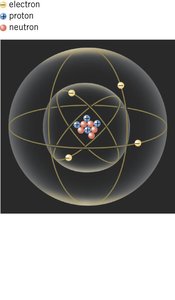
Electricity arises from the fundamental structure of atoms, which are composed of protons, neutrons, and electrons. The electrical nature of matter is due to the presence of charged particles within the atom. Protons carry a positive charge, electrons carry a negative charge, and neutrons are electrically neutral.
Proton mass: kg
Neutron mass: kg
Electron mass: kg
Elementary charge: C (Coulomb)
Atoms are electrically neutral when they contain equal numbers of protons and electrons.
Quantization of Charge
Charge is quantized, meaning it exists in discrete amounts. The smallest non-zero charge is the elementary charge, . The net charge of an object is given by:
where is the number of electrons added or removed.
Example: One coulomb of negative charge contains electrons.
Transferring Electric Charge
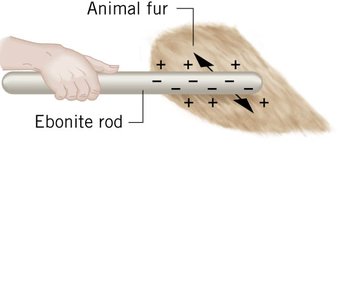
Electric charge can be transferred between objects, typically by moving electrons. The object losing electrons becomes positively charged, while the object gaining electrons becomes negatively charged.
Law of Conservation of Electric Charge: The net electric charge of an isolated system remains constant during any process.
Like charges repel, unlike charges attract.
Conductors, Insulators, and Semiconductors
Materials differ in their ability to conduct electric charge:
Conductors: Substances that readily conduct electric charge (e.g., metals like copper, aluminum, gold).
Insulators: Materials that conduct electric charge poorly (e.g., glass, plastics, rubber).
Semiconductors: Materials with intermediate conductivity (e.g., silicon, germanium, gallium-arsenide).
Charging by Contact and Induction
Objects can be charged by direct contact or by induction:
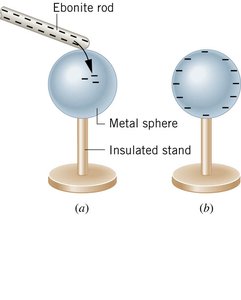
Charging by Contact: When a charged object touches another, electrons are transferred, resulting in both objects having similar charges.
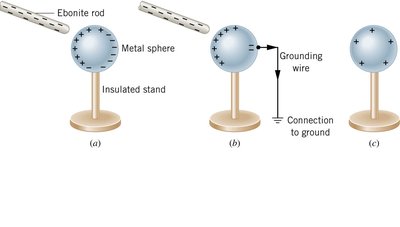
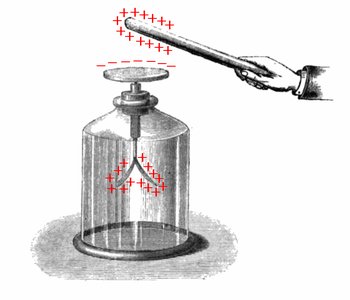
Charging by Induction: A charged object brought near a neutral object causes redistribution of charges within the neutral object, without direct contact. Grounding allows electrons to flow to or from the earth, stabilizing the charge.
Detection of Electric Charge: The Gold-Leaf Electroscope
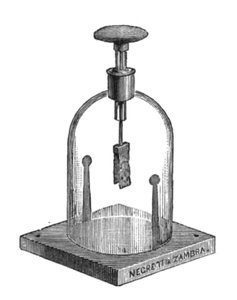
The gold-leaf electroscope is an early device used to detect electric charge. When a net charge is present, the gold leaves repel each other due to like charges.
Polarization of Molecules
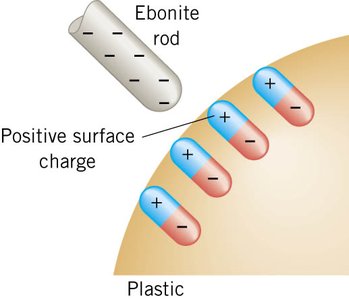
When a charged object is brought near a neutral insulator, it can polarize the molecules, causing a slight positive surface charge on the insulator.
Coulomb’s Law
Coulomb’s Law describes the electrostatic force between two point charges. The force is directly proportional to the product of the charges and inversely proportional to the square of the distance between them:
N·m/C (Coulomb constant)
C/N·m (permittivity of free space)
Analogous to Newton’s law of gravitation:
Application: Bohr Model of the Hydrogen Atom
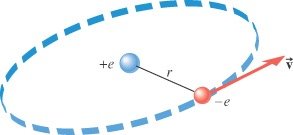
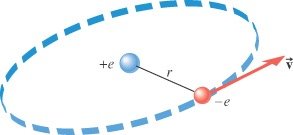
In the Bohr model, the electron orbits the proton at a fixed radius. The electrostatic force provides the centripetal force for circular motion:
For m, kg, C
Speed of electron:
Example: Three Charges on a Line
To find the net force on a charge due to other charges aligned on a line, calculate the individual forces using Coulomb’s Law and sum them vectorially.
Forces: and
Net force:
Example: Three Charges in Two Dimensions
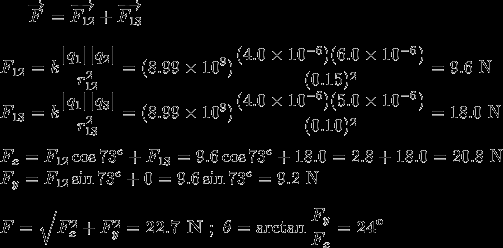
When charges are arranged in two dimensions, the net force is found by vector addition of the individual forces. The direction is determined using trigonometry.
Summary Table: Properties of Materials
Type | Conductivity | Examples |
|---|---|---|
Conductor | High | Copper, Aluminum, Gold |
Insulator | Low | Glass, Plastic, Rubber |
Semiconductor | Intermediate | Silicon, Germanium |
Key Equations
Additional info:
All examples and calculations are based on standard physics principles and typical introductory physics course content.
