 Back
BackElectric Charge and Electric Field: Core Concepts and Applications
Study Guide - Smart Notes
 Tailored notes based on your materials, expanded with key definitions, examples, and context.
Electric Charge and Electric Field
Introduction to Electrostatics
Electrostatics is the study of electric charges at rest and the forces and fields they produce. Everyday phenomena such as static electricity, lightning, and the behavior of charged objects are governed by electrostatic principles.
Static electricity can be observed when scuffing shoes on a carpet or combing hair, resulting in sparks or attraction/repulsion of objects.
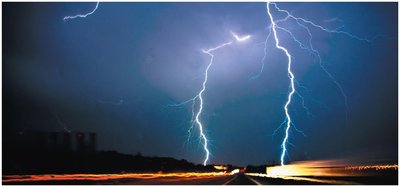
Lightning is a large-scale example of electrostatic discharge in nature.

Nature of Electric Charge
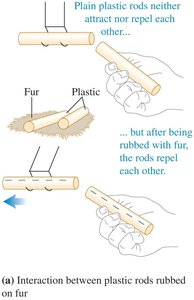
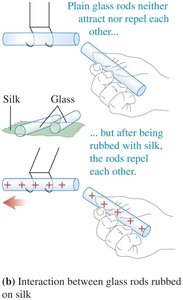
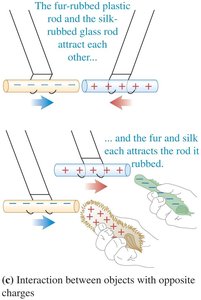
Electric charge is a fundamental property of matter, existing in two types: positive and negative. Experiments with rods and fur or silk demonstrate the transfer and interaction of charges.
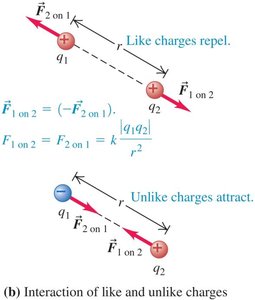
Like charges repel; unlike charges attract.
Objects can be charged by friction, conduction, or induction.
The Physical Basis of Electric Charge
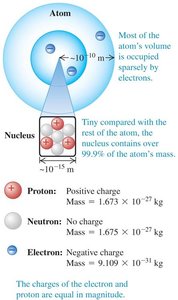
Atoms consist of a nucleus (protons and neutrons) surrounded by electrons. Protons carry positive charge, electrons negative, and neutrons are neutral. The balance of protons and electrons determines the net charge of an atom.
Proton: Positive charge, mass kg
Neutron: No charge, mass kg
Electron: Negative charge, mass kg
Neutral and Charged Atoms
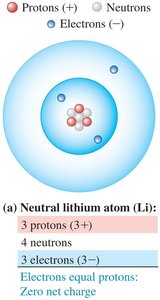
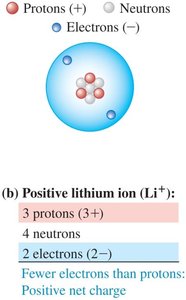
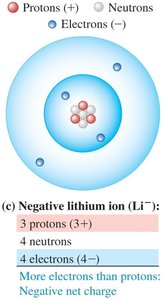
An atom is electrically neutral when it contains equal numbers of protons and electrons. If electrons are added or removed, the atom becomes an ion and acquires a net charge.
Neutral atom: Equal protons and electrons, net charge zero.
Positive ion (cation): Fewer electrons than protons.
Negative ion (anion): More electrons than protons.
Conductors and Insulators
Materials are classified based on their ability to allow electric charge to move freely:
Conductors: Allow free movement of charge (e.g., metals).
Insulators: Do not allow free movement of charge (e.g., rubber, glass).
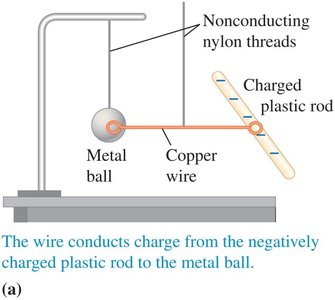
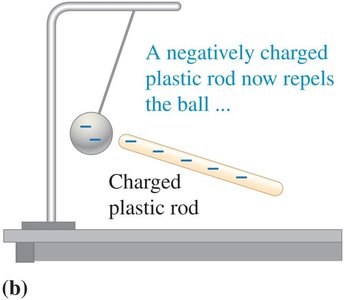
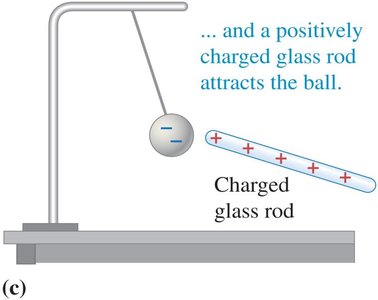
Charging by Induction
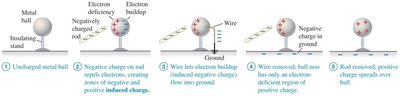
Induction is a method of charging an object without direct contact. A charged object brought near a conductor causes redistribution of charges, and grounding allows one type of charge to leave, leaving the object with a net charge.
Bring a charged rod near a neutral conductor.
Connect the conductor to ground to allow charge flow.
Remove the ground and then the rod; the conductor is left with a net charge.
Conservation and Quantization of Charge
Electric charge is both conserved and quantized:
Conservation: The total charge in a closed system remains constant; charge cannot be created or destroyed.
Quantization: Charge exists in discrete units, integer multiples of the elementary charge C.
Formula for quantization:
Example: If a plastic block has a net charge of , the number of excess electrons is .
Coulomb’s Law
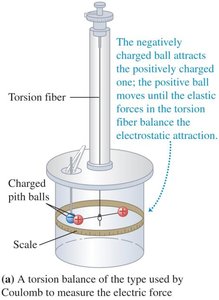
Coulomb’s law describes the force between two point charges:
The force is directly proportional to the product of the charges and inversely proportional to the square of the distance between them.
The force acts along the line joining the charges and is equal in magnitude and opposite in direction (Newton’s Third Law).
Mathematical form:
Where and
Applications of Coulomb’s Law
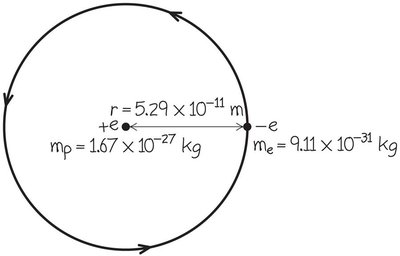
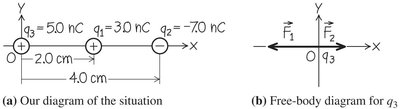
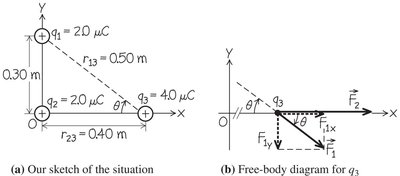
Coulomb’s law can be used to compare the strength of electrostatic and gravitational forces, and to calculate the net force on a charge due to multiple other charges using the principle of superposition.
Example: Comparing electric and gravitational forces in a hydrogen atom.
Superposition: The net force is the vector sum of forces from all other charges.
Electric Field
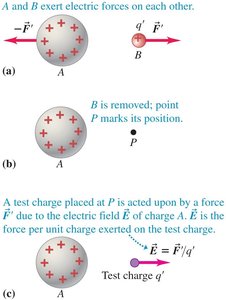
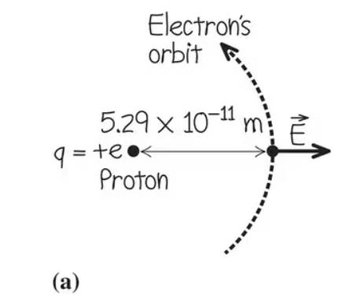
The electric field is a vector field that describes the force per unit charge at every point in space due to electric charges. It provides a way to describe how charges interact at a distance.
Defined as
For a point charge:
The principle of superposition applies:
Electric Field Lines
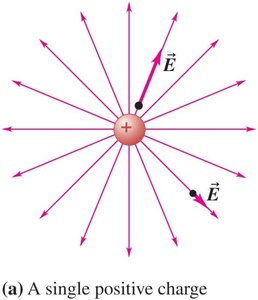
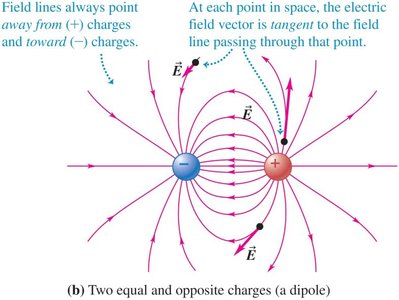
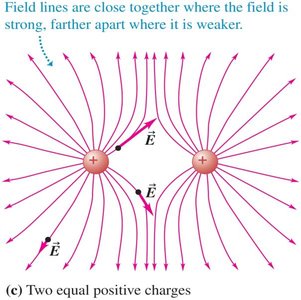
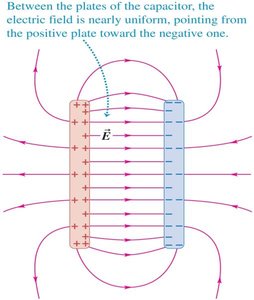
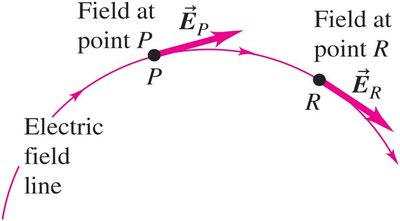
Electric field lines are a visual tool to represent the direction and strength of the electric field:
Lines point away from positive charges and toward negative charges.
Density of lines indicates field strength.
The field vector at any point is tangent to the field line.
Sample Problems and Applications
Understanding electric fields and forces involves solving problems involving point charges, field superposition, and the motion of charges in fields.
Problem 31: Calculating the electric field from force and charge.
Problem 34: Finding the field due to a point charge at a given distance.
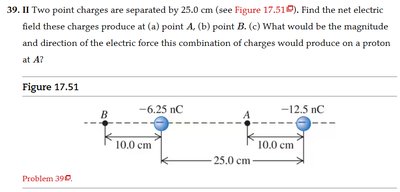
Problem 39: Net electric field from multiple charges at specified points.
Problem 42: Location where the net electric field is zero between two charges.



Accelerating a Charged Particle in a Uniform Electric Field
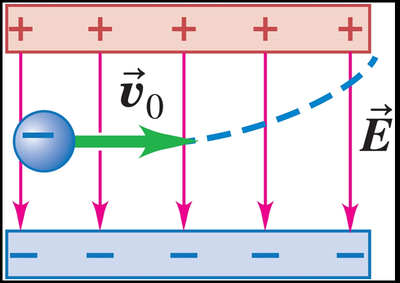
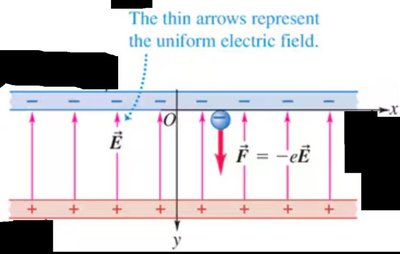
When a charged particle is placed in a uniform electric field, it experiences a constant force and thus a constant acceleration:
Coulomb’s force:
Newton’s Second Law:
Therefore,
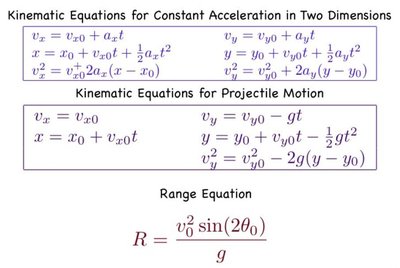
Kinematic equations can be used to analyze the motion.

Electric Flux (Skipped)
Electric flux quantifies the amount of electric field passing through a surface. It is defined as , where is the angle between the field and the normal to the surface. (This section is skipped in the provided material.)
Gauss’s Law (Skipped)
Gauss’s Law relates the net electric flux through a closed surface to the total charge enclosed. (This section is skipped in the provided material.)
Summary Table: Key Properties of Electric Charge and Field
Property | Description |
|---|---|
Charge Conservation | Total charge in a closed system is constant |
Charge Quantization | Charge exists in integer multiples of |
Coulomb’s Law | |
Electric Field | |
Superposition Principle | Total field/force is vector sum of individual contributions |
Additional info: Some advanced topics such as electric flux and Gauss’s Law are referenced but not covered in detail in these notes. For a deeper understanding, consult the relevant textbook chapters.
