Back
BackElectric Charge and Electric Field: Foundations of Electrostatics
Study Guide - Smart Notes
 Tailored notes based on your materials, expanded with key definitions, examples, and context.
Electric Charge and Electric Field
Introduction to Electrostatics
Electrostatics is the study of electric charges at rest and the forces and fields they produce. Understanding these concepts is essential for explaining the behavior of many physical and biological systems, such as why water is an excellent solvent.
Electric charge is a fundamental property of matter responsible for electric phenomena.
There are two types of electric charge: positive and negative.
Like charges repel; opposite charges attract.
Electric charge is quantized (in multiples of the elementary charge, C) and conserved (total charge in an isolated system remains constant).
The SI unit of charge is the coulomb (C).
Structure of Matter and Electric Charge
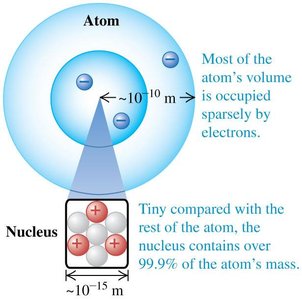
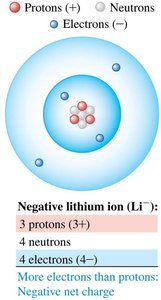
Atoms are composed of a dense nucleus (containing protons and neutrons) surrounded by electrons. The nucleus contains most of the atom's mass, while electrons occupy most of its volume.
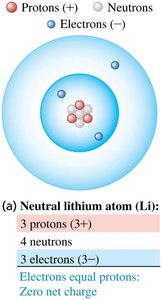
Protons carry positive charge, electrons carry negative charge, and neutrons are uncharged.
A neutral atom has equal numbers of protons and electrons.
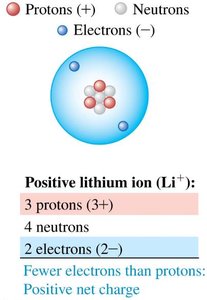
An ion is an atom with unequal numbers of protons and electrons, resulting in a net charge.
Coulomb’s Law
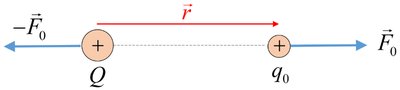
Coulomb’s law quantifies the electric force between two point charges. The force is proportional to the product of the charges and inversely proportional to the square of the distance between them.
Mathematically, the force between charges and separated by distance is:
Where N·m2/C2 is Coulomb’s constant.
The direction of the force is along the line joining the charges: repulsive for like charges, attractive for unlike charges.
Superposition Principle for Forces
When multiple charges are present, the net force on any charge is the vector sum of the forces exerted by all other charges.
Forces add according to vector addition:
Electric Field Concept
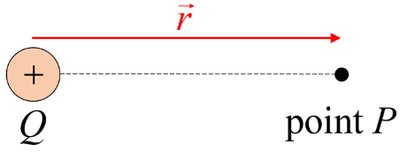
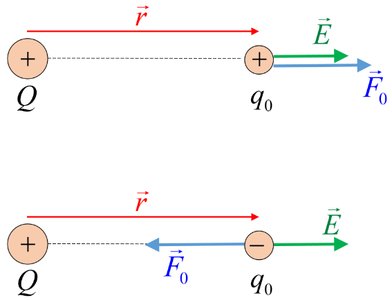
The electric field describes the influence a charge exerts on the space around it. A test charge placed in this field experiences a force.
The electric field at a point is defined as the force per unit charge:
SI unit: newton per coulomb (N/C).
The force on a test charge in an electric field is .
Electric Field of a Point Charge
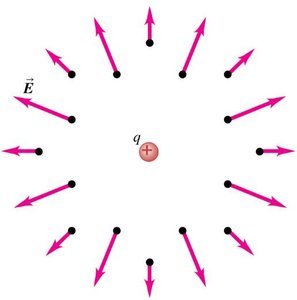
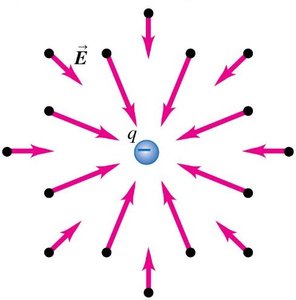
The electric field produced by a point charge at a distance is:
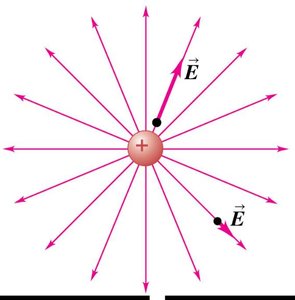
For a negative charge, the field points toward the charge; for a positive charge, it points away.
Superposition of Electric Fields
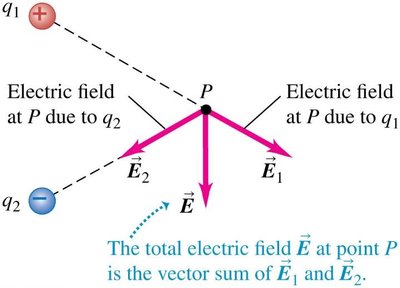
The total electric field at a point due to multiple charges is the vector sum of the fields produced by each charge individually.
Electric Field Lines
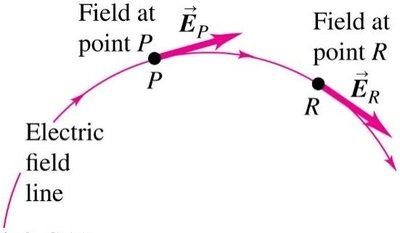
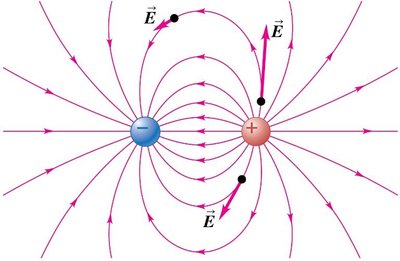
Electric field lines are a visual tool to represent the direction and strength of electric fields.
Field lines point away from positive charges and toward negative charges.
The density of lines indicates the field's strength.
Field lines never cross.
Electric Dipoles
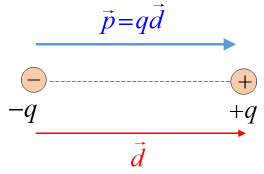
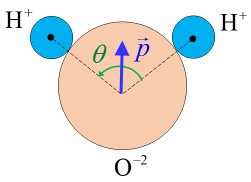
An electric dipole consists of two equal and opposite charges separated by a distance . The dipole moment is a vector quantity defined as , pointing from negative to positive charge.
Many molecules (e.g., water) are permanent dipoles, which explains their strong interactions with ions and other dipoles.
Electric Field of a Dipole
The electric field of a dipole at a point far from the dipole (on the perpendicular bisector) is given by:
Where is the dipole moment and is the distance from the center of the dipole.
Although the net charge is zero, the dipole produces a field at large distances.
Dipole in a Uniform Electric Field
A dipole in a uniform electric field experiences no net force but does experience a torque that tends to align the dipole with the field.
The torque is given by:
The potential energy of a dipole in an electric field is:
Electric Field of Charge Distributions
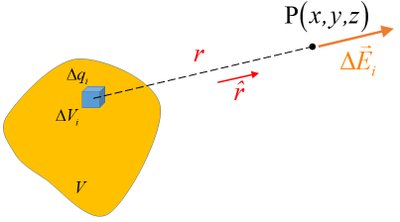
For continuous charge distributions, the total electric field at a point is found by integrating the contributions from each infinitesimal charge element:
Charge distributions can be:
Volume charge density ():
Surface charge density ():
Line charge density ():