 Back
BackElectric Charge and Electric Field: Fundamental Concepts and Applications
Study Guide - Smart Notes
 Tailored notes based on your materials, expanded with key definitions, examples, and context.
Electricity and Magnetism
Introduction
Electricity and magnetism are foundational to modern physics and technology. The forces responsible for the formation of solids and liquids are fundamentally electric in nature, and understanding these principles is essential for analyzing the behavior of matter and the operation of devices.
Electric Charge and the Structure of the Atom
Atomic Structure
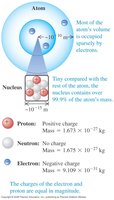
Atoms consist of three fundamental particles: electrons (negative charge), protons (positive charge), and neutrons (no charge). Protons and neutrons form the dense nucleus, while electrons occupy the surrounding space. The electric attraction between protons and electrons holds the atom together.
Atoms to Ions
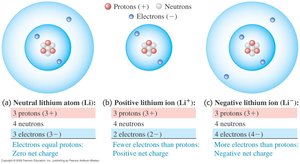
A neutral atom has equal numbers of protons and electrons. When electrons are removed, the atom becomes a positive ion; when electrons are added, it becomes a negative ion. This process is fundamental to chemical reactions and electrical phenomena.
Conservation and Quantization of Charge
Conservation of Charge
The conservation of charge principle states that the total electric charge in any closed system remains constant. The charge of a proton or electron is a natural unit, and all observable charge is quantized in this unit:
Elementary charge: Coulombs (C)
Quantization: (where N is an integer)
Smallest Charge Possible: Millikan Oil Drop Experiment
Robert Millikan's experiment in 1910 measured the charge of the electron, confirming that charge is quantized and the smallest possible charge is C.
Behavior of Electric Charge
Interaction of Charges
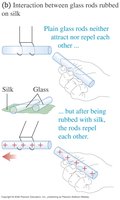
Like charges repel, and opposite charges attract. This fundamental behavior is observed in many physical and chemical processes.
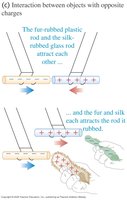
Conductors, Insulators, Semiconductors, and Superconductors
Materials are classified based on how easily charges move:
Conductors: Charges move freely (e.g., metals)
Insulators: Charges cannot move easily (e.g., nonmetals)
Semiconductors: Charges move under certain conditions (e.g., silicon)
Superconductors: Charges move effortlessly and cannot be stopped once moving
Charging Methods
Charging by Conduction
Charging by conduction involves direct contact between a charged object and a conductor, transferring charge.
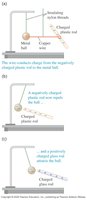
Charging by Induction
Charging by induction occurs when a charged object induces a charge in a nearby conductor without direct contact. The process can also cause polarization in insulators, where charges shift slightly, leading to attraction.
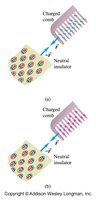
Coulomb's Law
Fundamental Law of Electric Force
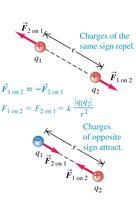
Coulomb's Law describes the force between two point charges:
The force is directly proportional to the product of the charges and inversely proportional to the square of the distance between them.
Mathematically:
N·m2/C2, C2/(N·m2)
Nature of Force
If is negative, the force is attractive.
If is positive, the force is repulsive.
Multiple Charges
The resultant force on any charge is the vector sum of the forces exerted by all other charges present.
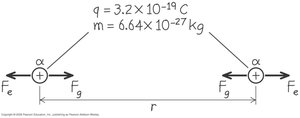
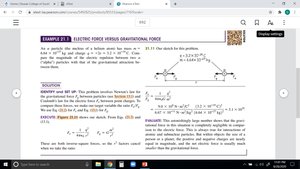
Comparison with Gravitational Force
Electric force and gravitational force are both fundamental interactions, but electric force is typically much stronger for atomic-scale particles.
Electric Field
Definition and Properties
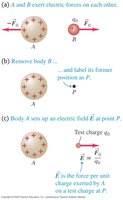
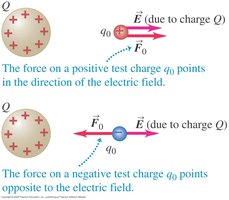
A charged body produces an electric field in the space around it. The electric field at a point is defined as the force per unit charge experienced by a small test charge placed at that point:
Units: newtons per coulomb (N/C)
For a charge in an electric field :

Electric Field Lines
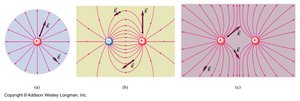
Electric field lines are a pictorial representation of the electric field:
Lines point away from positive charges and toward negative charges.
The number of lines is proportional to the magnitude of the charge.
No two field lines cross.
Field lines for a dipole indicate strong fields between opposite charges.
Electric Field Calculations and Examples
Electric Field from Point Charges
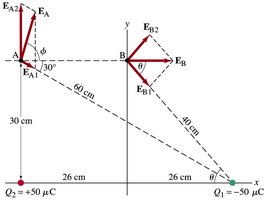
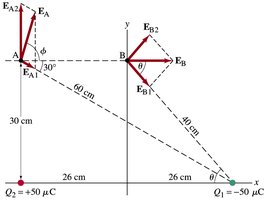
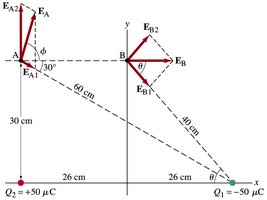
The electric field at a point due to multiple charges is the vector sum of the fields from each charge:
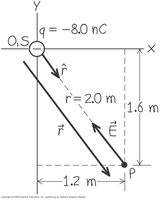
For a point charge:
For multiple charges:
Electric Field at Points Due to Multiple Charges
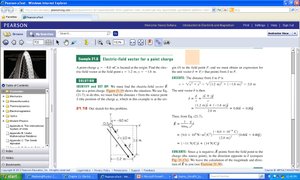
When calculating the electric field at a point due to several charges, compute the field from each charge and add them vectorially.
Electric Dipoles
Definition and Properties
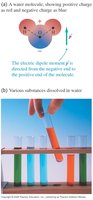
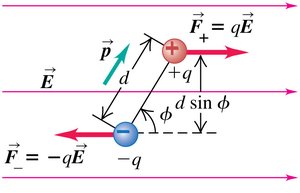
An electric dipole consists of two equal and opposite charges separated by a distance. The dipole moment is given by:
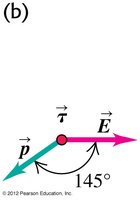
Force and Torque on a Dipole
In an electric field, a dipole experiences a force and a torque:
Torque:
Potential energy:
Summary Table: Types of Charge Distribution
Type | Charge Distribution | Density Symbol | Units |
|---|---|---|---|
Line Charge | Along a line | l | C/m |
Surface Charge | On a surface | s | C/m2 |
Volume Charge | In a volume | r | C/m3 |
Additional info: These types of charge distributions are important for advanced calculations but are not required for introductory exams.
