 Back
BackElectric Charge and Electric Field: Fundamental Concepts and Applications
Study Guide - Smart Notes
 Tailored notes based on your materials, expanded with key definitions, examples, and context.
Electric Charge and Its Properties
Nature of Electric Charge
Electric charge is a fundamental property of matter, introduced as a new physical dimension alongside mass, length, time, and temperature. It is measured in Coulombs (C) and exists in two types: positive and negative. The basic properties of electric charge are as follows:
Attraction and Repulsion: Like charges repel, while opposite charges attract.
Quantization: Electric charge is quantized; all observable charges are integer multiples of the elementary charge .
Conservation: The total electric charge in an isolated system remains constant.
Materials can be classified based on their ability to allow charge movement:
Conductors: Allow free movement of charge (e.g., metals).
Insulators: Do not allow charge to move freely (e.g., rubber, glass).
Charging can occur by direct contact (conduction), induction (without contact), or polarization (separation of charge within an object). Polarization is generally stronger in conductors than in insulators.
Coulomb’s Law
Force Between Point Charges
Coulomb’s Law describes the force between two point charges. The force is proportional to the product of the charges and inversely proportional to the square of the distance between them:
where is Coulomb’s constant. Alternatively, can be expressed in terms of the permittivity of free space :
, with
Coulomb’s Law is analogous to Newton’s Law of Gravitation, but the electric force is vastly stronger than the gravitational force at atomic scales.
Superposition Principle
For systems with multiple charges, the net force on any charge is the vector sum of the forces from all other charges. This principle also applies to electric fields.
Electric Field
Definition and Properties
The electric field is a vector field that assigns a force per unit charge to every point in space. It is defined as:
where is the electric force on a test charge . All charges create electric fields, but a charge does not exert a force on itself.
Electric Field of Point Charges
The electric field due to a single point charge is given by:
For multiple charges, the net electric field is the vector sum of the fields from each charge (superposition):
Field Lines
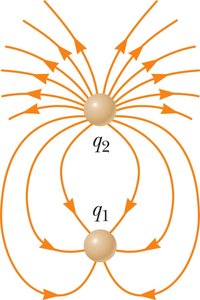
Electric field lines provide a pictorial representation of the field:
The number of lines is proportional to the magnitude of the charge.
Lines begin on positive charges and end on negative charges or extend to infinity.
The density of lines indicates the field’s strength.
Field lines never intersect, and the field vector is tangent to the line at any point.
Applications and Examples
Example 1: Force Between Two Spheres
Two identical conducting spheres are placed 0.300 m apart, one with a charge of 12.0 nC and the other with –18.0 nC. The electric force between them can be calculated using Coulomb’s Law. If connected by a conducting wire, charges redistribute until equilibrium is reached, and the force is recalculated with the new charges.
Example 2: Superposition with Three Charges
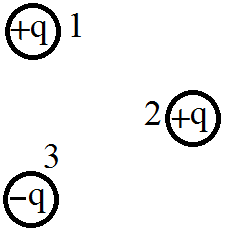
Three point charges of equal magnitude are placed at the corners of an equilateral triangle. The net force on one charge is found by vector addition of the forces from the other two.
Example 3: Vector Field Calculation
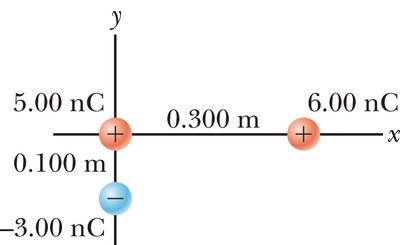
Given three charges arranged as shown, the vector field at the origin due to two of the charges can be found by calculating the field from each and adding them vectorially. The force on a third charge placed at the origin is then .
Example 4: Electric Field of an Extended Object
For an extended charged object, the field at a point is found by integrating the contributions from each infinitesimal charge element :
The total field is:
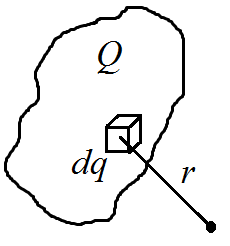
Charge density is used to express in terms of geometry:
Line charge: , = charge/length
Surface charge: , = charge/area
Volume charge: , = charge/volume
Example 5: Electric Field of a Charged Semicircle
A uniformly charged insulating rod bent into a semicircle creates an electric field at the center. The field’s magnitude and direction are found by integrating the contributions from each segment of the rod.

Electric Dipoles
Definition and Properties
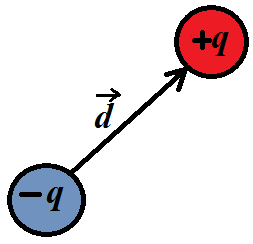
An electric dipole consists of equal and opposite charges separated by a distance . The dipole moment is:
When placed in an external electric field , a dipole experiences a torque:
The potential energy of a dipole in an external field is:
Example: Dipole in a Triangle of Charges
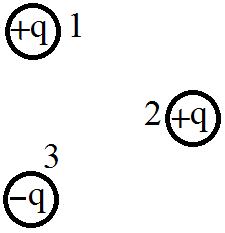
Three point charges of equal magnitude are at the corners of an equilateral triangle. Considering two as a dipole, the net torque on the dipole due to the third charge can be analyzed using the above formulas.
Additional info: The notes above expand on the original content by providing definitions, formulas, and context for each concept, ensuring the material is self-contained and suitable for exam preparation.
