 Back
BackElectric Charge and Electric Field: Fundamentals and Applications
Study Guide - Smart Notes
 Tailored notes based on your materials, expanded with key definitions, examples, and context.
Electric Charge and Electric Field
Introduction to Electricity and Magnetism
Electricity and magnetism are branches of physics that study the electromagnetic force, one of the four fundamental forces of nature. Historically, electricity (static and current) and magnetism were considered separate phenomena until their unification in the 19th century by James Clerk Maxwell. The electromagnetic force acts between objects with electric charge, analogous to the gravitational force between objects with mass.
Electric Charge: Properties and Conservation
Electric charge (q) is a fundamental property of matter responsible for electromagnetic interactions.
Charge is quantized: it exists in discrete amounts, typically as integer multiples of the elementary charge (e = 1.602 × 10⁻¹⁹ C).
Objects can be positively charged, negatively charged, or neutral.
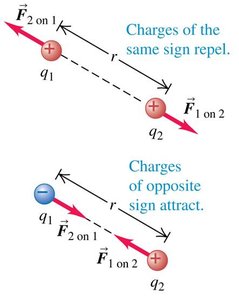
Like charges repel, opposite charges attract.
Conservation of charge: In an isolated system, the total electric charge remains constant; charge cannot be created or destroyed.
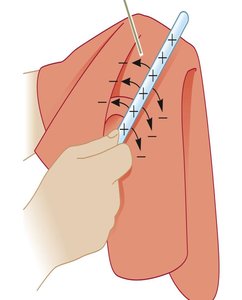
Example: Rubbing a glass rod with silk transfers electrons from the glass to the silk, making the glass positively charged and the silk negatively charged. Only electrons move during this process.
Conductors, Insulators, and Semiconductors
Materials are classified based on their ability to conduct electric charge:
Conductors: Allow free movement of charges (e.g., metals).
Insulators: Do not allow free movement of charges (e.g., rubber, glass).
Semiconductors: Intermediate properties; conductivity can be controlled (e.g., silicon).
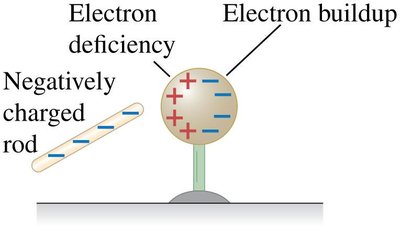
Charging by induction involves redistributing charges in a material without direct contact, while conduction involves direct transfer of charge.
Induced Charges and Polarization
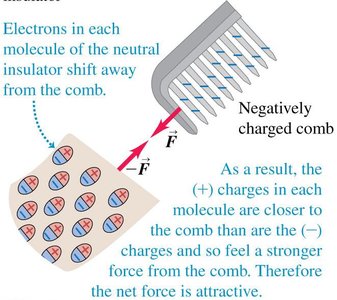
When a charged object is brought near an uncharged conductor or insulator, it can induce a redistribution of charges, leading to polarization. This effect explains phenomena such as a balloon sticking to a wall or a comb attracting small pieces of paper after being run through hair.

Coulomb's Law
Force Between Point Charges
Coulomb's Law quantifies the electric force between two point charges:
F: Magnitude of the force (in newtons, N)
q1, q2: Charges (in coulombs, C)
r: Distance between charges (in meters, m)
k: Coulomb's constant ( N·m2/C2)
\epsilon_0: Permittivity of free space ( C2/N·m2)
Direction: The force is repulsive for like charges and attractive for opposite charges.
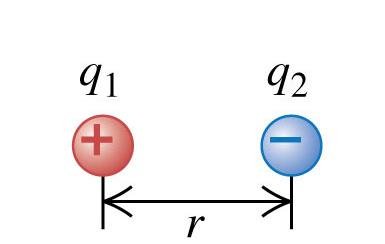
Examples and Applications
Example 1: Two charges, nC and nC, separated by cm. Find the force between them using Coulomb's Law.
Example 2: Calculate the number of excess electrons on two spheres 20.0 cm apart if the repulsive force is N.
Electric Field
Definition and Properties
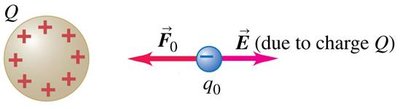
The electric field (E) is a vector field that describes the force per unit charge exerted on a test charge at any point in space. It is generated by electric charges and can be defined as:
\vec{F}_0: Force experienced by a test charge q0
Units: newtons per coulomb (N/C)
For a point charge Q at a distance r:
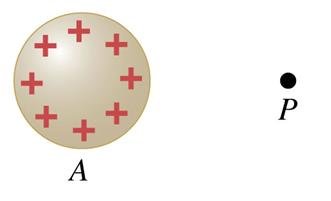
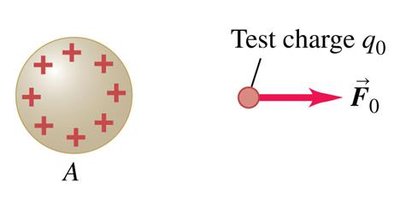
Electric Field and Force Relationship
The force on a test charge in an electric field is:
The direction of the electric field is the direction of the force on a positive test charge. For a negative test charge, the force is opposite to the field direction.
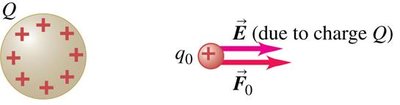
Comparison to Gravitational Field
There is a strong analogy between electric and gravitational fields:
Electric: and
Gravitational: and
Units: Electric field (N/C), Gravitational field (N/kg or m/s2).
Electric Field of a Point Charge
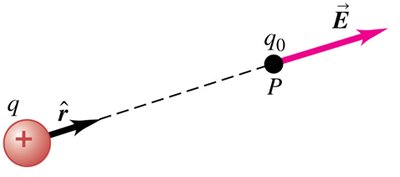
The electric field produced by a point charge q at a distance r is:
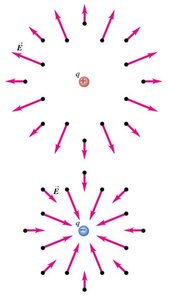
Points away from positive charges, towards negative charges.
Field strength decreases with the square of the distance.
Examples: Calculating Electric Fields
Example 1: Find the electric field 2.0 m from a 4.0 nC point charge.
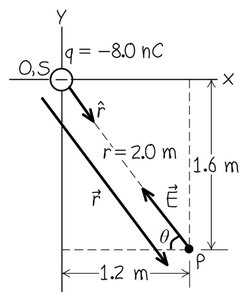
Example 2: A point charge nC at the origin; find the field at m.
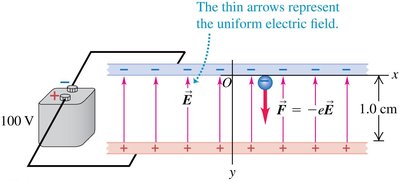
Uniform Electric Field
Between two parallel conducting plates connected to a battery, a uniform electric field is established. The field strength is given by:
V: Potential difference (volts)
d: Separation between plates (meters)
Example: Plates 1.0 cm apart, 100 V battery, N/C. An electron released from rest will accelerate towards the positive plate.
Superposition Principle for Electric Fields
The total electric field at a point due to multiple charges is the vector sum of the fields produced by each charge:
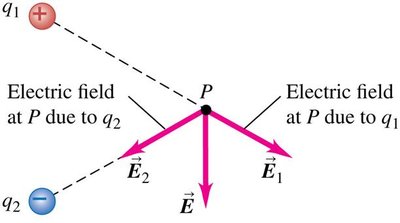
Electric Field Due to Continuous Charge Distributions
For objects with continuous charge distributions, divide the object into small elements and sum (integrate) their contributions:
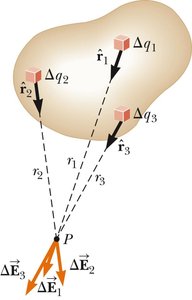
Examples: Continuous Charge Distributions
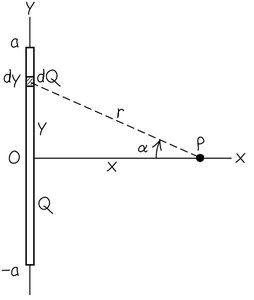
Line Segment: Uniform charge along the y-axis from to . Field at point on the x-axis:
(in the x-direction)
If the line is infinitely long: (where is linear charge density).
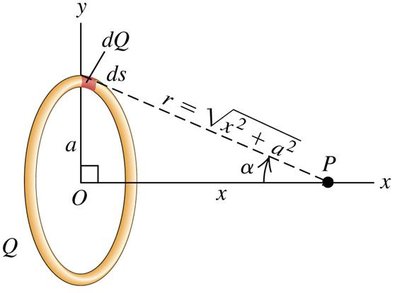
Ring of Charge: Uniform charge on a ring of radius . Field at a point on the axis a distance from the center:
(in the x-direction)
At the center (), due to symmetry.
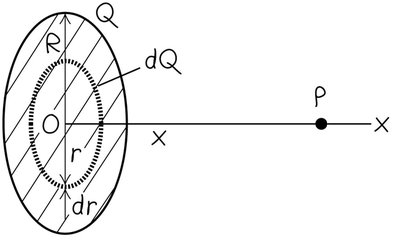
Uniformly Charged Disk: Disk of radius with surface charge density . Field at a point on the axis a distance from the center:
(in the x-direction)
If , (field of an infinite plane).
Electric Field Lines
Visualizing Electric Fields
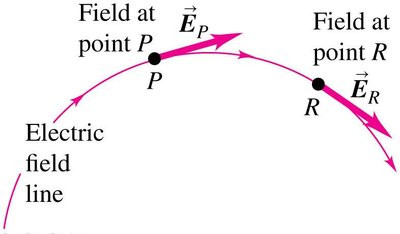
Electric field lines provide a visual representation of the direction and strength of the electric field:
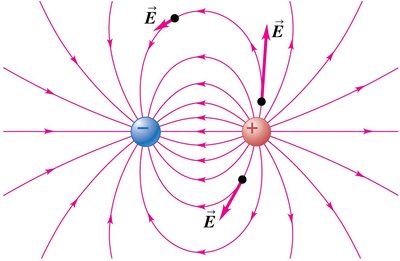
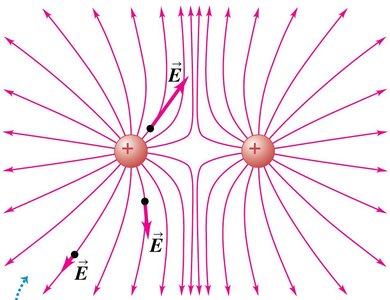
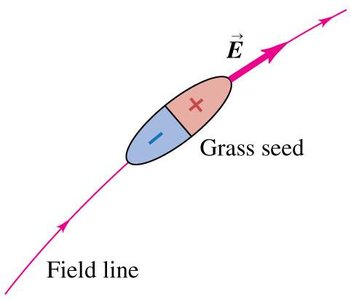
The field vector is tangent to the field line at every point.
The density of lines indicates the field's magnitude (closer lines = stronger field).
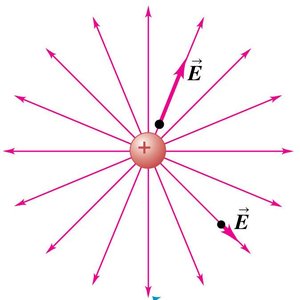
Lines point away from positive charges and toward negative charges.
Field lines never intersect.
Examples of Electric Field Lines
Point Charge: Radial lines emanate from (or converge to) the charge.
Dipole: Field lines emerge from the positive charge and terminate on the negative charge.
Two Equal Positive Charges: Field lines repel from both charges, showing symmetry.
Demonstration of Field Lines
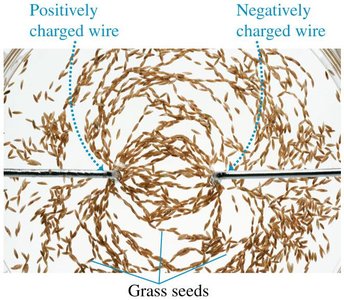
Field lines can be visualized experimentally using grass seeds in oil between charged wires. The seeds align with the electric field, making the pattern visible.
Summary Table: Key Equations and Concepts
Concept | Equation | Description |
|---|---|---|
Coulomb's Law | Force between two point charges | |
Electric Field (point charge) | Field at distance r from charge Q | |
Force on Test Charge | Force on charge in field | |
Superposition Principle | Sum of fields from all charges | |
Continuous Charge Distribution | Field from distributed charge |
