 Back
Chapter 16: Electric Charge and Electric Field – Physics with Calculus Study Notes
Study Guide - Smart Notes
 Tailored notes based on your materials, expanded with key definitions, examples, and context.
Electric Charge and Electric Field
Introduction to Static Electricity
Static electricity is a common phenomenon in daily life, observed when objects become electrically charged due to friction or contact. This chapter introduces the fundamental concepts of electric charge and the electric field, which are foundational to understanding electrostatics in physics.


The Nature of Electric Charge
Electric charge is a fundamental property of matter, existing in two forms: positive (protons) and negative (electrons).
Atoms are typically electrically neutral, containing equal numbers of protons and electrons.
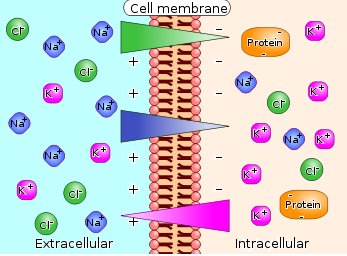
Ions are atoms or molecules with an unequal number of protons and electrons, resulting in a net charge.
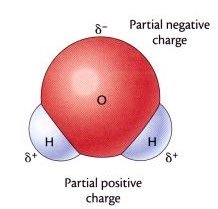
Many molecules, such as water, are polarized, meaning their charge distribution is uneven.
Quantization and Conservation of Charge
Charge is quantized: the smallest unit of charge is the elementary charge, C.
SI unit of charge: coulomb (C).
Common static charges range from nano-coulombs (nC) to micro-coulombs (μC).
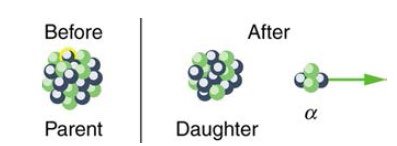
Law of charge conservation: The total electric charge in an isolated system remains constant.

Forces Between Charges: Coulomb's Law
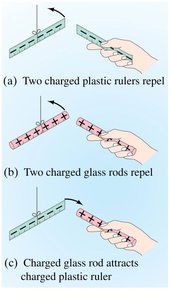
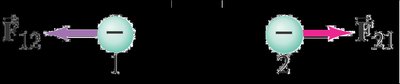
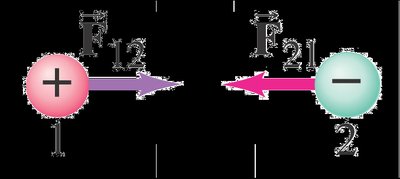
Electric charges exert forces on each other: like charges repel, and opposite charges attract. The force between two point charges is described by Coulomb's Law:
The force acts along the line joining the charges.
It is attractive for opposite charges and repulsive for like charges.

Coulomb's Law (in SI units):
where N·m2/C2, and are the charges, and is the distance between them.


Superposition Principle
When more than two charges are present, the net force on any charge is the vector sum of the forces exerted by all other charges (superposition principle).

Conductors, Insulators, and Charging
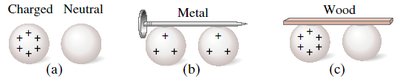
Conductors: Materials (like metals) where charges move freely.
Insulators: Materials where charges do not move freely (e.g., rubber, glass).
Semiconductors: Materials with intermediate conductivity.
Electric Field (E-Field)
The electric field is a vector field that describes the force per unit charge at every point in space due to electric charges.
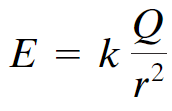
The electric field produced by a point charge at a distance is:
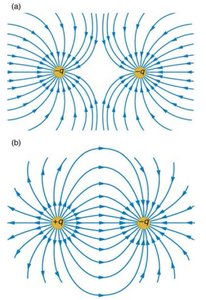
The direction of the field is away from positive charges and toward negative charges.
Electric Field Lines
Field lines start on positive charges and end on negative charges.
The density of lines indicates the strength of the field.
Electric Force in an Electric Field
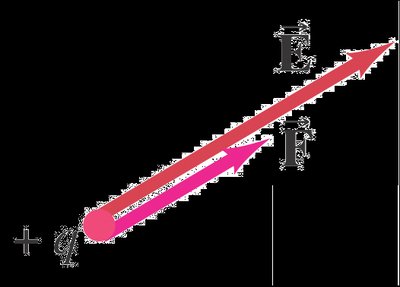
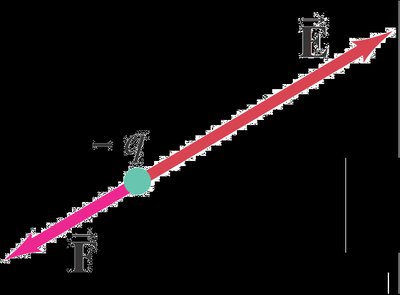
The force on a charge in an electric field is:
For a positive charge, the force is in the direction of the field.
For a negative charge, the force is opposite to the field direction.
Gauss's Law and Electric Flux
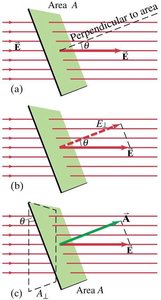
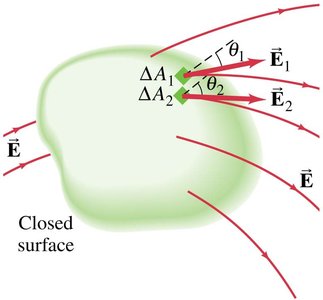
Electric flux () measures the number of electric field lines passing through a surface. Gauss's Law relates the net electric flux through a closed surface to the charge enclosed:
is the permittivity of free space: C2/(N·m2).

Conductors in Electrostatic Equilibrium
The electric field inside a conductor is zero when in electrostatic equilibrium.
Excess charge resides on the surface of a conductor.
The electric field just outside a charged conductor is perpendicular to the surface.

Faraday Cage and Shielding
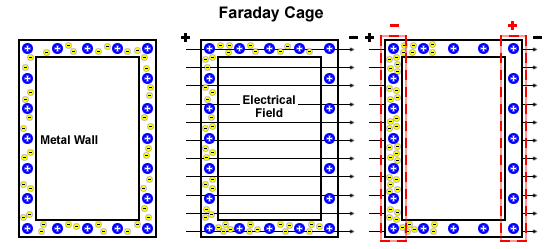
A Faraday cage is a conducting enclosure that blocks external electric fields, keeping the field inside the cage zero.
This principle explains why electronic devices may lose signal inside metal enclosures (e.g., elevators).
Electric Field Near Sharp Objects and Lightning Rods
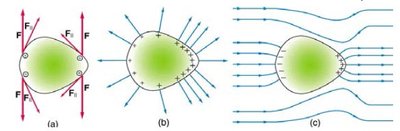
Charge accumulates at sharp points on conductors, creating a strong local electric field.
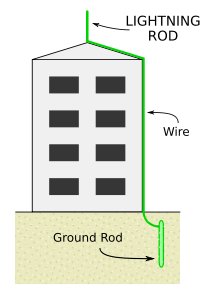
Lightning rods use this effect to safely direct lightning strikes to the ground.

Applications: Electrostatics in Technology
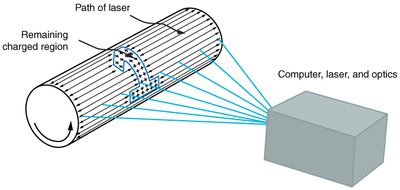
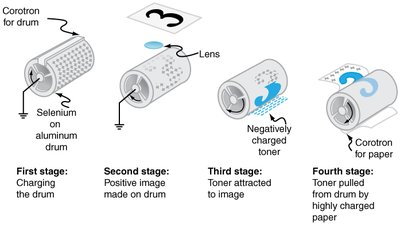
Laser printers and xerography use electrostatic charges to transfer toner to paper.
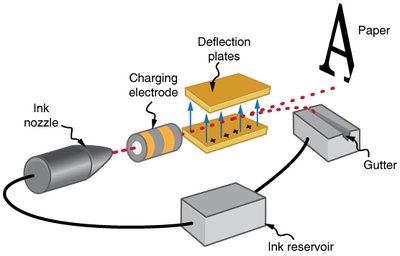
Ink-jet printers use charged droplets to control ink placement.
Summary Table: Key Concepts in Electric Charge and Field
Concept | Definition/Formula | Notes |
|---|---|---|
Elementary Charge | C | Smallest unit of charge |
Coulomb's Law | Force between two point charges | |
Electric Field (Point Charge) | Field due to a single charge | |
Electric Flux | Number of field lines through a surface | |
Gauss's Law | Relates flux to enclosed charge | |
Permittivity of Free Space | C2/(N·m2) | Constant in electrostatics |
Chapter Summary
There are two types of electric charge: positive and negative.
Charge is conserved and quantized.
Conductors allow free movement of charge; insulators do not.
Coulomb's law describes the force between charges.
The electric field is the force per unit charge and can be visualized with field lines.
Gauss's law provides a powerful method for calculating electric fields in symmetric situations.
Applications of electrostatics include lightning rods, Faraday cages, and modern printing technologies.
