 Back
BackElectric Charge and Electric Field: Study Notes
Study Guide - Smart Notes
 Tailored notes based on your materials, expanded with key definitions, examples, and context.
Chapter 21: Electric Charge and Electric Field
Electric Charge
Electric charge is a fundamental property of matter responsible for electric forces of attraction and repulsion. It is quantized and conserved in all physical processes.
Definition: Electric charge is the source of the electric force, analogous to mass being the source of gravitational force.
Types of Charge: There are two types: positive (proton) and negative (electron).
Unit: The SI unit is the coulomb (C). More practical units are nanocoulomb (nC) and microcoulomb (μC).
Elementary Charge: C is the smallest unit of charge found in isolation (on a proton or electron).
Quantization: Charge exists in integer multiples of ; fractional charges are not observed in ordinary matter.
Charge Conservation: The total electric charge in a closed system remains constant.
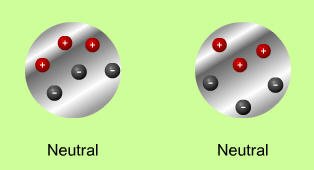
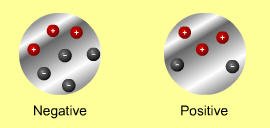
Neutrality: Atoms are neutral when they have equal numbers of protons and electrons. Excess electrons result in a negative charge; excess protons result in a positive charge.
Charge Redistribution and Induced Charges
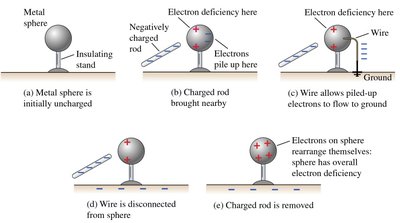
Charges can be transferred or redistributed by contact or induction, leading to charged or polarized objects.
Contact: Direct transfer of charge between objects.
Induction: Redistribution of charges within an object due to the influence of a nearby charged object, without direct contact.
Conductors, Insulators, and Grounding
Materials are classified based on their ability to allow charge movement.
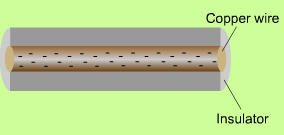
Conductor: Material in which charges move freely (e.g., metals).
Insulator: Material in which charges do not move freely (e.g., rubber, glass).
Ground: A reference point of zero electric potential; connecting an object to ground allows excess charge to flow away, neutralizing the object.
Coulomb’s Law
Coulomb’s Law quantifies the electric force between two point charges.
Formula:
where N·m2/C2, C2/N·m2
Vector Nature: The force acts along the line joining the charges; like charges repel, unlike charges attract.
Superposition Principle: The net force on a charge is the vector sum of forces from all other charges.
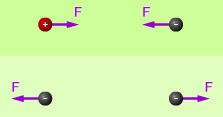
Comparison with Gravitational Force
Both forces are inverse-square laws: .
Gravitational force is always attractive; electric force can be attractive or repulsive.
Electric forces are much stronger than gravitational forces at the atomic scale.
Example: Force Calculation
Given nC, nC, nC, calculate the total force on due to and .
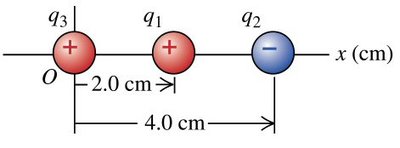
Electric Field and Electric Forces
The electric field describes the force per unit charge at a point in space, providing a model for action-at-a-distance forces.
Definition: , where is a test charge.
Unit: Newton per coulomb (N/C).
Direction: The direction of is the direction of the force on a positive test charge.
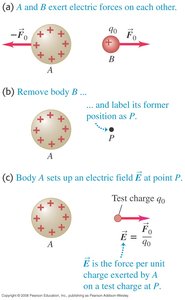
Analogy to Gravitational Field
Gravitational field:
Electric field:
Electric Field of a Point Charge
The electric field produced by a point charge at a distance is:
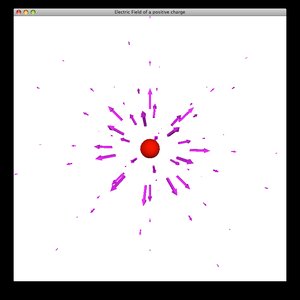
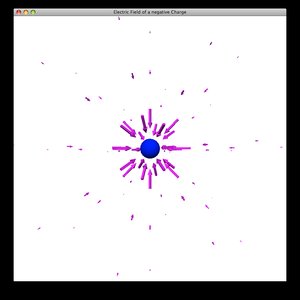
Electric Field Lines
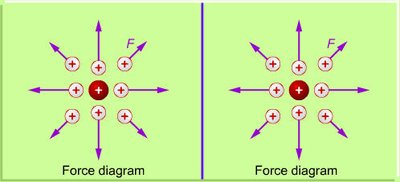
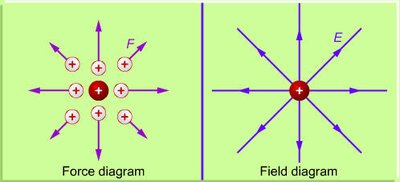
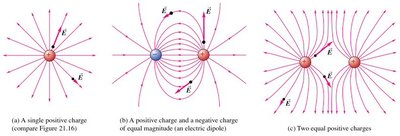
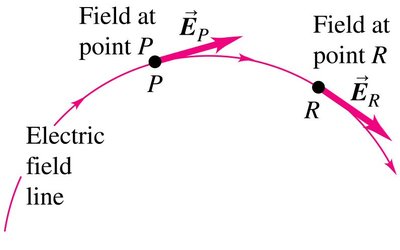
Field lines point away from positive charges and toward negative charges.
The density of lines indicates field strength.
At any point, the direction of the field is tangent to the field line.
Field Strength and Superposition
Field strength is greater where lines are closer together.
The net electric field is the vector sum of fields from all charges:
Force on a Charge in an Electric Field
The force on a charge in an electric field is:
Examples
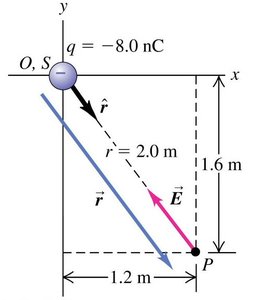
Example 3: Find the electric field at point P due to a point charge.
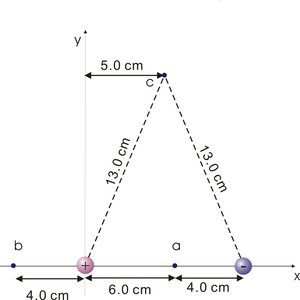
Example 4: Find the electric fields at points a, b, c due to two charges nC, nC.
Example 5: Find the position where the total electric field due to two charges is zero.
Motion of a Charge in a Uniform Electric Field
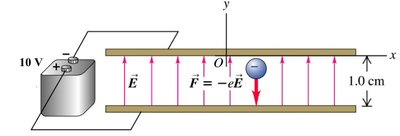
When a charge is released in a uniform electric field, it experiences constant acceleration.
Equations of motion can be applied to determine position, velocity, and time.
Electric Dipoles
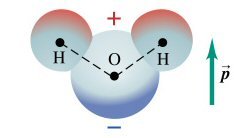
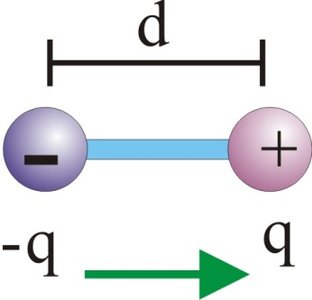
An electric dipole consists of two equal and opposite charges separated by a distance. Dipoles are important in molecular physics and electric field analysis.
Dipole Moment: , where is the charge and is the displacement vector from negative to positive charge.
Direction: From negative to positive charge.
Example: Water molecule has a dipole moment C·m.
Torque on an Electric Dipole
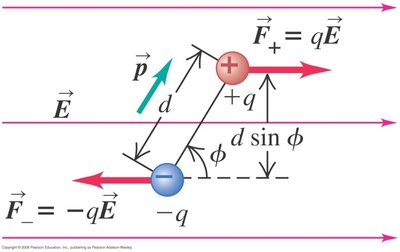
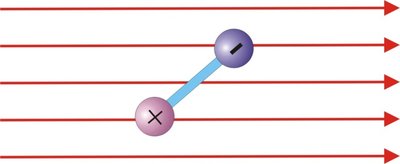
When placed in a uniform electric field, a dipole experiences a torque that tends to align it with the field.
Formula:
The net force on a dipole in a uniform field is zero, but the torque is nonzero unless the dipole is aligned with the field.
Example: Dipole in a Uniform Electric Field
Given charges C separated by m in a field of N/C, calculate the dipole moment and the torque.
Additional info: The above notes expand on the provided slides with definitions, formulas, and context for each concept, ensuring a self-contained study guide for college-level physics students.
