 Back
Electric Charge and Electric Field: Study Notes for Physics with Calculus
Study Guide - Smart Notes
 Tailored notes based on your materials, expanded with key definitions, examples, and context.
Electric Charge and Electric Field
Electric Charge: Fundamental Properties
Electric charge is a fundamental property of matter that gives rise to electric forces and interactions. It is not a substance but an intrinsic property of particles such as protons and electrons.
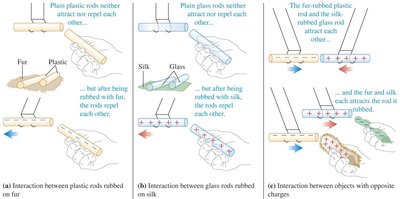
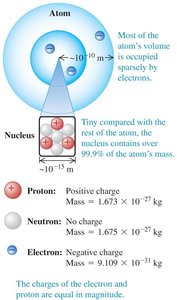
Two Types of Charge: Positive and negative. Protons carry positive charge (+e), electrons carry negative charge (−e), and neutrons are neutral.
Charge Conservation: The total electric charge in an isolated system remains constant.
Quantization of Charge: Charge exists in discrete packets, multiples of the elementary charge C.
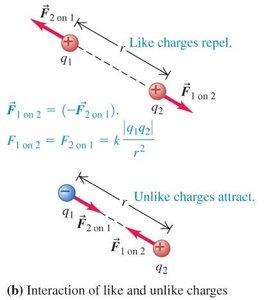
Like Charges Repel, Unlike Charges Attract: This is a fundamental experimental observation.
Atomic Structure and Charge Distribution
Atoms: Consist of a small, massive nucleus (protons and neutrons) surrounded by electrons.
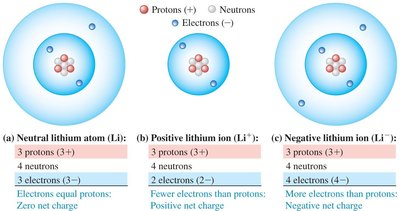
Neutrality: An atom is electrically neutral if it contains equal numbers of protons and electrons.
Ions: Atoms can gain or lose electrons, forming ions with net positive or negative charge.
Conductors, Insulators, and Semiconductors
Materials are classified based on their ability to allow charge to move freely:
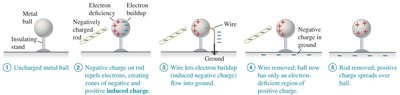
Conductors: Materials (e.g., metals) with free electrons that can move easily, allowing charge to flow.
Insulators: Materials (e.g., glass, rubber) where electrons are tightly bound and do not move freely.
Semiconductors: Materials with electrical properties between conductors and insulators; their conductivity can be tuned.
Charge Transfer Mechanisms
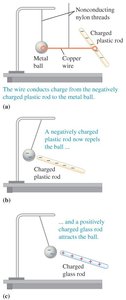
Conduction: Transfer of charge by direct contact between materials.
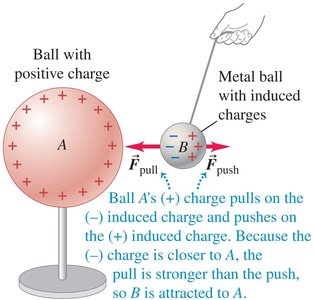
Induction: Redistribution of charge in a material due to the presence of a nearby charged object, without direct contact.
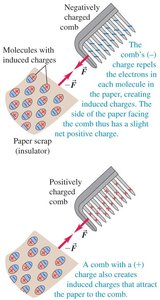
Polarization: Separation of charges within an object, often observed in insulators when exposed to an external electric field.
Everyday Examples of Charge and Polarization
Static Electricity: Hair standing on end or paper attracted to a comb are common demonstrations of charge and polarization effects.


Coulomb's Law and Electric Force
Coulomb's Law
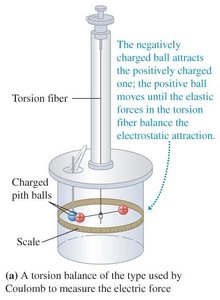
Coulomb's Law quantifies the electric force between two point charges:
Formula: where N·m2/C2, and are the charges, and is the distance between them.
Vector Form: The force acts along the line joining the charges; it is repulsive for like charges and attractive for unlike charges.
Superposition Principle
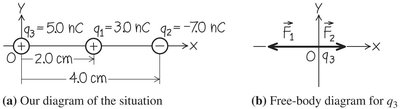
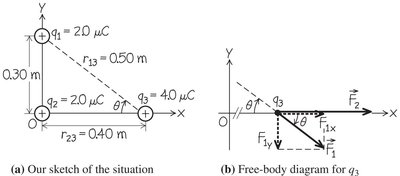
The net force on a charge due to multiple other charges is the vector sum of the individual forces exerted by each charge.
Example: Calculating the net force on a charge in a system of three charges.
Electric Field and Electric Field Lines
Definition of Electric Field
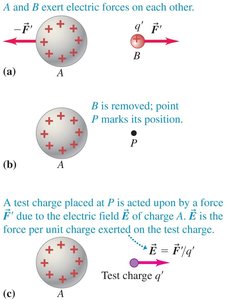
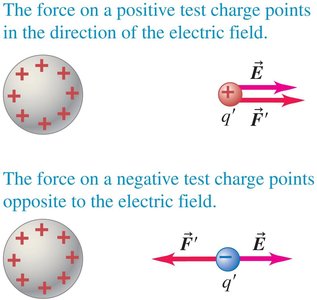
The electric field E at a point in space is defined as the force per unit positive test charge placed at that point:
Formula: where is the force on a test charge .
For a Point Charge: where is the source charge, is the distance from the charge, and is the unit vector pointing from the source to the field point.
Electric Field Lines
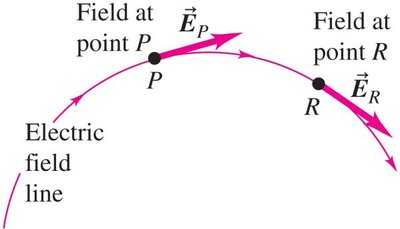
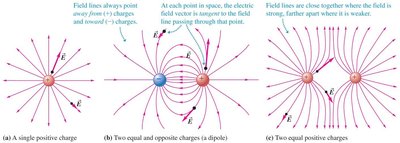
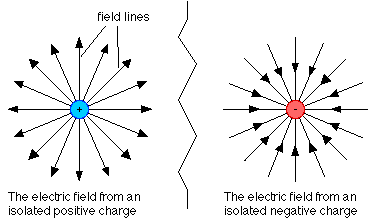
Electric field lines provide a visual representation of the direction and strength of the electric field:
Field lines point away from positive charges and toward negative charges.
The density of lines indicates the strength of the field.
Field lines never cross and are tangent to the direction of the field at any point.
Electric Field Due to Multiple Charges and Continuous Distributions
Superposition Principle: The total electric field at a point is the vector sum of the fields due to all individual charges.
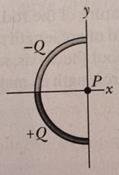
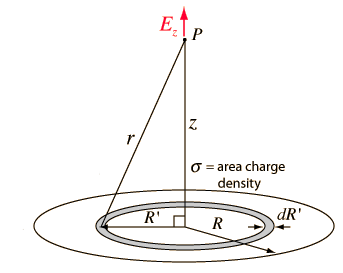
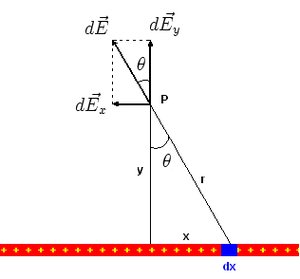
Continuous Charge Distributions: For objects like rings, disks, or lines of charge, calculus is used to sum the contributions from each infinitesimal charge element.
Electric Dipoles
Dipole: Consists of two equal and opposite charges separated by a distance.
Dipole Moment: , where is the charge and is the displacement vector from negative to positive charge.
Field of a Dipole: The electric field of a dipole decreases more rapidly with distance than that of a single charge.
Force and Motion in Electric Fields
Force on a Charge in an Electric Field
A charge in an electric field experiences a force .
The direction of the force depends on the sign of the charge.
Motion of Charges in Uniform Electric Fields
Charged particles entering a uniform electric field experience constant acceleration, similar to projectile motion under gravity.
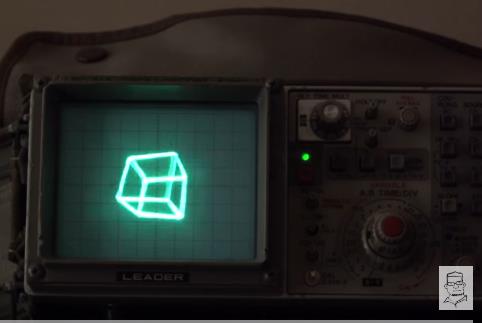
Applications include cathode ray tubes and oscilloscopes.
Electric Dipole in a Uniform Electric Field
Net Force: Zero, but a net torque acts to align the dipole with the field.
Torque:
Potential Energy:
Summary Table: Key Concepts
Concept | Definition/Formula | Notes |
|---|---|---|
Elementary Charge | C | Smallest unit of charge |
Coulomb's Law | Force between two point charges | |
Electric Field (Point Charge) | Field due to a single charge | |
Dipole Moment | Vector from negative to positive charge | |
Force on Charge | Direction depends on sign of | |
Torque on Dipole | Aligns dipole with field | |
Potential Energy (Dipole) | Minimum when aligned with field |
