Back
Electric Charge and Electric Field: Study Notes for Physics with Calculus
Study Guide - Smart Notes
 Tailored notes based on your materials, expanded with key definitions, examples, and context.
Electric Field Lines and Electric Dipoles
Electric Field Lines
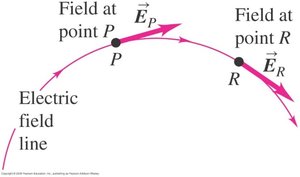
Electric field lines are a conceptual tool used to visualize the direction and strength of electric fields. The tangent to a field line at any point gives the direction of the electric field vector at that location.
Definition: An electric field line is an imaginary line or curve whose tangent at any point is the direction of the electric field vector at that point.
Origin and Termination: Field lines begin on positive charges and terminate on negative charges.
Proportionality: The number of lines drawn is proportional to the magnitude of the charge creating the field.
Uniqueness: At any point, the electric field has a unique direction; thus, only one field line can pass through each point. Field lines never intersect.
Field Strength: The electric field is stronger where the field lines are closer together.
Example: The field lines for a single positive charge radiate outward, while those for a negative charge converge inward. For two equal and opposite charges (a dipole), field lines originate from the positive charge and terminate at the negative charge, forming characteristic patterns.
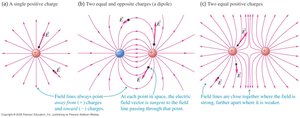
Rules for Drawing Electric Field Lines
Number of Lines: Proportional to the charge magnitude.
Direction: Lines start at positive and end at negative charges.
No Intersection: Field lines never cross or touch.
Density: Closer lines indicate stronger fields.
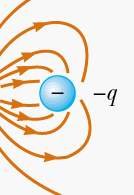
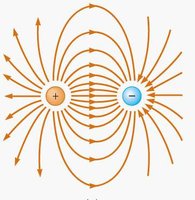
Electric Dipoles
Definition and Properties
An electric dipole consists of two point charges of equal magnitude and opposite sign, separated by a small distance. Dipoles are important in physics, chemistry, and biology, as they explain molecular interactions and properties such as solubility.
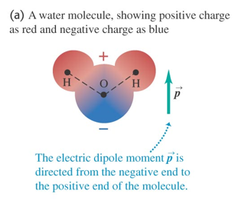
Example: The water molecule (H2O) is electrically neutral but forms a dipole due to the displacement of charge, resulting in a net negative charge on the oxygen end and a net positive charge on the hydrogen end.
Dipole Moment: The electric dipole moment is a vector directed from the negative charge to the positive charge, with magnitude where is the charge and is the separation distance.
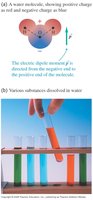
Field of an Electric Dipole
The electric field produced by a dipole is more complex than that of a single charge. It is strongest along the axis connecting the two charges and weaker perpendicular to this axis.
Force and Torque on an Electric Dipole in a Uniform Electric Field
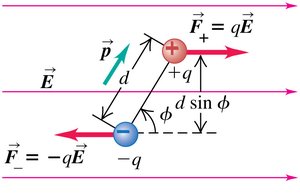
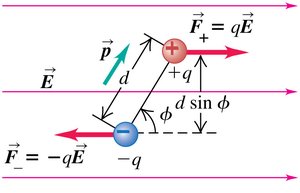
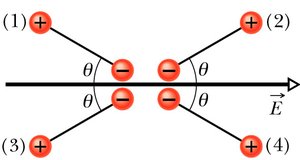
When placed in a uniform electric field, an electric dipole experiences a torque but no net force. The torque tends to align the dipole moment with the direction of the electric field.
Net Force: The net force on a dipole in a uniform field is zero.
Torque: The torque is given by , where is the dipole moment, is the electric field strength, and is the angle between and .
Potential Energy of a Dipole in an Electric Field
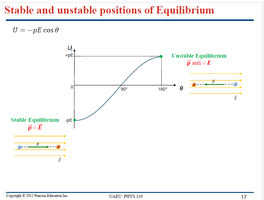
The potential energy of a dipole in a uniform electric field depends on the orientation of the dipole moment relative to the field:
Formula:
Stable Equilibrium: When (dipole aligned with field), is minimum (stable).
Unstable Equilibrium: When (dipole anti-aligned), is maximum (unstable).
Summary Table: Key Concepts in Electric Fields and Dipoles
Concept | Definition | Formula |
|---|---|---|
Electric Field Line | Imaginary line showing field direction | N/A |
Electric Dipole Moment | Vector from -q to +q | |
Torque on Dipole | Rotational effect in field | |
Potential Energy | Energy due to orientation |
Applications and Examples
Biology: Water's dipole nature makes it an excellent solvent, crucial for life processes.
Material Science: Dipoles affect dielectric properties and molecular interactions.
Physics: Understanding dipoles is essential for analyzing electric fields in molecules and materials.
Practice Questions
Q1: Identify errors in a diagram of field lines for multiple charges.
Q2: Determine the net torque on a dipole due to another charge.
Q3: Find the direction of net force exerted by a charge on a dipole.
Q4: Identify the orientation of a dipole with maximum potential energy in an external field.
Summary of Chapter 21
Electric field lines provide a visual representation of electric fields.
Electric dipoles are fundamental in understanding molecular and material properties.
Torque and potential energy concepts explain dipole behavior in fields.