 Back
BackElectric Charge, Force, and Field: Study Notes
Study Guide - Smart Notes
 Tailored notes based on your materials, expanded with key definitions, examples, and context.
Electric Charge, Force, and Field
Electric Force Between Point Charges
The electric force between two point charges is described by Coulomb's Law, which quantifies the magnitude and direction of the force based on the charges and their separation.
Coulomb's Law: The force between two point charges is given by where , and are the charges, and is the distance between them.
Direction: The force is attractive if the charges are of opposite sign and repulsive if they are of the same sign.
Vector Nature: The net force on a charge due to multiple other charges is the vector sum of the individual forces.
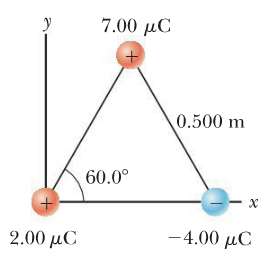
Example: Three point charges at the corners of an equilateral triangle. To find the net force on the charge at the origin, calculate the vector sum of the forces due to the other two charges.
Dependence of Electric Force on Charge and Distance
The electric force between two charges depends directly on the magnitude of the charges and inversely on the square of the distance between them.
Doubling the Charge: If one charge is doubled, the force also doubles.
Halving the Distance: If the distance between charges is halved, the force increases by a factor of four (since ).
Electric Field
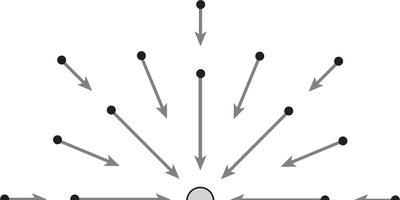
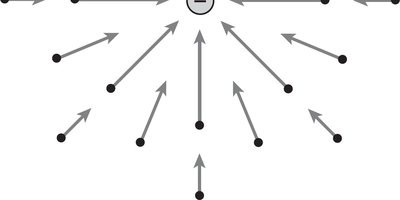
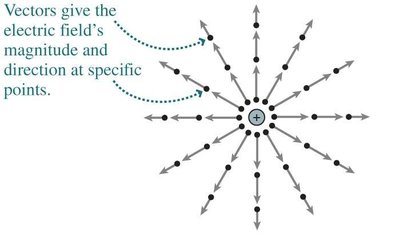
The electric field is a vector field that represents the force per unit charge at a given location in space.
Definition: , where is the force experienced by a test charge .
Direction: The field points in the direction a positive test charge would accelerate.
Units: Newtons per Coulomb (N/C).
Independence: The electric field exists independently of the test charge; it is a property of the source charges.
Example: The electric field at a distance from a point charge is
Superposition Principle for Electric Fields
The net electric field due to multiple charges is the vector sum of the fields produced by each charge individually.
Mathematical Expression:
For Point Charges:
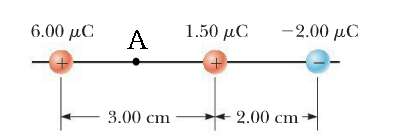
Example: Calculating the electric field at a point between several charges.
Electric Dipole
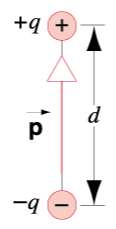
An electric dipole consists of two equal and opposite charges separated by a small distance. Many molecules and charge distributions behave like dipoles.
Dipole Moment: , where is the charge and is the displacement vector from negative to positive charge.
Field Far from Dipole:
Perpendicular to dipole (|y| >> d):
Parallel to dipole (|x| >> d):
Example: Water molecules act as electric dipoles due to their charge distribution.

Torque on an Electric Dipole in an External Field
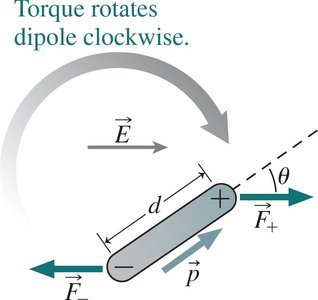
An electric dipole in a uniform electric field experiences a torque that tends to align the dipole with the field.
Torque Formula:
Physical Meaning: The torque rotates the dipole so that its moment aligns with the electric field direction.
Continuous Charge Distributions
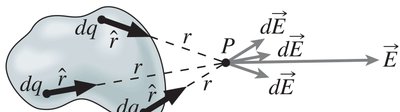
For real objects, charge is often distributed continuously rather than as discrete points. The electric field is calculated by integrating over the charge distribution.
General Formula:
Types of Charge Distributions:
Line charge:
Surface charge:
Volume charge:
Example: Electric field a distance from a long straight wire with uniform line charge density .

Motion of Charges in an Electric Field
Charged particles experience a force and thus accelerate in an electric field according to Newton's second law.
Force on a Charge:
Acceleration:
Direction: Positive charges accelerate in the direction of the field; negative charges accelerate opposite to the field.
Conductors and Insulators
Materials are classified based on their ability to allow charge to move freely.
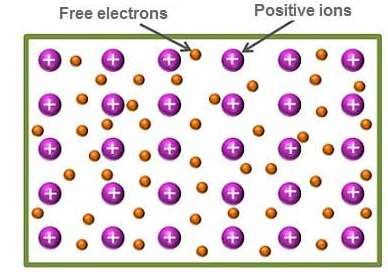
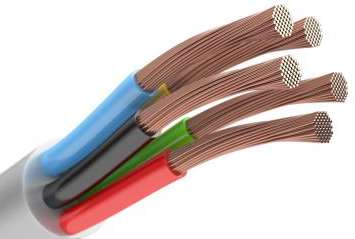
Conductors: Charges move freely; excess charge spreads out on the surface. Metals are good conductors. The flow of charge is called electric current.
Insulators: Charges are bound and cannot move freely. Excess charge remains where it is placed, leading to static electricity. Examples include rubber, glass, and plastic.
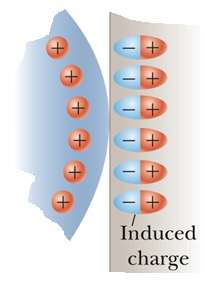
Mechanisms for Excess Charge: Contact-induced charge separation (triboelectric effect) and dielectric polarization (alignment of dipoles in an external field).
Lightning: A Natural Example of Charge Separation
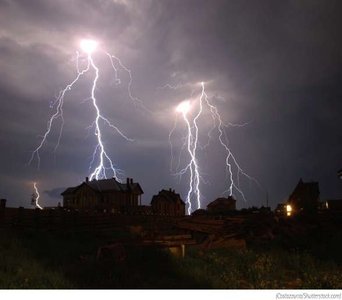
Lightning is a dramatic example of charge separation and electrostatic discharge in nature.
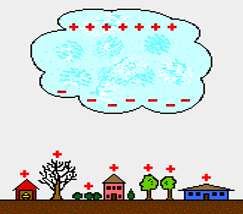
Collisions in clouds separate charges: negative at the bottom, positive at the top.
The net charge in the cloud induces an opposite charge on the ground.
When the potential difference is large enough, a rapid discharge (lightning) occurs through the air.
Electric Field vs. Gravity
The electric field is analogous to the gravitational field, but acts on charge instead of mass.
Electric Field:
Gravitational Field:
To find the force, multiply the field by the property (charge or mass): ,
Example Problem: Block on an Inclined Plane in an Electric Field
A block of mass and charge is placed on a frictionless inclined plane at angle . An electric field is applied parallel to the incline.
Find the electric field that keeps the block at rest:
If the block has a negative charge: The electric field must point in the opposite direction to balance the gravitational component.

Further Reading and Preparation
Recommended reading: Essential University Physics, Vol. 2, Chapter 20 (Electric Charge, Force, and Field)
Next topic: Electric field lines and Gauss’s Law
