 Back
BackElectric Charge, Forces, and Fields: Foundations of Electrostatics
Study Guide - Smart Notes
 Tailored notes based on your materials, expanded with key definitions, examples, and context.
Electric Charge and Its Properties
Definition and Historical Context
Electric charge is a fundamental property of matter, responsible for electromagnetic interactions. The concept of electric charge dates back to antiquity, with the Greek word 'electron' meaning amber, a material known for its ability to attract small objects when rubbed.
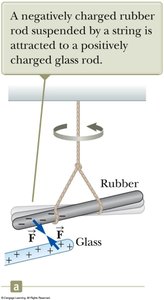
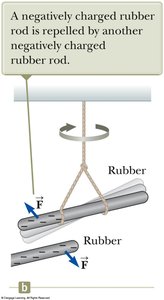
Two Types of Charge: Positive (+) and Negative (−). Opposite charges attract, like charges repel.
Conservation and Quantization: Electric charge is conserved in all processes and exists in discrete units (quantized).
Historical Figures: Early studies by Thales of Miletus, William Gilbert, Charles Coulomb, and Michael Faraday contributed to our understanding of electricity and magnetism.

Structure of Matter
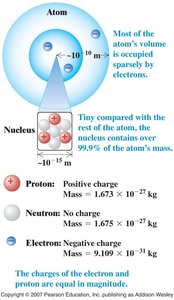
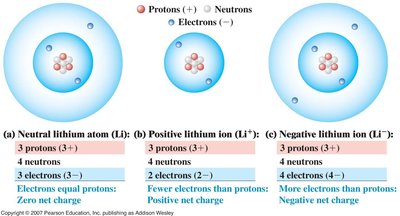
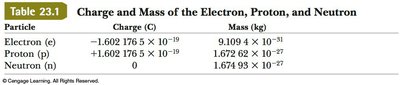
Atoms consist of electrons (negative charge), protons (positive charge), and neutrons (no charge). The atom is electrically neutral when the number of electrons equals the number of protons. Ions are atoms with a net charge due to the loss or gain of electrons.
Electron: Charge = C, Mass = kg
Proton: Charge = C, Mass = kg
Neutron: Charge = 0, Mass = kg
Conductors, Insulators, and Semiconductors
Classification of Materials
Conductors: Materials (e.g., metals) with free-moving electrons. Charges distribute over the surface when charged.
Insulators: Materials (e.g., glass, rubber) with electrons bound to atoms. Few free electrons.
Semiconductors: Intermediate properties; electrical behavior can be modified by doping (e.g., silicon, germanium).
Charging Objects: Methods and Effects
Charging by Rubbing, Induction, and Polarization
Rubbing: Electrons transfer between objects, resulting in one object becoming positively charged and the other negatively charged.
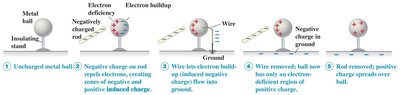
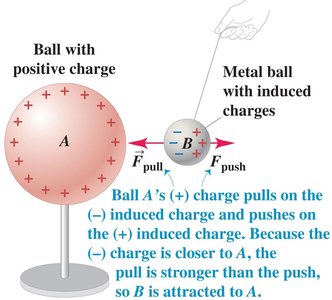
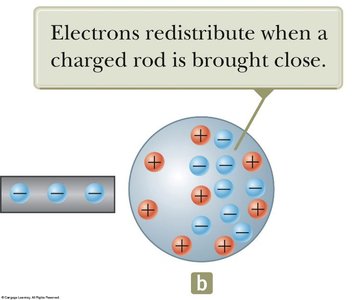
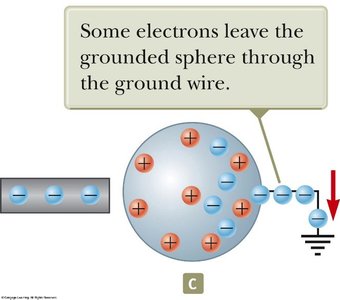
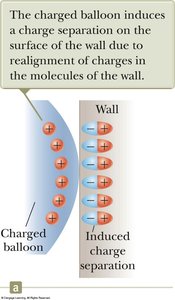
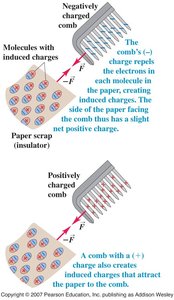
Induction: Bringing a charged object near a conductor causes redistribution of charges without direct contact. Grounding allows electrons to leave or enter, resulting in net charge.
Polarization: In insulators, external charges cause separation of electron and nucleus centers, creating dipoles.

Coulomb’s Law: Electric Forces Between Charges
Mathematical Formulation
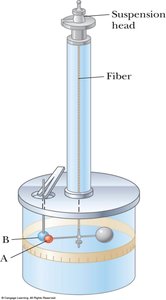
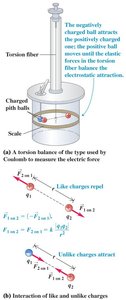
Coulomb’s Law describes the force between two point charges:
Formula:
Direction: Along the line joining the charges; attractive for opposite charges, repulsive for like charges.
Coulomb Constant: N·m2/C2 ()
Permittivity of Free Space: C2/N·m2
Comparison with Newton’s Law of Gravitation
Both laws are inverse-square laws, proportional to the product of intrinsic properties (charge or mass), but gravitational force is always attractive, while electric force can be attractive or repulsive.
Examples and Applications
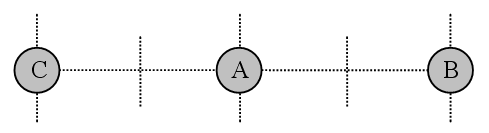
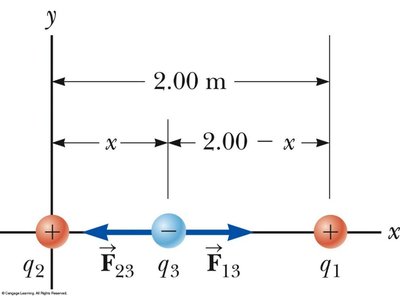
Zero Resultant Force: The position where the net force on a charge is zero can be found by equating the magnitudes of opposing forces.
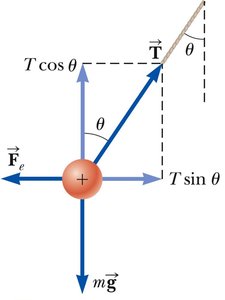
Equilibrium of Charged Spheres: Charged spheres in equilibrium experience electrical and other forces (e.g., tension, gravity).

Electric Field: Concept and Calculation
Definition and Properties
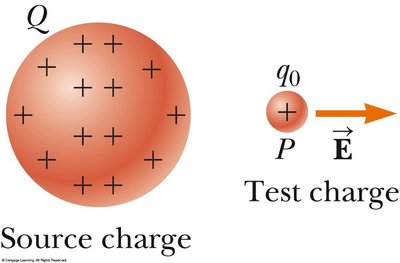
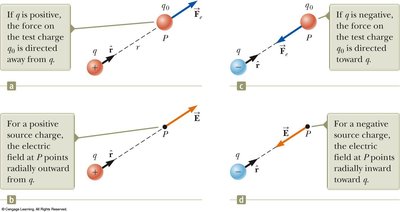
The electric field is a region of space where a charged particle experiences a force. It is a vector quantity, defined as the force per unit charge.
Formula:
Field of Point Charge:
Direction: Away from positive charges, toward negative charges.
Principle of Superposition: The total electric field at a point is the vector sum of fields from all charges.


Electric Field Lines: Visualization and Rules
Drawing and Interpretation
Electric field lines provide a pictorial representation of the field.
Direction: Lines point from positive to negative charges.
Density: The number of lines per unit area is proportional to field strength.
Rules: Lines never cross; begin on positive, end on negative charges; number of lines proportional to charge magnitude.
Conductors and Insulators in Electric Fields
Behavior in External Fields
Conductors: Free charges redistribute to cancel the internal field; electric field inside is zero. Conductors act as shields (e.g., Faraday cage).
Insulators: Atomic dipoles align with the field; internal field is reduced but not zero. Insulators do not shield electric fields.
Motion of Charged Particles in Electric Fields
Force and Acceleration
A charged particle in an electric field experiences a force and accelerates according to Newton’s second law.
Formula: ,
Uniform Field: Acceleration is constant; trajectory is parabolic for electrons between capacitor plates.
Parallel Plate Capacitor and Electrostatic Equilibrium
Capacitor Structure and Field
Parallel Plate Capacitor: Two conductive plates separated by distance, storing equal and opposite charges.
Electric Field Inside: ; uniform and constant between plates, zero outside.
Electrostatic Equilibrium in Conductors
Field Inside: Zero everywhere inside a conductor at equilibrium.
Charge Distribution: Charges reside on the surface; highest density at sharp points.
Field at Surface: Perpendicular to surface.
Summary Table: Charge and Mass of Fundamental Particles
Particle | Charge (C) | Mass (kg) |
|---|---|---|
Electron (e) | −1.602 × 10⁻¹⁹ | 9.109 × 10⁻³¹ |
Proton (p) | +1.602 × 10⁻¹⁹ | 1.672 × 10⁻²⁷ |
Neutron (n) | 0 | 1.675 × 10⁻²⁷ |
Key Equations
Coulomb’s Law:
Electric Field (Point Charge):
Superposition Principle:
Electric Field in Capacitor:
Additional info:
Historical context and biographical details were inferred to provide academic completeness.
Some images were selected to visually reinforce key concepts such as charge interactions, induction, field lines, and capacitor structure.
