 Back
BackWeek 1 Lec. 1
Study Guide - Smart Notes
 Tailored notes based on your materials, expanded with key definitions, examples, and context.
Key Concepts in Electric Charge and Vectors
Introduction
This study guide covers foundational concepts in electricity and magnetism, focusing on vectors, electric charge, polarization, and methods of charging objects. These topics are essential for understanding how electric forces arise and interact in physical systems.
Vectors in Physics
Vector Basics
Vectors are quantities that have both magnitude and direction. They are used extensively in physics to represent forces, velocities, and other directional quantities.
Components of a Vector: Any vector \( \vec{a} \) can be broken into x and y components using trigonometry:
Vector Notation: Vectors are often written with arrows (\( \vec{a} \)), boldface (a), or with unit vectors (\( a_x \hat{x} + a_y \hat{y} \)).
Vector Operations
Inverse: Reverses the direction of the vector.
Addition: Combine vectors using the head-to-tail or parallelogram method, or by adding components:
Subtraction: Add the inverse of the vector.
Multiplication: Two types:
Dot Product (Scalar):
Cross Product (Vector): (direction by right-hand rule)
Applications: Cross products are used in torque (\( \vec{\tau} = \vec{r} \times \vec{F} \)) and angular momentum (\( \vec{L} = \vec{r} \times \vec{p} \)).
Electric Charge
Nature and Types of Charge
Electric charge is an intrinsic property of matter. There are two types:
Positive Charge: Associated with protons.
Negative Charge: Associated with electrons.
Neutral Atoms: Contain equal numbers of protons and electrons.
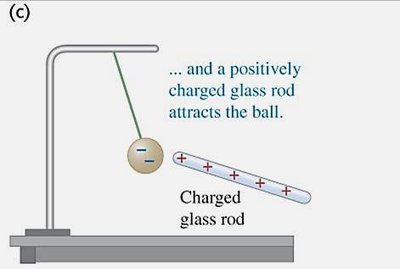
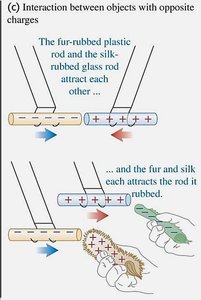
Key Principle: Like charges repel; opposite charges attract.
Quantization of Charge
Charge is quantized, meaning it occurs in discrete amounts. The fundamental unit is the elementary charge (e):
Where N is an integer, e = 1.602 × 10⁻¹⁹ C.
Proton: +e, Electron: −e.
Example: Millikan’s oil drop experiment demonstrated the quantization of charge.
Charging by Contact (Conduction)
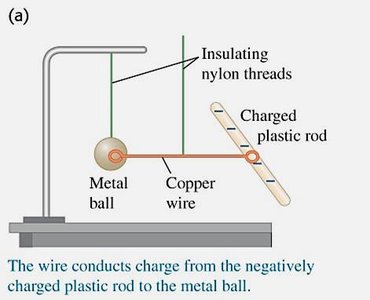
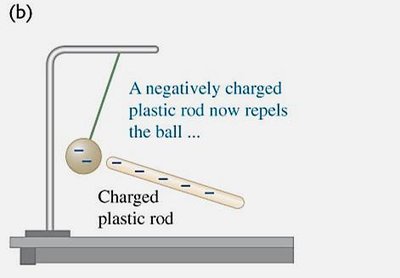
When a charged object touches a conductor, electrons can move freely, transferring charge.
Conductors: Materials that allow easy passage of charge (e.g., metals).
Insulators: Materials that resist electron flow (e.g., plastic, glass).
Charging by Induction
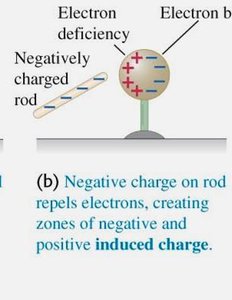
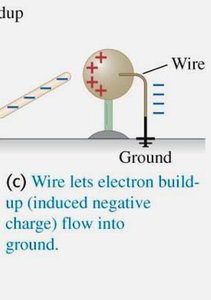
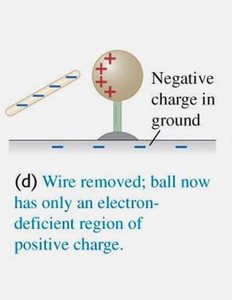
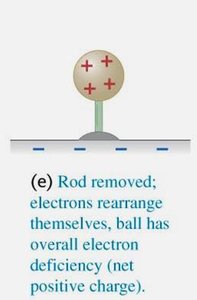
Charging by induction involves redistributing charges in a conductor without direct contact. A charged object brought near a conductor causes electrons to move, creating regions of positive and negative charge.
Grounding allows excess charge to leave or enter the conductor.
After removing the ground and the external charge, the conductor retains a net charge.
Polarization and Static Electricity
Polarization of Insulators
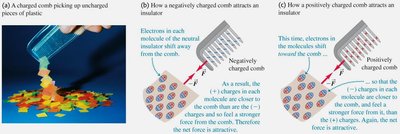
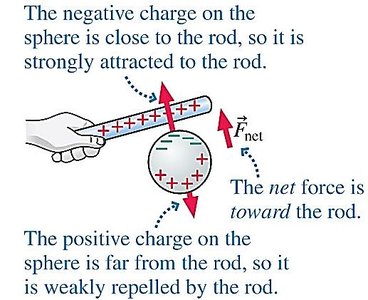
Polarization occurs when the charges within an insulator rearrange in response to a nearby charged object, creating a net attractive force even though the insulator remains overall neutral.
Negative charges in the insulator are attracted or repelled, causing a shift in charge distribution.
This explains why neutral objects can be attracted to charged objects.
Mechanisms of Charging and Interaction Examples
Friction: Charging by Rubbing
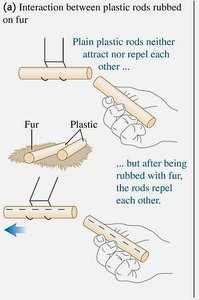
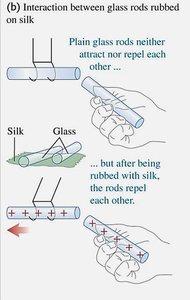
When two different materials are rubbed together, electrons can be transferred from one to the other, resulting in one object becoming negatively charged and the other positively charged.
Plastic rod and fur: Rubbing transfers electrons to the plastic, making it negative.
Glass rod and silk: Rubbing transfers electrons from glass to silk, making glass positive.
Everyday Examples of Static Electricity
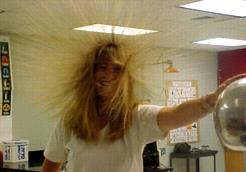
Static electricity can be observed in daily life, such as a charged comb picking up bits of paper or hair standing on end after contact with a charged object.
Conceptual Examples and Applications
Attraction and Repulsion
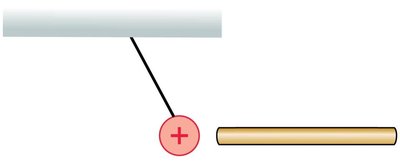
Charged rods and balls can be used to demonstrate the principles of attraction and repulsion between like and unlike charges.
Summary Table: Methods of Charging
Method | Description | Example |
|---|---|---|
Friction | Transfer of electrons by rubbing two materials | Plastic rod and fur, glass rod and silk |
Conduction | Direct contact allows electrons to move between objects | Metal ball and charged rod |
Induction | Redistribution of charge in a conductor due to a nearby charged object, with grounding | Metal ball, charged rod, and ground wire |
Conclusion
Understanding vectors, electric charge, and the mechanisms of charging is fundamental to the study of electricity and magnetism. These principles explain a wide range of physical phenomena, from the behavior of subatomic particles to everyday static electricity.
