 Back
BackElectric Charges and Fields: Structured Study Notes
Study Guide - Smart Notes
 Tailored notes based on your materials, expanded with key definitions, examples, and context.
Electric Charges and Fields
Introduction to Electrostatics
Electrostatics is the branch of physics that studies forces, fields, and potentials arising from static (non-moving) electric charges. Everyday phenomena such as sparks from synthetic clothes, lightning, and shocks from touching metal objects are explained by the discharge of accumulated static electricity.
Static Electricity: Refers to electric charges at rest.
Electrostatics: The study of static electric charges and their interactions.
Example: Lightning during thunderstorms is a large-scale discharge of static electricity.
Electric Charge
Electric charge is a fundamental property of matter, discovered through experiments such as rubbing amber with wool. There are two types of charges: positive and negative. Like charges repel, unlike charges attract.
Polarity: The property distinguishing positive and negative charges.
Electrification: Objects acquire charge through rubbing, which can be neutralized by contact.
Conservation: Charges are transferred, not created or destroyed.
Example: Glass rod rubbed with silk becomes positively charged; silk becomes negatively charged.
Conductors, Insulators, and Semiconductors
Materials are classified based on their ability to allow electric charge to move:
Conductors: Allow free movement of charges (e.g., metals, human body).
Insulators: Resist charge movement (e.g., glass, plastic, wood).
Semiconductors: Intermediate behavior between conductors and insulators.
Basic Properties of Electric Charge
Additivity: Total charge is the algebraic sum of individual charges.
Conservation: Total charge in an isolated system remains constant.
Quantisation: Charge is always an integer multiple of the elementary charge C.
Example: The charge on a body is , where is an integer.
Coulomb’s Law
Coulomb’s law quantifies the force between two point charges:
Formula:
Vector Form:
Permittivity of Free Space:
Comparison: Electric forces are much stronger than gravitational forces between elementary particles.
Superposition Principle
The force on a charge due to multiple other charges is the vector sum of individual forces:
Formula:
Example: Forces in a system of three charges are added vectorially.
Electric Field
An electric field is produced by a charge and exerts a force on other charges placed in its vicinity:
Definition:
Force Relation:
Direction: Outward for positive charges, inward for negative charges.
Unit: Newton per Coulomb (N/C)
Electric Field Due to Multiple Charges
The electric field at a point due to a system of charges is the vector sum of fields due to each charge:
Formula:
Electric Field Lines
Electric field lines are a pictorial representation of the electric field:
Properties:
Start at positive charges, end at negative charges.
Never cross each other.
Density indicates field strength.
Do not form closed loops.
Example: Field lines around a dipole show attraction and repulsion.
Electric Flux
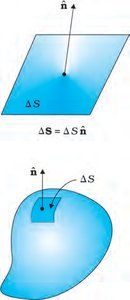
Electric flux measures the number of electric field lines passing through a surface:
Definition:
Total Flux:
Unit: N·m2/C
Electric Dipole
An electric dipole consists of two equal and opposite charges separated by a distance:
Dipole Moment:
Field on Axis:
Field on Equatorial Plane:
Physical Significance: Polar molecules have permanent dipole moments.
Dipole in a Uniform External Field
A dipole in a uniform electric field experiences a torque:
Torque:
Net Force: Zero in uniform field; nonzero in non-uniform field.
Continuous Charge Distribution
Charge can be distributed over a line, surface, or volume:
Linear Density:
Surface Density:
Volume Density:
Gauss’s Law
Gauss’s law relates the electric flux through a closed surface to the charge enclosed:
Statement:
Gaussian Surface: Any closed surface used to apply Gauss’s law.
Applications: Useful for symmetric charge distributions.
Applications of Gauss’s Law
Infinite Line Charge:
Infinite Plane Sheet:
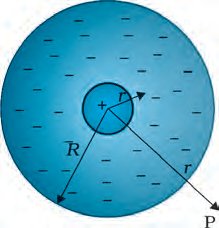
Thin Spherical Shell:
Outside:
Inside:
Summary Table: Key Physical Quantities
Physical Quantity | Symbol | Dimensions | Unit | Remarks |
|---|---|---|---|---|
Vector area element | ΔS | [L2] | m2 | ΔS = ΔS ˆn |
Electric field | E | [MLT-3A-1] | V/m | Vector quantity |
Electric flux | φ | [ML3T-3A-1] | V·m | φ = E ΔS |
Dipole moment | p | [LTA] | C·m | Vector from -q to +q |
Linear charge density | λ | [L-1TA] | C/m | Charge/length |
Surface charge density | σ | [L-2TA] | C/m2 | Charge/area |
Volume charge density | ρ | [L-3TA] | C/m3 | Charge/volume |
Points to Ponder
Protons are held together in the nucleus by the strong force, not by electrostatic repulsion.
Coulomb force can be attractive or repulsive; gravity is always attractive.
Charge is a scalar and is conserved; quantisation is a fundamental law.
Superposition principle is not obvious; it excludes multi-body forces.
Electric field due to a charge configuration with total charge zero falls off faster than .
Practice Exercises
Calculate forces, fields, and flux for various charge configurations using the formulas above.
Apply Gauss’s law to symmetric distributions for efficient calculation of electric fields.
Relevant Images
Description: Illustrates the concept of vector area element and its normal direction, essential for understanding electric flux and Gauss's law.
Description: Shows a spherical charge distribution and the Gaussian surface used in applying Gauss's law to find the electric field inside and outside a sphere.
Additional info: The notes above expand on brief textbook points, providing full academic context, definitions, formulas, and examples for self-contained study. All equations are formatted in LaTeX for clarity. Only images directly relevant to the explanation of electric flux and Gauss's law are included.
