 Back
BackElectric Charges, Forces, and Fields (Chapter 19) – Study Notes
Study Guide - Smart Notes
 Tailored notes based on your materials, expanded with key definitions, examples, and context.
Electric Charges, Forces, and Fields
Introduction to Electric Charge
Electric charge is a fundamental property of matter responsible for electric phenomena. The study of electric charges, their interactions, and the resulting fields forms the basis of electrostatics.
Electric charge can be positive or negative. Like charges repel, and opposite charges attract.
Charge is quantized (comes in discrete amounts) and conserved (cannot be created or destroyed).
The SI unit of charge is the coulomb (C).
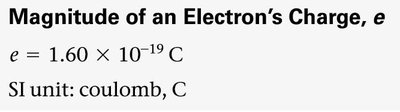
The elementary charge (magnitude of the charge of a single proton or electron):
Static Electricity and Charging
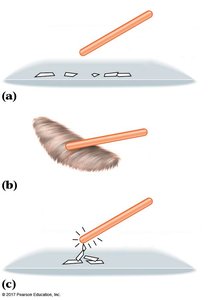
Static electricity arises when electric charges are transferred between materials, often by friction (triboelectric effect).
When an object is rubbed (e.g., amber with fur), electrons may transfer from one material to another, leaving one object negatively charged and the other positively charged.
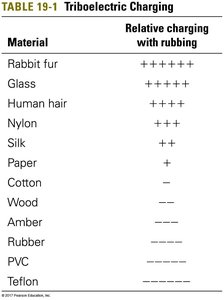
Materials can be ranked by their tendency to gain or lose electrons when rubbed (triboelectric series).
Atomic Structure and Charge
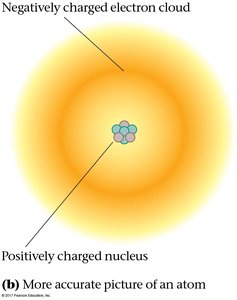
Atoms consist of a positively charged nucleus (protons and neutrons) surrounded by a cloud of negatively charged electrons. In a neutral atom, the number of protons equals the number of electrons.
Electrons can be transferred relatively easily, leading to charged atoms (ions).
All electrons have the same charge; protons have equal but opposite charge.
Conductors, Insulators, and Semiconductors
Materials are classified by how easily charges move within them:
Conductors: Electrons move freely (e.g., metals).
Insulators: Electrons are tightly bound and do not move easily (e.g., glass, rubber).
Semiconductors: Intermediate properties; conductivity can be altered by impurities or light.
Excess charge on a conductor resides on its surface, and the charges distribute themselves to minimize repulsion.
Charging by Induction and Polarization
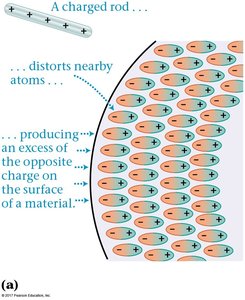
Objects can be charged without direct contact through induction. Polarization occurs when the charges within a neutral object rearrange in response to an external electric field.
Induction: Bringing a charged object near a conductor causes charges to redistribute. If the conductor is grounded, charges can leave or enter, resulting in a net charge.
Polarization: In insulators, atoms or molecules rotate or shift slightly, creating regions of slight positive and negative charge.
Coulomb’s Law
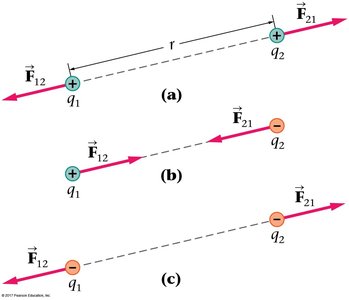
Coulomb’s law quantifies the force between two point charges:
The force is along the line joining the charges.
It is attractive for opposite charges and repulsive for like charges.
where

Superposition Principle
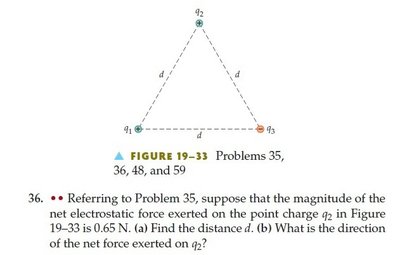
If multiple charges are present, the net force on any charge is the vector sum of the forces from all other charges.
The Electric Field
The electric field describes the influence a charge exerts on the space around it. It is defined as the force per unit charge:
The direction of is the direction of the force on a positive test charge.
For a point charge at distance :
Electric fields from multiple charges add as vectors (superposition).
Electric Field Lines
Electric field lines are a visual tool to represent the direction and strength of the electric field.
Lines point away from positive charges and toward negative charges.
The density of lines indicates field strength.
Lines never cross.
Shielding and Charge Distribution in Conductors
In conductors, excess charge resides on the surface, and the electric field inside is zero (in electrostatic equilibrium). The field is perpendicular to the surface and strongest at sharp points.
Electric Flux and Gauss’s Law
Electric flux measures the number of electric field lines passing through a surface. Gauss’s law relates the electric flux through a closed surface to the charge enclosed:
Gauss’s law is especially useful for systems with high symmetry (spheres, cylinders, planes).
Summary Table: Triboelectric Charging
The following table summarizes the relative tendency of materials to gain or lose electrons when rubbed (triboelectric series):
Material | Relative charging with rubbing |
|---|---|
Rabbit fur | +++++++ |
Glass | +++++ |
Human hair | +++++ |
Nylon | +++ |
Silk | ++ |
Paper | + |
Cotton | - |
Wood | -- |
Amber | --- |
Rubber | ---- |
PVC | ----- |
Teflon | ------ |
Key Equations
Coulomb’s Law:
Electric Field (point charge):
Electric Flux:
Gauss’s Law:
Examples and Applications
Lightning is a dramatic example of charge separation and discharge in nature.

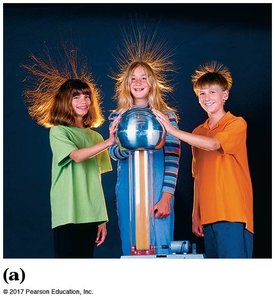
Van de Graaff generator demonstrates charge accumulation and repulsion.
Summary
Electric charge is a conserved, quantized property of matter.
Conductors, insulators, and semiconductors differ in their ability to allow charge movement.
Coulomb’s law describes the force between charges; the electric field describes the force per unit charge.
Electric field lines and Gauss’s law are powerful tools for visualizing and calculating electric fields.
