 Back
BackWeek 5 Lec. 3
Study Guide - Smart Notes
 Tailored notes based on your materials, expanded with key definitions, examples, and context.
Electric Circuits
Discharging a Capacitor in an RC Circuit
When a charged capacitor is connected across a resistor, it discharges over time, and the charge and current in the circuit decrease exponentially. Understanding the time behavior of an RC circuit is essential for analyzing transient responses in electric circuits.
Kirchhoff’s Loop Law: For a discharging capacitor, the sum of potential differences around the loop is zero: .
Current as Rate of Change of Charge: (the negative sign indicates decreasing charge).
Differential Equation: .
Solution for Charge: , where is the initial charge.
Solution for Current: .
Example: If a capacitor with and is discharged, after , .
Power in Electric Circuits
Power in electric circuits is the rate at which energy is transferred or converted. It can be calculated using Ohm’s Law and the definitions of voltage, current, and resistance.
Power Formulas:
Application: For a resistor of and , .
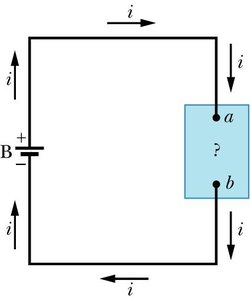
Safety Note: Currents as low as 5 mA can cause a shock, 10 mA can cause muscle contraction, and 100 mA can be fatal if passing through the body for 1 second.
Magnetism
Basic Properties of Magnets
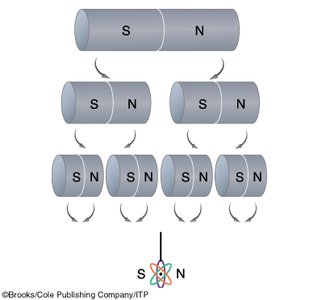
Magnets have two poles, North and South. Like poles repel, and unlike poles attract. Magnetic poles always occur in pairs; isolated magnetic monopoles have not been observed.
Breaking a Magnet: Each piece forms its own North and South poles, no matter how many times it is divided.
Magnetic Field Lines
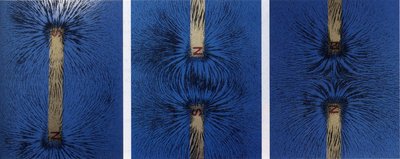
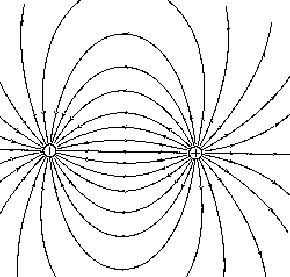
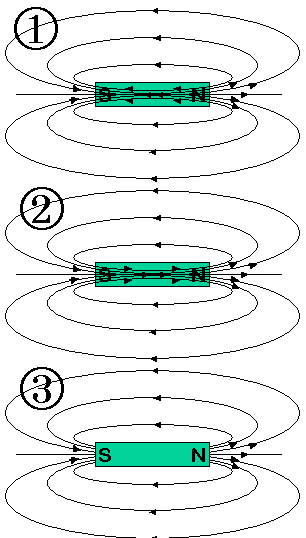
Magnetic field lines visually represent the direction and strength of the magnetic field. They emerge from the North pole and enter the South pole outside the magnet, forming closed loops.
Direction: Arrows indicate the direction of the field (N to S outside the magnet).
Density: The closer the lines, the stronger the field.
Continuity: Field lines never start or stop abruptly; they are continuous.
Magnetism and Materials
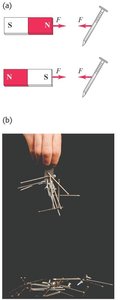
Magnets attract certain metals, such as iron, due to the alignment of magnetic domains within the material. Both poles of a magnet can attract ferromagnetic materials.
Earth’s Magnetic Field
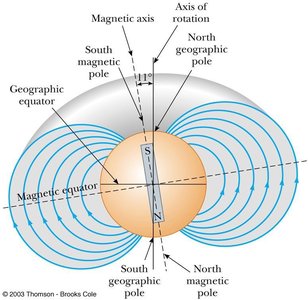
The Earth acts as a giant magnet with a magnetic field similar to that of a bar magnet. The magnetic axis is tilted relative to the geographic axis, and the magnetic poles are not exactly at the geographic poles.
Magnetic Force on Moving Charges (Lorentz Force)
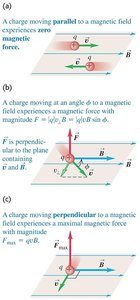
A moving electric charge in a magnetic field experiences a force called the Lorentz force. The magnitude and direction of this force depend on the charge, velocity, and the magnetic field.
Force Equation:
Magnitude:
Direction: Perpendicular to both and (right-hand rule).
Special Cases:
If is parallel to , .
If is perpendicular to , is maximum.
Direction of Magnetic Force and Field Lines
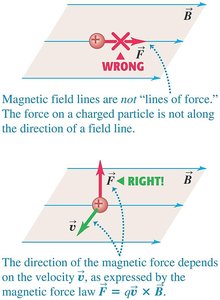
Magnetic field lines are not lines of force. The force on a charged particle is not along the field line but is determined by the cross product of velocity and field. The right-hand rule helps determine the direction of the force.
Additional info: The notes above integrate and expand upon the provided material, ensuring all key concepts are covered with academic clarity and completeness.
