 Back
Backlec 6
Study Guide - Smart Notes
 Tailored notes based on your materials, expanded with key definitions, examples, and context.
Electromotive Force and Electric Current
Electromotive Force (emf)
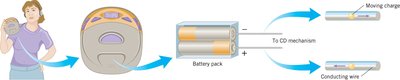
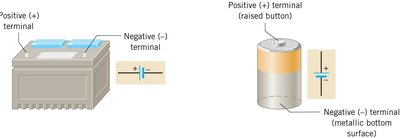
The electromotive force (emf) is the maximum potential difference provided by an energy source, such as a battery, to drive charge around a circuit. It is measured in volts (V). The emf is not a force but a potential difference that causes current to flow.
Example: A 12 V battery has an emf of 12 V.
Source of emf: Batteries and generators are common sources.
Electrochemical Cells
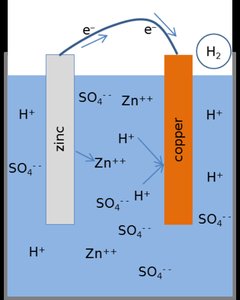
Electrochemical cells, such as the zinc-copper cell, generate emf through chemical reactions that transfer electrons from one terminal to another. The movement of electrons from the zinc to the copper electrode creates a potential difference.
Example Reaction: Zn → Zn2+ + 2e−; 2H+ + 2e− → H2
Electrolyte: The solution (e.g., H2SO4) allows ion movement to complete the circuit.
Electric Current
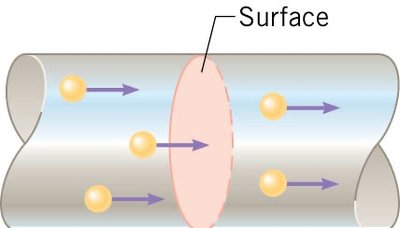
Electric current (I) is the rate at which charge flows through a surface perpendicular to the motion of the charges. It is measured in amperes (A), where 1 A = 1 coulomb/second.
Formula:
Direct Current (DC): Charges move in one direction (e.g., batteries).
Alternating Current (AC): Charges reverse direction periodically (e.g., household outlets).
Conventional Current vs. Electron Flow
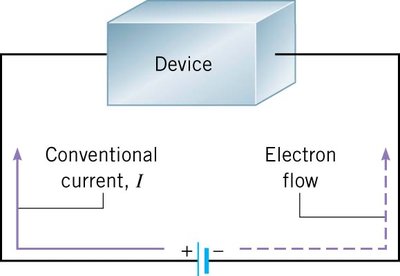
By convention, current is considered to flow from the positive to the negative terminal, even though electrons actually move from negative to positive. This is known as conventional current.
Conventional current: Direction positive charges would move.
Electron flow: Actual direction of electron movement (opposite to conventional current).
Ohm’s Law and Resistance
Ohm’s Law
Ohm’s Law states that the current through a conductor between two points is directly proportional to the voltage across the two points, provided the temperature remains constant. The proportionality constant is the resistance (R):
Formula:
Resistance (R): Measured in ohms (Ω), where .
Interpretation: Higher resistance means less current for a given voltage.
Resistors
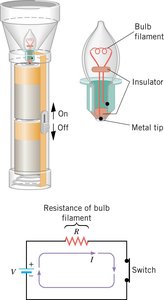
A resistor is a device or material that resists the flow of electric current, converting electrical energy into heat. The resistance depends on the material, length, and cross-sectional area.
Example: The filament in a light bulb acts as a resistor, heating up and emitting light when current passes through it.
Resistance and Resistivity
The resistance of a uniform conductor is given by:
Formula:
Where:
= resistance (Ω)
= resistivity (Ω·m), a material property
= length of conductor (m)
= cross-sectional area (m2)
Interpretation: Longer wires and smaller cross-sectional areas increase resistance.
Resistivity of Materials
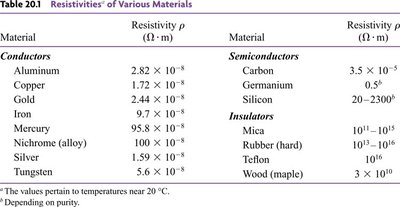
Different materials have different resistivities. Conductors have low resistivity, insulators have high resistivity, and semiconductors have intermediate values.
Material | Resistivity (Ω·m) |
|---|---|
Aluminum | 2.82 × 10⁻⁸ |
Copper | 1.72 × 10⁻⁸ |
Gold | 2.44 × 10⁻⁸ |
Iron | 9.7 × 10⁻⁸ |
Carbon (semiconductor) | 3.5 × 10⁻⁵ |
Mica (insulator) | 1011–1015 |
Rubber (hard, insulator) | 1013–1016 |
Teflon (insulator) | 1016 |
Temperature Dependence of Resistivity
The resistivity of most materials increases with temperature. The relationship is given by:
Formula:
= resistivity at reference temperature
= temperature coefficient of resistivity
= temperature in °C
For some materials, if the temperature is lowered below a critical value (), they become superconductors with zero resistivity ().
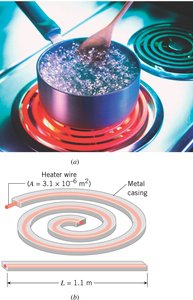
Example: Heating Element
The resistance of a heating element can be calculated using its resistivity, length, and cross-sectional area. As the temperature increases, so does the resistance.
Energy Storage in Capacitors
Energy Stored in a Capacitor
A capacitor stores energy in the electric field between its plates. The energy stored is given by:
Formula:
= capacitance (F)
= potential difference (V)
= charge (C)
Energy Density in an Electric Field
The energy density (energy per unit volume) stored in an electric field is:
Formula:
= dielectric constant
= permittivity of free space
= electric field (V/m)
Example Calculation
How much energy is stored in a 10 F capacitor with a potential difference of 3 V?
This is equivalent to the gravitational potential energy of a 4.6 kg mass raised 1 m above the ground ().
Summary Table: Resistivity of Various Materials
Material | Resistivity (Ω·m) |
|---|---|
Aluminum | 2.82 × 10⁻⁸ |
Copper | 1.72 × 10⁻⁸ |
Gold | 2.44 × 10⁻⁸ |
Iron | 9.7 × 10⁻⁸ |
Mercury | 9.58 × 10⁻⁷ |
Silver | 1.59 × 10⁻⁸ |
Tungsten | 5.6 × 10⁻⁸ |
Carbon (semiconductor) | 3.5 × 10⁻⁵ |
Germanium (semiconductor) | 0.5 |
Silicon (semiconductor) | 20–2300 |
Mica (insulator) | 1011–1015 |
Rubber (hard, insulator) | 1013–1016 |
Teflon (insulator) | 1016 |
Wood (maple, insulator) | 3 × 10¹⁰ |
Additional info: The above notes cover the core concepts of electric circuits, including emf, current, resistance, Ohm's law, resistivity, temperature effects, and energy storage in capacitors, as relevant to a college-level physics course.
