 Back
BackElectric Current and Electromotive Force (EMF): Foundations of Electric Circuits
Study Guide - Smart Notes
 Tailored notes based on your materials, expanded with key definitions, examples, and context.
Electric Current and EMF
Introduction to Electric Current and Circuits
Electric current is the flow of electric charge through a conductor, forming the basis of electric circuits. This section transitions from the study of electric fields and potentials due to individual charges or distributions to the collective behavior of charges in circuits.
22.1: A Model for Current
Macroscopic and Microscopic Models of Current
Electric current in a conductor can be understood both macroscopically (as a flow of charge) and microscopically (as the movement of electrons within a metal lattice).
Macroscopic Model: Current is the net movement of charge through a wire or circuit element.
Microscopic Model: In metals, conduction electrons are free to move among fixed positive ions, creating current when an electric field is applied.
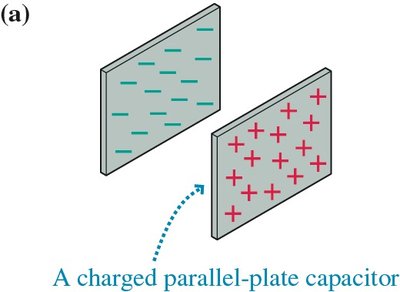
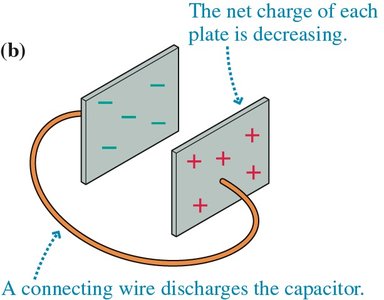
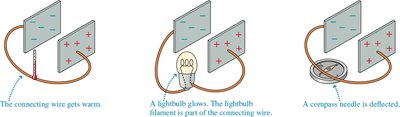
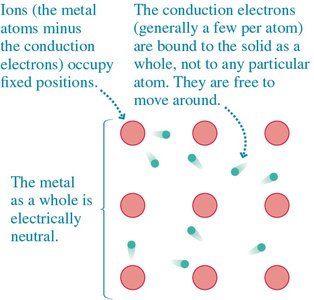
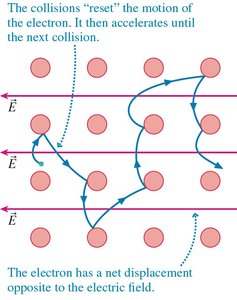
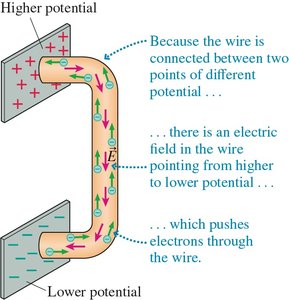
Key Point: The electric field inside a conductor drives the motion of electrons, even though the net field in a static conductor is zero. When connected to a voltage source, a field is established, causing current.
Factors Affecting Current: Material properties (resistivity), cross-sectional area, length, and applied voltage.
22.2: Defining and Describing Current
Definition and Units of Electric Current
Electric current (I) is defined as the rate at which charge (q) flows through a surface or conductor.
Formula:
Units: Amperes (A), where 1 A = 1 coulomb/second (C/s).
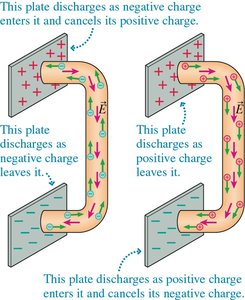
Direction of Current: By convention, current direction is the direction positive charges would move, even though electrons (negative charges) are the actual charge carriers in metals.
Example: Charge Flow Through a Lightbulb
Given a 50 W light bulb with a current of 0.43 A, the total charge passing through in 1 minute is:
Example: Seawater Salinity Probe
A probe passes 1 μA (1 × 10⁻⁶ A) between electrodes. The number of sodium ions passing per second can be calculated using the charge of a single ion.

Number of ions per second: , where .
Conservation of Current
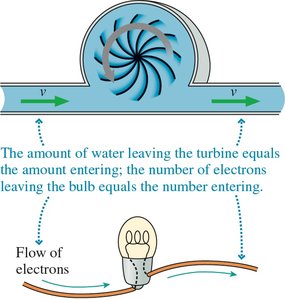
Current is conserved at any junction in a circuit, meaning the total current entering a junction equals the total current leaving.
Junction Rule:
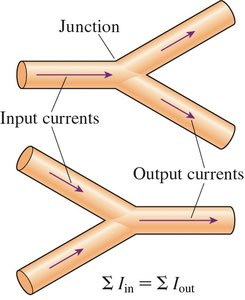
Example: Currents at a Junction
Given several wires meeting at a junction, the unknown current can be found using the conservation rule.
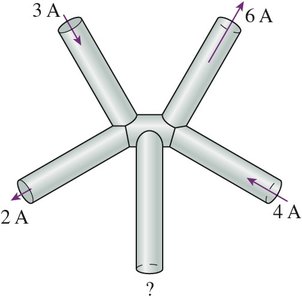
Example Calculation: If 3 A, 2 A, and 6 A enter, and 4 A leaves, the unknown current must be 7 A leaving to balance the equation.
22.3: Batteries and Electromotive Force (EMF)
Batteries as Sources of EMF
Batteries provide the energy needed to maintain a continuous flow of current in a circuit by supplying an electromotive force (EMF, ).
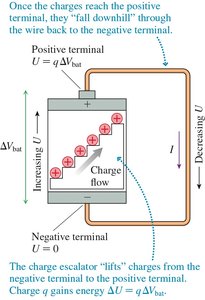
EMF (): The energy supplied per unit charge by a battery or generator, measured in volts (V).
Potential Difference:
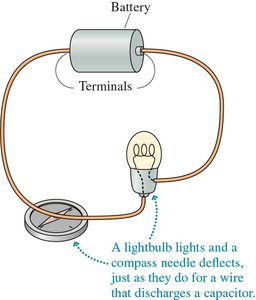
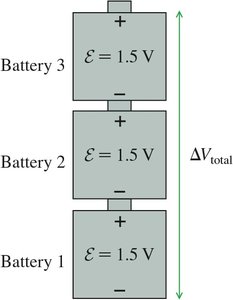
Batteries in Series: The total EMF is the sum of individual EMFs:
Energy Transfer: As charge moves through the battery, it gains energy , which is then delivered to the circuit.
Reference: Fundamental Equations and Constants
Key Equations for Circuits
Current:
Ohm's Law:
Resistance: , where is resistivity, is length, is cross-sectional area
Power:
EMF:
Fundamental Constants
Constant | Symbol | Value |
|---|---|---|
Elementary charge | e | C |
Permittivity of free space | C2/(N·m2) | |
Permeability of free space | T·m/A | |
Speed of light | c | m/s |
Summary Table: Key Concepts in Electric Current and EMF
Concept | Definition/Formula | Units |
|---|---|---|
Current (I) | A (C/s) | |
EMF () | Energy per unit charge supplied by a source | V (J/C) |
Ohm's Law | V | |
Resistance (R) | Ω | |
Power (P) | W (J/s) |
Additional info: This guide covers the foundational concepts of electric current, its microscopic and macroscopic models, the definition and calculation of current, conservation at junctions, and the role of batteries and EMF in circuits. It also provides essential equations and constants for solving circuit problems.
