 Back
BackElectric Current, Circuits, and Ohm’s Law: Study Guide
Study Guide - Smart Notes
 Tailored notes based on your materials, expanded with key definitions, examples, and context.
Electric Current
Definition and Properties
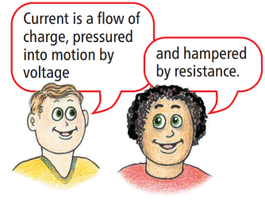
Electric current is the flow of electric charge, typically electrons, through a conductor. Current flows only when there is a difference in electric potential (voltage) across the conductor. The unit of current is the ampere (A), where 1 ampere equals 1 coulomb of charge passing a point per second.
Current flows only when there is a voltage difference.
No voltage means no current.
Current is measured in amperes (A).
1 ampere = 1 coulomb/second.
Voltage (Electric Potential Difference)
Definition and Role
Voltage, or electric potential difference, is the "electrical pressure" that pushes charges through a circuit. It supplies energy per unit charge and is measured in volts (V). Voltage does not flow; it is the cause of charge flow.
Voltage supplies energy to charges.
Measured in volts (V): 1 volt = 1 joule/coulomb.
Common sources: batteries (chemical energy), generators (mechanical energy).
Electrical Resistance
Definition and Factors
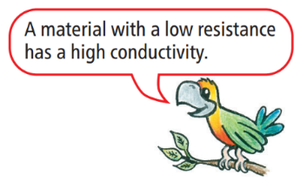
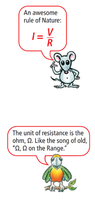
Electrical resistance is the property of a material that opposes the flow of charge. It is measured in ohms (Ω). Resistance depends on material, length, thickness, and temperature.
Material: Copper has lower resistance than steel.
Length: Longer wires have more resistance.
Thickness: Thicker wires have less resistance.
Temperature: Higher temperature increases resistance in most metals.
More resistance means less current for a given voltage.
Ohm’s Law
Relationship Between Current, Voltage, and Resistance
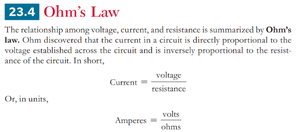
Ohm’s Law relates current (I), voltage (V), and resistance (R) in a circuit. It states that current is directly proportional to voltage and inversely proportional to resistance.
Formula:
Increasing voltage increases current.
Increasing resistance decreases current.
Used to calculate missing values in a circuit.

Electric Circuits
Types and Properties
An electric circuit is a complete path for electric current. Circuits can be open (no current flows) or closed (current flows). The two main types are series and parallel circuits.
Series circuit: Only one path for current; same current flows through all components.
Parallel circuit: Multiple paths for current; same voltage across each branch.
Series Circuits
In a series circuit, all devices share the same current. The total resistance is the sum of individual resistances. If one device fails, the entire circuit stops.
Adding more bulbs increases resistance and decreases brightness.
All bulbs get dimmer as more are added.
Parallel Circuits
In a parallel circuit, current splits among branches, and the same voltage is applied to each branch. If one device fails, others continue to work. Adding devices increases total current, not brightness.
Used in home wiring for reliability.
Electric Power
Definition and Calculation
Electric power is the rate at which electric energy is used or transferred. It is measured in watts (W) and calculated as the product of current and voltage.
Formula:
Energy companies charge for kilowatt-hours (kWh).
Higher power means more energy used and higher cost.
Direct Current (DC) vs Alternating Current (AC)
Comparison and Applications
Direct current (DC) flows in one direction and is produced by batteries. Alternating current (AC) vibrates back and forth and is used in household electricity. AC is preferred for long-distance power transmission.
In the U.S., AC frequency is 60 Hz.
Speed and Source of Electrons
Electron Movement and Electric Field
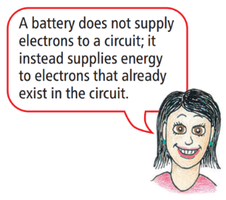
Electric signals travel nearly at the speed of light, but electrons themselves move slowly (drift velocity). Batteries supply energy, not electrons; electrons are already present in the circuit.
Lamps and Energy Efficiency
Types of Bulbs and Efficiency
Incandescent bulbs produce light by heating a filament, wasting most energy as heat. CFLs and LEDs use less energy, last longer, and produce less heat. LEDs are the most efficient lighting option.
Overloading, Fuses, and Circuit Breakers
Safety Devices
Too many devices can cause excess current and fire risk. Fuses melt and break the circuit if current is too high. Circuit breakers automatically shut off the circuit and can be reset. Both are safety devices to prevent overheating.
Summary of Terms
Key Definitions
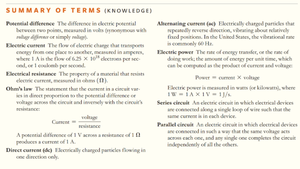
Potential difference: Difference in electric potential between two points, measured in volts.
Electric current: Flow of electric charge, measured in amperes.
Electrical resistance: Property of a material that resists current, measured in ohms.
Ohm’s Law:
Direct current (dc): Charges flow in one direction.
Alternating current (ac): Charges vibrate back and forth.
Electric power:
Series circuit: One path for current.
Parallel circuit: Multiple paths for current.
Conceptual Check Points
Understanding Circuit Behavior
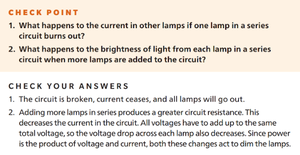
If one lamp in a series circuit burns out, the circuit is broken and all lamps go out.
Adding more lamps in series increases resistance and decreases brightness.
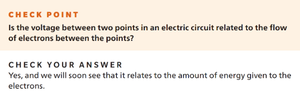
Voltage between two points relates to the energy given to electrons.
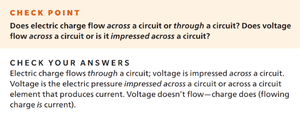
Charge flows through a circuit; voltage is impressed across a circuit.
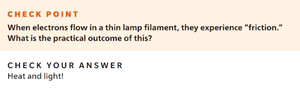
Electrons flowing in a lamp filament produce heat and light due to resistance.
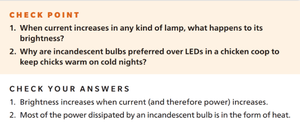
Brightness increases with current; incandescent bulbs dissipate most power as heat.
Summary Table: Ohm’s Law Formulas
To Find | Formula |
|---|---|
Voltage (V) | |
Current (I) | |
Resistance (R) |
Summary Table: Circuit Types
Type | Current | Voltage | Effect of Adding Devices |
|---|---|---|---|
Series | Same through all devices | Divided among devices | Increases resistance, decreases brightness |
Parallel | Splits among branches | Same across all branches | Increases total current, brightness unchanged |
Additional info: Academic context and explanations have been expanded for clarity and completeness.
