 Back
BackElectric Current, Circuits, and Resistance: Step-by-Step Physics Guidance
Study Guide - Smart Notes
 Tailored notes based on your materials, expanded with key definitions, examples, and context.
Q1. Find the drift speed of electrons in a wire with a diameter of 2.00 mm, conduction electron density of electrons/m, and a current of 2.10 A.
Background
Topic: Electric Current and Drift Velocity
This question tests your understanding of how electric current relates to the drift speed of electrons in a conductor, using the concept of current density and the microscopic model of current.
Key Terms and Formulas
Current (): The rate of flow of electric charge.
Drift speed (): The average velocity of conduction electrons due to an electric field.
Number density (): Number of conduction electrons per unit volume.
Cross-sectional area (): Area through which current flows.
Key formula:
Where:
= current (A)
= conduction electron density (electrons/m)
= elementary charge ( C)
= cross-sectional area of the wire (m)
= drift speed (m/s)
Step-by-Step Guidance
Calculate the cross-sectional area of the wire using its diameter: , where and mm (convert to meters).
Rearrange the formula for drift speed:
Plug in the known values: A, electrons/m, C, and your calculated .
Check your units to ensure consistency (A, m, electrons/m, C).
Try solving on your own before revealing the answer!
Q2. Calculate the diameter of a 2.83 cm long tungsten filament with resistance 0.775 Ω. (Resistivity of tungsten: Ω·m)
Background
Topic: Resistance and Resistivity
This question tests your ability to relate the physical dimensions of a conductor to its resistance using the resistivity formula.
Key Terms and Formulas
Resistance (): Opposition to current flow, measured in ohms (Ω).
Resistivity (): Material property that quantifies how strongly a material opposes current flow.
Length (): Length of the conductor (in meters).
Area (): Cross-sectional area (in m).
Key formula:
Where and .
Step-by-Step Guidance
Convert the filament length from cm to meters.
Rearrange the resistance formula to solve for area :
Calculate using the given values for , , and .
Find the radius from , then double it to get the diameter (convert to mm).
Try solving on your own before revealing the answer!
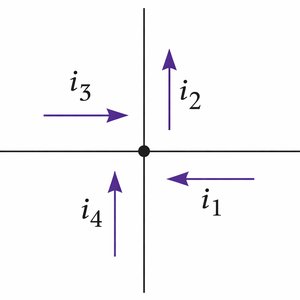
Q3. For the junction shown in the figure, which equation correctly expresses the sum of the currents?
Background
Topic: Kirchhoff's Junction Rule (Conservation of Charge)
This question tests your understanding of how currents entering and leaving a junction relate, based on the principle of conservation of electric charge.
Key Terms and Formulas
Junction Rule: The sum of currents entering a junction equals the sum of currents leaving the junction.
Current direction: Currents directed toward the junction are considered positive (entering), and those directed away are negative (leaving), or vice versa depending on convention.
Step-by-Step Guidance
Identify which currents are entering and which are leaving the junction based on the arrows in the diagram.
Apply Kirchhoff's Junction Rule:
Write an equation where the sum of entering currents minus the sum of leaving currents equals zero.
Match your equation to one of the provided answer choices.
Try solving on your own before revealing the answer!
Q4. Three resistors (19.6 Ω, 21.1 Ω, 12.5 Ω) are connected in parallel across 89 V. What is the total resistance?
Background
Topic: Resistors in Parallel
This question tests your ability to calculate the equivalent resistance for resistors connected in parallel.
Key Terms and Formulas
Parallel resistors: The reciprocal of the total resistance is the sum of the reciprocals of individual resistances.
Key formula:
Step-by-Step Guidance
Write down the values for Ω, Ω, Ω.
Plug these values into the parallel resistance formula.
Calculate each reciprocal and sum them.
Take the reciprocal of the sum to find .
Try solving on your own before revealing the answer!
Q5. A battery with emf 12.00 V and internal resistance r is connected to a resistor R. Terminal voltage is 11.70 V and current is 0.13 A. What is the value of the external resistor R?
Background
Topic: Circuits with Internal Resistance
This question tests your understanding of how internal resistance affects the terminal voltage and how to use Ohm's law to find the external resistance.
Key Terms and Formulas
Terminal voltage (): The voltage measured across the battery's terminals when a current flows.
Ohm's Law:
Key formula:
Step-by-Step Guidance
Identify the terminal voltage ( V) and current ( A).
Use Ohm's law to solve for :
Plug in the values and calculate .
Try solving on your own before revealing the answer!
Q6. What is the internal resistance r of the battery?
Background
Topic: Internal Resistance of Batteries
This question tests your ability to relate emf, terminal voltage, current, and internal resistance.
Key Terms and Formulas
Emf (): The ideal voltage of the battery.
Internal resistance (): The resistance inside the battery.
Key formula:
Step-by-Step Guidance
Write the equation relating emf, terminal voltage, current, and internal resistance.
Rearrange to solve for :
Plug in the values for , , and .
Try solving on your own before revealing the answer!
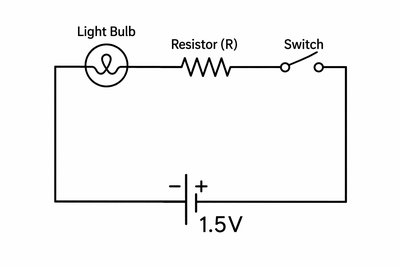
Q7. What is the voltage across the switch in the circuit shown below?
Background
Topic: Circuits with Open Switches
This question tests your understanding of how an open switch affects the voltage distribution in a simple series circuit.
Key Terms and Formulas
Open switch: No current flows through the circuit.
Potential difference: Voltage across an open switch is equal to the emf of the battery if the switch is the only break in the circuit.
Step-by-Step Guidance
Recognize that with the switch open, no current flows in the circuit.
Determine the potential difference across the open switch by considering the battery's emf and the lack of current.
Relate the voltage across the switch to the battery voltage.
Try solving on your own before revealing the answer!
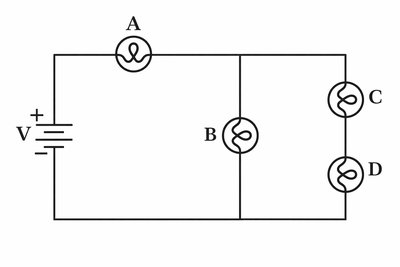
Q8. Rank the order of the lightbulbs (A–D) based on brightness from brightest to dimmest in the circuit below.
Background
Topic: Series and Parallel Circuits, Power Dissipation
This question tests your understanding of how current and voltage are distributed in series and parallel circuits, and how this affects the brightness of identical bulbs.
Key Terms and Formulas
Brightness: Proportional to power dissipated ( or ).
Series and parallel: Bulbs in parallel get the same voltage; bulbs in series share the voltage.
Step-by-Step Guidance
Identify which bulbs are in series and which are in parallel.
Determine the voltage across each bulb or group of bulbs.
Use the power formula to compare the brightness of each bulb.
Rank the bulbs from brightest to dimmest based on your analysis.
Try solving on your own before revealing the answer!
Q9. An uncharged capacitor and a resistor are connected in series to a source of EMF ( V, μF, Ω). Calculate the time constant of the circuit (in ms).
Background
Topic: RC Circuits – Time Constant
This question tests your understanding of the time constant in an RC (resistor-capacitor) circuit, which determines how quickly the capacitor charges or discharges.
Key Terms and Formulas
Time constant (): The time it takes for the charge (or voltage) to change significantly (about 63%) in an RC circuit.
Key formula:
Step-by-Step Guidance
Convert the capacitance from μF to F ( F).
Multiply the resistance () by the capacitance () to find in seconds.
Convert from seconds to milliseconds (1 s = 1000 ms).
Try solving on your own before revealing the answer!
Q10. What is the current through the resistor after a long time has passed?
Background
Topic: RC Circuits – Steady State
This question tests your understanding of the behavior of an RC circuit after a long time, when the capacitor is fully charged and acts as an open circuit.
Key Terms and Formulas
Steady state: After a long time, the current through the capacitor is zero.
Ohm's Law:
Step-by-Step Guidance
Recognize that after a long time, the capacitor is fully charged and no current flows through it.
The current through the resistor is determined only by the battery and the resistor.
Use Ohm's law to calculate the current:
Convert the current to mA if necessary (1 A = 1000 mA).
Try solving on your own before revealing the answer!
Q11. Two resistors Ω and Ω are connected in series to a battery supplying V. How much power is dissipated by resistor ?
Background
Topic: Power Dissipation in Series Circuits
This question tests your ability to calculate the power dissipated by a specific resistor in a series circuit.
Key Terms and Formulas
Power (): The rate at which energy is used or dissipated.
Series circuit: The same current flows through all resistors.
Key formulas:
Step-by-Step Guidance
Calculate the total resistance: .
Find the current using .
Calculate the power dissipated by using .
Try solving on your own before revealing the answer!
