 Back
BackWeek 4 Lec. 1
Study Guide - Smart Notes
 Tailored notes based on your materials, expanded with key definitions, examples, and context.
Electric Current and Drift Velocity
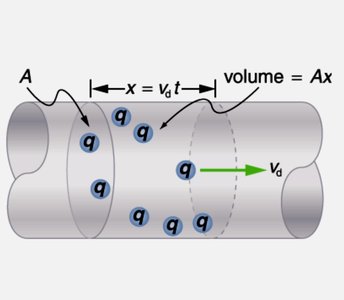
Drift Velocity in Conductors
Drift velocity refers to the average velocity of free charge carriers (such as electrons) in a conductor when subjected to an electric field. Although electrons move randomly in the absence of an external field, the application of a field causes a net movement, known as drift.
Drift velocity (vd): The average velocity of charge carriers due to an electric field.
Formula: , where I is current, n is charge carrier density, q is charge, and A is cross-sectional area.
Drift velocity is much slower than the speed at which the electrical signal propagates.
In copper conductors, electrons drift, but conventional current is defined in the opposite direction.
Example: In a copper wire, electrons drift at approximately 0.4 mm/s, while the signal travels much faster.
Microscopic Motion of Electrons
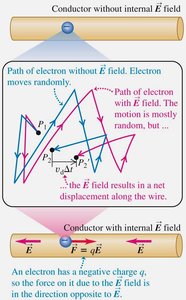
Electrons in a metal move randomly when no electric field is present. When an electric field is applied, it imposes a net drift on the electrons, resulting in a current.
Without an electric field, electron motion is random.
With an electric field, electrons experience a force and drift in a direction opposite to the field.
The direction of current is defined as the direction a positive charge would move, opposite to electron flow.
Electric Current: Definition and Measurement
Definition of Electric Current
Electric current is the flow of electric charge through a conductor. The magnitude of current is the rate at which charge passes through a cross-section.
Formula: , where dq is the charge passing through in time dt.
Current is a scalar quantity.
The direction of current is defined as the direction positive charges would move.
Steady (Direct) Current
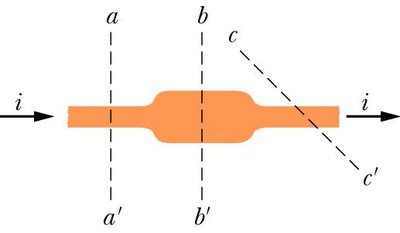
Steady or direct current (DC) is an electric current whose magnitude does not vary with time. Once the steady state is reached, the current is uniform across any cross-section of the conductor.
Total charge passed: for constant current.
SI Unit: Ampere (A), where 1 A = 1 C/s.
Current Density
Definition and Properties
Current density is a vector quantity representing the amount of current flowing per unit area of a cross-section. It is useful for describing how current is distributed in a conductor.
Formula: for uniform current.
The direction of current density is the direction positive charges would move.
Total current through a cross-section: .
Macroscopic View: Ohm's Law and Resistance
Ohm's Law
Ohm's Law relates the current, voltage, and resistance in a conductor. It is a fundamental law for understanding electric circuits.
Formula: , where V is voltage, I is current, and R is resistance.
Resistance depends on the material's resistivity, length, and cross-sectional area.
Resistance and Physical Characteristics
Resistance is defined as the ratio of applied voltage to the current passing through a conductor. It depends on both the geometry and the material properties.
Formula: , where \rho is resistivity, L is length, and A is cross-sectional area.
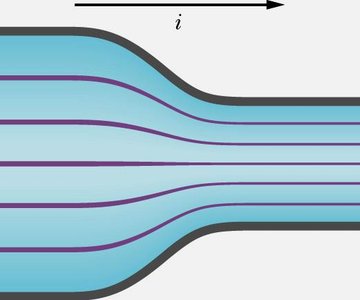
Increasing length increases resistance; increasing area decreases resistance.
Analogous to water flow in a pipe: longer pipes impede flow, wider pipes facilitate it.
Unit: Ohm (Ω).
Example: A copper wire with greater length or smaller cross-sectional area will have higher resistance.
Summary Table: Resistance and Physical Properties
Property | Effect on Resistance |
|---|---|
Length (L) | Increase L → Increase R |
Area (A) | Increase A → Decrease R |
Resistivity (ρ) | Higher ρ → Higher R |
Additional info: The notes expand on the analogy between water flow and electric current, emphasizing the dependence of resistance on geometry and material properties.
