 Back
BackWeek 4 Lec. 3
Study Guide - Smart Notes
 Tailored notes based on your materials, expanded with key definitions, examples, and context.
Electric Current, EMF, and Internal Resistance
Resistance and Temperature Dependence
The resistance of a conductor depends on its material, length, cross-sectional area, and temperature. For metals, resistance increases with temperature due to increased atomic vibrations.
Resistance Formula: , where is resistivity, is length, and is cross-sectional area.
Temperature Dependence: , where is resistance at reference temperature , is the temperature coefficient.
Example: Calculating resistance of platinum wire at different temperatures using the above formula.
Application: Used in temperature sensors and electrical heating elements.
Electromotive Force (EMF)
Electromotive force (EMF) is the energy per unit charge supplied by a source (such as a battery) to move charges from lower to higher potential. It is not a force, but a potential difference.
Definition: , where is work done and is charge moved.
SI Unit: Volt (V), where .
Ideal EMF Device: No internal resistance; terminal voltage equals EMF.
Real EMF Device: Has internal resistance; terminal voltage is less than EMF due to energy dissipation.
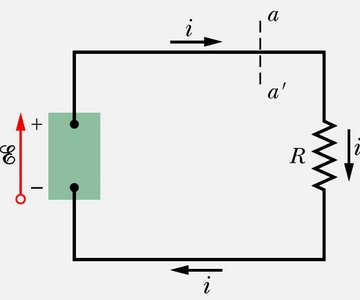
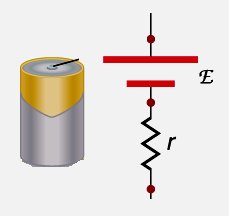
Example: A battery supplying energy to a circuit.
Electric Current
Electric current is the rate of flow of charge through a conductor. It can be instantaneous or average.
Instantaneous Current:
Average Current:
Unit: Ampere (A), where
Application: Used to measure the flow of electrons in circuits.
Internal Resistance and Terminal Voltage
All real sources of EMF have internal resistance, which reduces the voltage available to the external circuit.
Terminal Voltage: , where is internal resistance.
Current Through Load:
Effect: Limits the maximum current and reduces output voltage.
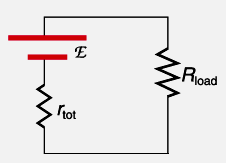
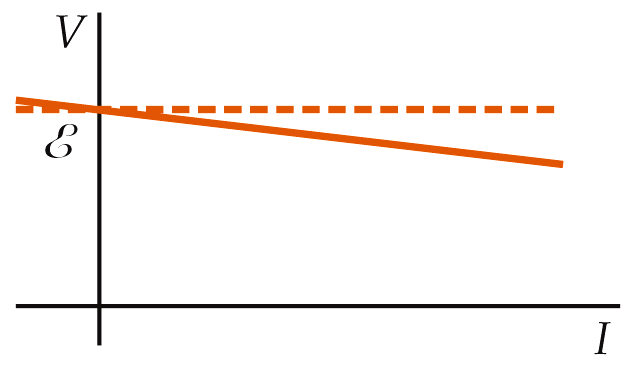
Example: Calculating terminal voltage for a battery with internal resistance.
Potential Changes Around a Circuit
In a closed circuit, the net change in potential energy is zero. Local differences in potential and EMF occur, but the sum of all potential changes around the loop is zero (Kirchhoff's loop rule).
Kirchhoff's Loop Rule:
Application: Used to analyze voltage drops and gains in complex circuits.
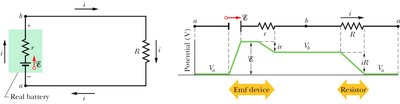
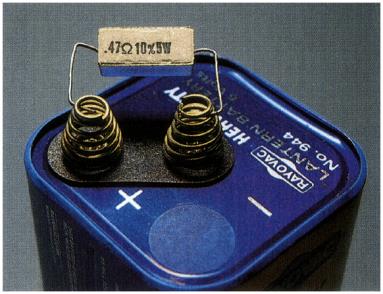
Internal Resistance of a Battery
The internal resistance of a battery affects the terminal voltage and the current delivered to the load.
Terminal Voltage:
Load Current:
Energy Dissipation: Some energy is lost as heat inside the battery.
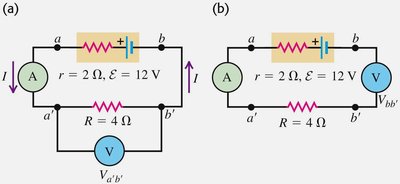
Voltmeters and Ammeters
Voltmeters and ammeters are instruments used to measure voltage and current, respectively. Their placement in a circuit is crucial for accurate measurements.
Ammeter: Connected in series to measure current.
Voltmeter: Connected in parallel to measure voltage across a component.
Example: Determining current and voltage values in a circuit with internal resistance.
Additional info: The notes cover topics from Chapter 25 (Current, Resistance, and EMF) and Chapter 26 (Direct-Current Circuits) of a college physics course.
