 Back
Electric Currents and Circuits: Physics with Calculus Study Notes
Study Guide - Smart Notes
 Tailored notes based on your materials, expanded with key definitions, examples, and context.
Electric Currents
Definition and Basic Concepts
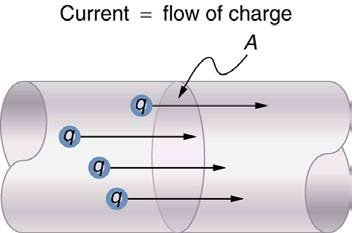
Electric current is the rate at which electric charge flows through a surface. It is a fundamental concept in understanding how electrical circuits operate and is measured in amperes (A), where 1 A = 1 coulomb/second (C/s).
Electric Current (I): Defined as , where is the amount of charge passing through a cross-section in time .
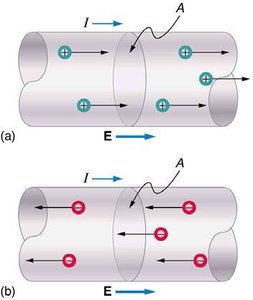
Direction of Current: By convention, current direction is the direction a positive charge would move, from high to low electric potential.
Potential Difference (V): Drives the current through a conductor.
Positive and Negative Charge Flow
Both positive and negative charges can contribute to electric current, but in metals, only electrons (negative charges) are mobile. The direction of current is defined as the direction of positive charge flow, even though electrons move in the opposite direction.
Force on a Charge: , where is the charge and is the electric field.
In biological systems, ions such as Ca2+ and Cl- move through cell membranes, contributing to current.
Drift Velocity of Electrons
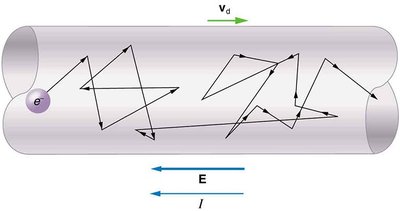
In conductors, electrons move randomly but acquire a small net velocity (drift velocity) in the presence of an electric field, resulting in a net current.
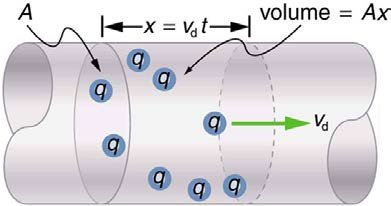
Drift Velocity (): The average velocity of charge carriers due to the electric field, typically much smaller than their random thermal velocity.
Relationship: , where is the charge carrier density, is the charge, is the cross-sectional area, and is the drift velocity.
Ohm's Law and Resistance
Ohm's Law
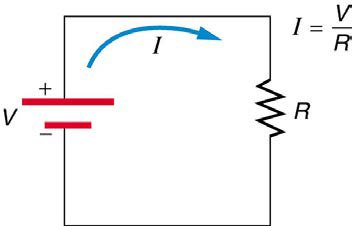
Ohm's Law states that the current through a conductor between two points is directly proportional to the voltage across the two points, provided the temperature remains constant.
Ohm's Law: , where is the resistance in ohms (Ω).
Resistance is a property of the material and its geometry.
Resistance and Resistivity
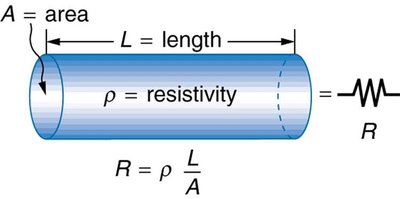
Resistance depends on the material's resistivity, its length, and cross-sectional area. Resistivity () is a material property, while resistance () depends on the object's shape and size.
Resistance Formula: , where is the length and is the cross-sectional area.
Resistivity increases with temperature for metals, but decreases for semiconductors.

Electric Power
Power in Electric Circuits
Electric power is the rate at which electrical energy is converted to another form (heat, light, etc.).
Power Formula:
Unit: Watt (W), where 1 W = 1 J/s.

Power in Household Circuits
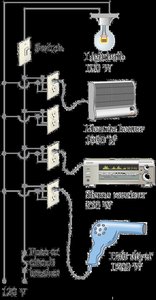
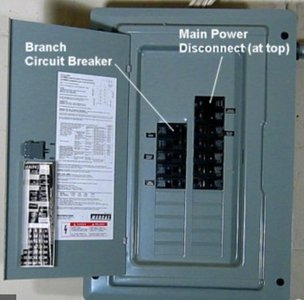
Household circuits are typically rated for a maximum current (e.g., 15 A). Exceeding this current can trigger circuit breakers or fuses to prevent overheating and fire.
Appliances are rated by power (W), and total current is the sum of individual appliance currents:
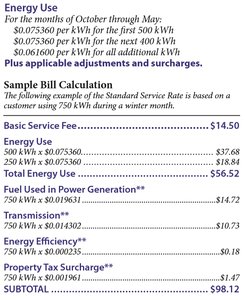
Energy consumption is measured in kilowatt-hours (kWh).
Alternating Current (AC) and Direct Current (DC)
AC vs. DC
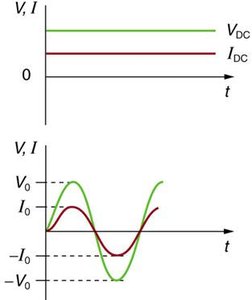
Direct current (DC) is constant in time, while alternating current (AC) varies sinusoidally with time. Most household electricity is AC, characterized by its root mean square (rms) values.
DC: Voltage and current are constant.
AC: Voltage and current oscillate with time, typically at 60 Hz in the US.
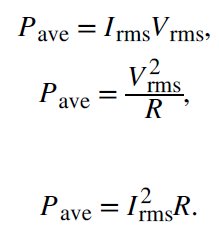
RMS Values: ,
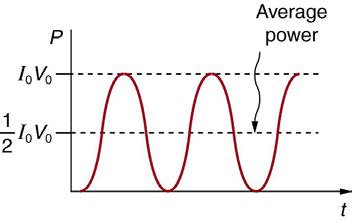
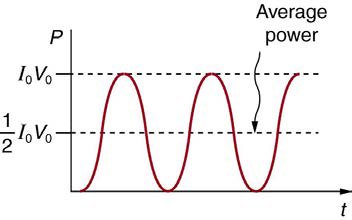
Power (average):
Electrical Safety
Short Circuits, Fuses, and Circuit Breakers
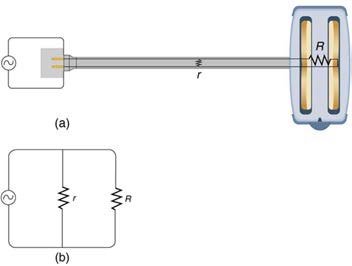
Short circuits occur when resistance drops unexpectedly, causing excessive current and potential fire hazards. Fuses and circuit breakers are safety devices that disconnect the circuit when current exceeds safe limits.
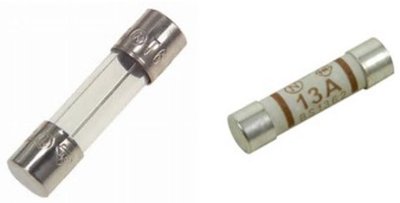
Fuse: A thin wire that melts when current is too high, breaking the circuit.
Circuit Breaker: A switch that automatically opens when current exceeds a preset value.
Electrical Shock and Human Safety
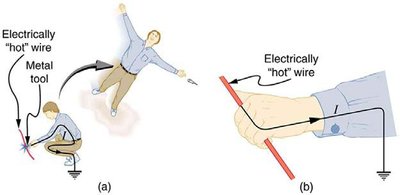
Electric shock occurs when current passes through the human body. The severity depends on the current magnitude and duration. Dry skin has higher resistance than wet skin, reducing the risk of dangerous current flow.
Typical body resistance (dry): ~200 kΩ; (wet): ~10 kΩ.
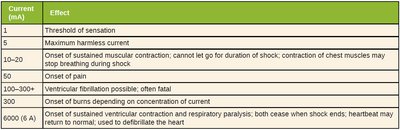
Current as low as 10-20 mA can cause sustained muscular contraction; higher currents can be fatal.
Current (mA) | Effect |
|---|---|
1 | Threshold of sensation |
5 | Maximum harmless current |
10–20 | Onset of sustained muscular contraction; cannot let go for duration of shock; contraction of chest muscles may stop breathing during shock |
50 | Onset of pain |
100–300+ | Ventricular fibrillation possible; often fatal |
300 | Onset of burns depending on concentration of current |
6000 (6 A) | Onset of sustained ventricular contraction and respiratory paralysis; both cease when shock ends; heartbeat may return to normal; used to defibrillate the heart |
Summary of Key Equations
Current:
Ohm's Law:
Resistance:
Resistivity (temperature dependence):
Power:
AC RMS values: ,
AC Power:
